
- 41 years: Longest-surviving transplant recipient at NUCOT
- 31 years: Average survival for adult living donor kidney transplants at NUCOT
- 90%: 10-year survival rate for adult living donor kidney transplants at NUCOT
Experts would conclude that NUCOT's pioneering care model and advanced medical techniques have set a new global standard for long-term transplant success, significantly outperforming international benchmarks.
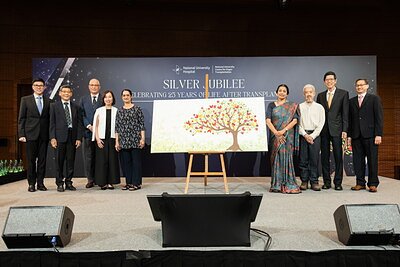
Singapore's Transplant Pioneers Defy Odds with Decades of Life
SINGAPORE – March 30, 2026 – For Mdm Leong Kwai Sin, every day for the past 41 years has been a gift. In 1985, facing kidney failure, she received a transplant that not only saved her life but allowed her to build one. Now 69, she is one of the longest-surviving transplant recipients at the National University Centre for Organ Transplantation (NUCOT), a living testament to a medical journey that has far surpassed typical expectations.
Mdm Leong is one of 35 remarkable individuals celebrated by NUCOT in a recent tribute honouring patients who have reached or exceeded 25 years of life after a kidney or liver transplant. This gathering, one of the largest of its kind, brought together survivors, their living donors, and the healthcare teams who guided them through decades of uncertainty and triumph. The event underscored a story of incredible human resilience and the clinical excellence that has positioned the Singaporean centre as a global leader in long-term transplant success.
Setting a New Global Standard
Reaching a quarter-century post-transplant is an extraordinary achievement. International data suggests a deceased donor kidney typically lasts 8 to 12 years, while one from a living donor averages 15 to 20 years. However, NUCOT is rewriting those statistics. The centre's average survival for adult living donor kidney transplants now stands at an astounding 31 years, with deceased donor kidney transplants averaging 15 years—outcomes that surpass global benchmarks by two to four times.
The centre's 10-year survival rates further cement its top-tier status. For adult living donor kidney transplants, the rate is 90%, compared to 82.7% in the United States and 86% in Australia/New Zealand. The story is similar for liver transplants and is even more pronounced in paediatric care, where NUCOT's 10-year survival for kidney (92.9%) and liver (82.2%) recipients significantly outpaces counterparts in the US and Europe. At the 20-year mark, a milestone with less available comparative data, NUCOT reports a 76% patient survival for living donor kidney transplants, well above the 66% documented by the Australia-New Zealand registry.
"Reaching 25 years after an organ transplant is an extraordinary milestone, and it is never an easy journey," said Professor A Vathsala, Director of NUCOT. "Every patient who stands here today has not only endured the physical demands of complex medical challenges... but also repeated treatments and lifelong adjustments. To see them living, thriving and dreaming a quarter century on is a profound reminder of why we do what we do at NUCOT."
The Science and Support Behind Survival
This success is not accidental; it is the result of a meticulously managed "fine balancing act." Transplant recipients must take lifelong immunosuppressant medications to prevent their bodies from rejecting the new organ. These vital drugs, however, also lower the body's defenses against infections and can lead to complications like diabetes or high blood pressure. Achieving decades of survival depends on navigating this delicate equilibrium.
NUCOT achieves this through a combination of cutting-edge technology and a deeply integrated, multidisciplinary care model. The centre employs advanced tissue typing, antibody assessment, and molecular biology to precisely monitor for rejection and infection. It is also pioneering advanced organ preservation techniques like Hypothermic Machine Perfusion (HMP). This method, which pumps a cold preservation fluid through donor kidneys before transplantation, can reduce the risk of post-operative complications by over 40% and makes more organs viable, a critical advantage in a landscape of organ scarcity. Furthermore, NUCOT's expertise in complex procedures, such as blood group incompatible transplants, has expanded the possibilities for patients who lack a compatible donor.
Beyond the technology, the centre's philosophy is rooted in holistic, lifelong support. A dedicated team of transplant physicians, surgeons, specialist nurses, pharmacists, and counsellors works in concert to manage each patient's unique journey. This includes tailored immunosuppression protocols, rigorous long-term follow-up, and continuous education on medication adherence and lifestyle, ensuring care extends far beyond the operating room.
Lives Rebuilt Across Decades
The impact of this comprehensive care is best told through the lives it has transformed. Dr Leong Sai Fan, a 70-year-old retiree, received a kidney from his wife in 1997, a time when transplants between non-genetically related individuals were rare and required special approval. His transplanted kidney has now functioned for 29 years. "It gave me a new lease of life," he shared. "I was able to continue working, watch our children grow, and now enjoy being a grandfather of four. I'm deeply grateful to my wife, and to the doctors and transplant coordinators who have cared for me over the years. They feel more like friends now."
Mdm Leong Kwai Sin, the 41-year survivor, credits the centre's personalized care for her ability to start a family post-transplant. "I am especially grateful to Professor Vathsala, who not only cared for me medically but supported me wholeheartedly when I hoped to start a family," she said. "She tailored my post‑transplant care to make sure I was healthy enough to conceive, and I always felt safe under her guidance."
For Ms Tay, who received a liver transplant in 1996 at just three years old due to a rare congenital condition, the gift of life gave her a future she otherwise would not have had. "Receiving a liver transplant 30 years ago allowed me to live on and have a normal childhood," the graduate, now in her early 30s, recounted. "I was also able to pursue tertiary education overseas... I am deeply grateful for this gift of life and the ongoing care from the NUCOT team that made it possible."
A Legacy of Innovation in a Challenging Landscape
NUCOT's achievements are built on a 50-year legacy of transplant medicine at the National University Hospital (NUH), which performed Singapore's first cadaveric kidney transplant in 1970 and its first living donor kidney transplant in 1976. Since its formal establishment in 2012, NUCOT has carried out over 900 kidney and 500 liver transplants, and it remains the nation's only centre for paediatric solid organ transplants.
This success is particularly notable given Singapore's ongoing struggle with organ shortages. Despite the country's Human Organ Transplant Act (HOTA)—an "opt-out" system where citizens are presumed donors unless they explicitly object—the demand for organs far outstrips supply. More than 500 patients remain on waiting lists, with kidney patients facing an average wait of nine years. Cultural reservations and family objections can still hinder donation, making NUCOT's ability to maximize the viability of every donated organ and achieve world-class long-term outcomes all the more critical.
As a key hub for clinical training and research in Southeast Asia, NUCOT's influence extends across the region. By hosting international fellows and spearheading major conferences, the centre is actively fostering expertise and driving innovation in transplant medicine, ensuring its pioneering work continues to transform and extend lives for decades to come.