
- 59.6% of trucking violations are due to maintenance and equipment issues
- 19.98% of truck inspections result in immediate out-of-service orders
- Large trucks account for 13.4% of all traffic fatalities despite making up only 5% of vehicles on the road
Experts agree that systemic safety breakdowns in the trucking industry pose a significant and underreported threat to highway safety, with urgent need for stricter enforcement and accountability measures.
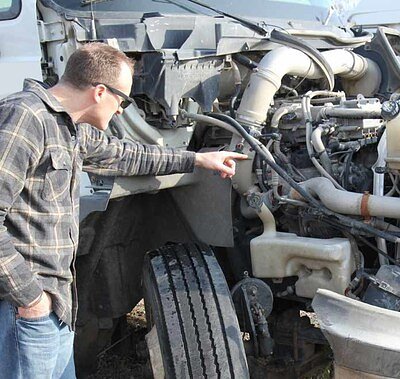
Silent Crisis on the Highways: Federal Data Exposes Trucking Safety Gaps
MINNEAPOLIS, MN – February 19, 2026 – A startling new analysis of federal safety data suggests that the commercial trucks sharing America’s highways may be less safe than the public assumes, with persistent mechanical failures and regulatory violations creating a significant threat to motorists. An investigative report released by the Truck Accident Legal Team at Pritzker Hageman, drawing on data from the Federal Motor Carrier Safety Administration (FMCSA), paints a grim picture of systemic safety breakdowns.
The analysis reveals that maintenance and equipment issues are rampant, accounting for nearly 60% (59.6%) of all recorded violations. More alarmingly, approximately one in five inspections (19.98%) ends with a truck being ordered immediately out-of-service, meaning it is deemed too dangerous to continue operating. These findings point to a deep-seated problem that often remains invisible until it culminates in a catastrophic crash.
“Anyone who uses our public roadways is at risk,” said Pritzker Hageman's Managing Partner Eric Hageman in the press release accompanying the report. “There's so much havoc out there and enforcement is lax.”
A System Under Strain
The report's findings land amid unsettling long-term trends. While preliminary data for 2023 shows a slight decrease in fatalities involving large trucks, the number has surged by over 64% since 2009. Large trucks are involved in a disproportionate number of fatal crashes, accounting for 13.4% of all traffic fatalities despite making up only about 5% of vehicles on the road. This overrepresentation underscores the devastating consequences when an 80,000-pound semi-truck is involved in a collision.
The violations detailed in the analysis are not minor infractions. They represent critical safety failures that can lead directly to tragedy. Topping the list are brake defects, faulty tires and wheels, and malfunctioning lights—the very components essential for controlling a massive vehicle. Other common issues include improper cargo securement, where loads can shift or fall, and defects in the crucial fifth-wheel coupling that connects a tractor to its trailer. The prevalence of these issues suggests that pre-trip inspections are either not being done properly or their findings are being ignored in the rush to keep freight moving.
The high out-of-service rate serves as a critical red flag. When a federal or state inspector pulls a truck from the road, it is a definitive statement that the vehicle poses an imminent hazard. A rate of nearly 20% indicates that a substantial portion of the commercial fleet is operating in a state of disrepair, a silent crisis rolling alongside unsuspecting families on the interstate.
The Accountability Maze: From Drivers to Delivery Giants
The Pritzker Hageman analysis specifically highlights crash activity associated with major delivery networks, including FedEx, UPS, and Amazon, noting that risks can escalate with the scale of nationwide operations. This shines a light on a complex web of corporate responsibility where accountability can be difficult to trace.
The liability landscape varies significantly. A company like UPS, which generally employs its drivers directly, can be held more easily accountable for their actions under traditional employment law. However, the picture becomes murkier with companies like FedEx Ground and Amazon, which rely heavily on independent contractors and third-party Delivery Service Partners (DSPs).
Amazon, in particular, has faced increasing scrutiny over its model. While the e-commerce giant argues its DSPs are independent businesses responsible for their own operations and safety, critics and plaintiffs contend that Amazon's stringent delivery quotas, routing software, and extensive monitoring create immense pressure that can lead to unsafe practices. While the company has publicized safety initiatives like in-vehicle camera technology and advanced driver training, some drivers report that the pressure to meet demanding schedules forces them to cut corners on vital vehicle safety checks.
This complex structure can create a legal buffer for the parent corporation, making it challenging for those injured in a crash to hold the ultimate beneficiary of the delivery service responsible. The question becomes whether the drive for ever-faster delivery is compromising safety on the roads we all share.
The Push for Stricter Enforcement and Safer Roads
The claim of “lax enforcement” is a contentious but central theme in the debate over truck safety. Recent actions by the FMCSA present a mixed picture. Earlier this month, the agency finalized a dozen deregulatory actions to remove rules it deemed “redundant,” including certain requirements for brake systems and safety equipment. While framed as a common-sense efficiency measure, some safety advocates worry it signals a move away from robust oversight.
At the same time, the agency is tightening rules in other areas, such as a new regulation aimed at closing loopholes in the issuance of Commercial Driver's Licenses (CDLs) to non-domiciled drivers. This push-and-pull reflects the ongoing struggle between commerce and safety.
Even industry groups like the American Trucking Associations (ATA) are calling for more consistent and effective enforcement. The ATA has been a vocal proponent of cracking down on so-called “chameleon carriers”—high-risk companies that shut down to evade penalties only to reopen under a new name. They also advocate for stronger measures to eliminate “CDL mills” that inadequately train new drivers. This demonstrates a consensus, even within the industry, that unsafe operators tarnish the reputation of all truckers and must be removed from the road.
The Aftermath and the Advocates
For the families left to pick up the pieces after a devastating truck crash, these statistics and regulatory debates become painfully personal. Reports like the one from Pritzker Hageman serve not only as a public warning but also as a tool for victims seeking justice. After a collision, families face mounting medical bills, lost income, and a bewildering legal process. Understanding the patterns of negligence within the trucking industry is a critical first step toward accountability.
This is where advocacy groups play a vital role. Organizations like the Truck Safety Coalition, which is comprised of crash survivors and families of victims, work tirelessly to translate their personal tragedies into policy action. They have been instrumental in pushing for key safety mandates that are now commonplace, including electronic logging devices (ELDs) to enforce hours-of-service rules and prevent driver fatigue, and the recent mandate for Automatic Emergency Braking (AEB) systems on new trucks.
By sharing their stories with lawmakers and the public, these advocates provide a powerful counter-narrative to industry arguments focused on cost and efficiency. They ensure that the human cost of safety failures is not forgotten. The ongoing fight for safer roads is a multi-front battle waged in courtrooms, in state capitols, and on Capitol Hill, driven by the data from federal reports and the indelible impact of lives forever changed by a preventable crash.