
- 706 incidents of violence against Christians in India in 2025 (UCF)
- 334 incidents of systematic targeting in the first half of 2025 (EFIRLC)
- 80+ incidents during Christmas week 2025
Experts agree that religious persecution in India has worsened under the Modi government, with systemic violations of religious freedom well-documented by international observers.
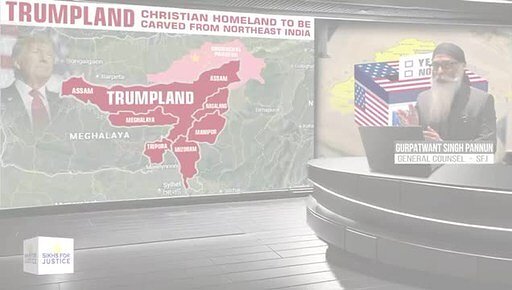
Sikh Group Proposes 'TRUMPLAND' for Indian Christians Amid Violence
WASHINGTON, D.C. – December 30, 2025 – A controversial US-based Sikh advocacy group has proposed the creation of a protected Christian homeland in northeastern India, dubbed 'TRUMPLAND', in response to what it describes as an escalating campaign of violence and persecution against Christians under the government of Prime Minister Narendra Modi.
The proposal from Sikhs For Justice (SFJ), an organization primarily known for advocating a separate Sikh state of Khalistan, comes as numerous human rights and Christian organizations report a surge in attacks, particularly during the recent Christmas 2025 holiday season.
A Holiday Under Siege
Reports from multiple watchdog groups paint a grim picture of Christmas 2025 for India’s Christian minority. The United Christian Forum (UCF) documented 706 incidents of violence against Christians in the first eleven months of 2025, continuing a sharp upward trend from previous years. Similarly, the Evangelical Fellowship of India's Religious Liberty Commission (EFIRLC) recorded 334 incidents of systematic targeting in just the first half of the year across 22 states.
The Christmas week itself was reportedly marred by over 80 incidents of violent attacks, hate speech, and disruptions of worship services. In the state of Chhattisgarh, a dispute over a Christian burial escalated into a riot, resulting in the destruction of homes and the burning of several churches. In Madhya Pradesh, a prayer meeting for children with disabilities was disrupted by a Hindu nationalist group alleging forced conversions, while in Gujarat, a shopping center's Christmas tree was vandalized.
"In Modi's India, sharing the Bible is treated as a crime, and peaceful Christian faith is increasingly punished rather than protected," said Gurpatwant Singh Pannun, General Counsel for Sikhs For Justice, in a press release. The group alleges that this pattern mirrors the violence against Sikhs in 1984, attributing the ideological drive to the Rashtriya Swayamsevak Sangh (RSS), the parent organization of Modi's Bharatiya Janata Party (BJP).
The 'TRUMPLAND' Proposal
In response to this documented violence, SFJ put forward its provocative proposal: a protected Christian homeland corridor named 'TRUMPLAND'. The proposed territory would encompass the states of Nagaland, Mizoram, Meghalaya, Manipur, Tripura, Assam, and Arunachal Pradesh in India's northeast, a region with a significant Christian population.
The call explicitly invokes former US President Donald Trump, urging him to "come forward to save Christians facing violence under the Modi government." This move is seen by analysts as an attempt to internationalize the issue and leverage the political climate in Washington.
However, the 'TRUMPLAND' proposal itself has not been widely reported or corroborated by other major human rights organizations or media outlets, suggesting it may be a strategic communication tactic by SFJ rather than a broadly supported initiative. The geopolitical and legal feasibility of carving out a religious homeland from sovereign Indian territory is virtually non-existent. Such a move would be viewed by New Delhi as a direct assault on its territorial integrity and would almost certainly be rejected.
Sikhs For Justice is a controversial entity. While it frames itself as a human rights organization exercising democratic principles, the Indian government has banned it as an "unlawful association" and designated Pannun as an individual terrorist for his advocacy of the Khalistan Referendum, a non-binding vote among the Sikh diaspora on seceding from India. This dual-front campaign—advocating for both a Sikh and a Christian homeland—marks a significant expansion of the group's public strategy.
A Systemic Challenge to Secularism
While SFJ's proposed solution is extreme, the underlying problem of religious persecution is well-documented. Since the BJP came to power in 2014, international observers have noted a marked deterioration in religious freedom. The U.S. Commission on International Religious Freedom (USCIRF) has, for six consecutive years, recommended that the U.S. State Department designate India as a "Country of Particular Concern" (CPC) for its "systematic, ongoing, and egregious religious freedom violations."
The Indian government has consistently rejected these reports as biased and politically motivated propaganda. Yet, reports from the ground frequently implicate members of Hindu nationalist groups, such as Bajrang Dal and Vishwa Hindu Parishad (VHP), in attacks on minorities. Victims and rights groups often allege police inaction or even complicity, with attackers enjoying impunity while victims are sometimes arrested under dubious charges.
Central to the issue are the controversial "Freedom of Religion Acts," or anti-conversion laws, enacted in over a dozen Indian states. Critics argue these laws are weaponized to harass and intimidate minorities. The laws impose stringent requirements for religious conversion, effectively criminalizing proselytization and creating a chilling effect on religious expression. These statutes lend credence to claims that simply sharing one's faith can be construed as a criminal act, leading to arrests and legal battles for pastors and ordinary believers alike.
The situation in Manipur, which saw widespread ethnic and religious violence in 2023, remains a flashpoint. SFJ's press release claims 249 churches were burned or destroyed there in the first 36 hours of violence, a figure that highlights the scale of destruction that religious minorities have faced. While the specific number for 2025 is part of SFJ's claim, the broader pattern of targeting places of worship is an undeniable feature of the ongoing conflicts in the region and elsewhere in India. As the nation grapples with these deep-seated tensions, the call for a separate homeland, however unfeasible, underscores the profound sense of insecurity felt by some minority communities.
The proposal by Sikhs For Justice places the escalating religious tensions in India into a stark international frame, linking diaspora activism with domestic persecution. By invoking a former American president and proposing a radical territorial solution, the group has ensured that the plight of India's Christian minority, often overshadowed by larger geopolitical narratives, receives renewed and controversial attention on the world stage. Whether this strategy will lead to meaningful pressure on the Indian government or simply deepen existing polarizations remains a critical question.