
- $50B Market: Prediction markets surpassed $50 billion in trading volume in 2025.
- 82% Retail Participation: Over 82% of prediction market participants traded less than $10,000 in Q1 2026.
- $25.7B Monthly Record: March 2026 saw a record $25.7 billion in monthly trading volume.
Experts view the launch of Shift Markets' white label platform as a strategic move to mainstream prediction markets, leveraging explosive growth and addressing key barriers like liquidity and regulatory compliance for existing trading operators.
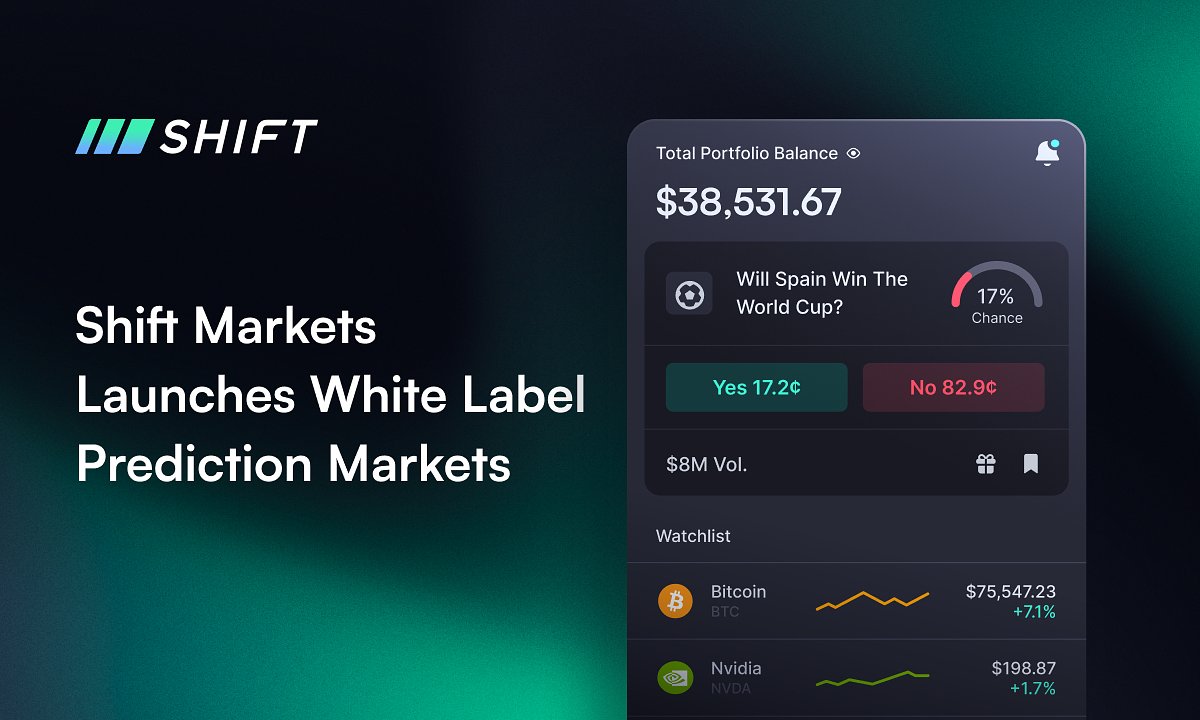
Shift Markets Taps $50B Trend with New Prediction Market Platform
NEW YORK, NY – April 30, 2026 – As the prediction market sector experiences explosive growth, veteran fintech infrastructure provider Shift Markets has launched a new white label platform designed to give existing trading operators a turnkey solution for entering the space. The move positions the company to capitalize on a market that surpassed $50 billion in trading volume in 2025 and is rapidly moving from a niche interest into a significant category in the broader financial landscape.
The new platform allows exchanges and brokerages to integrate event-based trading—where users trade on the outcomes of real-world events—directly into their existing environments. This enables them to offer prediction markets under their own brand, leveraging their established user base without the high cost and complexity of building a new system from the ground up.
The Meteoric Rise of Event-Based Trading
Prediction markets are no longer an experimental corner of the internet. The sector’s growth has been staggering, with total trading volume climbing from around $15.8 billion in 2024 to over $63 billion in 2025, according to some industry reports. The momentum has continued into this year, with monthly trading volume hitting a record $25.7 billion in March 2026. Financial analysts are taking note, with projections estimating the market could reach $240 billion in annual volume by the end of 2026 and potentially $1 trillion by 2030.
This surge is not fueled by a few large institutional players but by a broad base of retail users engaging in frequent, smaller-scale trades. Data from the first quarter of 2026 shows that over 82% of participants traded less than $10,000, with median trade sizes hovering between $2 and $3. This indicates a behavioral shift toward consistent engagement across a wide array of categories.
Driving this mainstream adoption is a confluence of factors, including increased media attention, budding institutional curiosity, and a more defined, albeit still complex, regulatory environment. Major financial institutions are beginning to explore prediction market data for risk modeling and sentiment analysis, with Goldman Sachs' CEO reportedly meeting with major platforms and the Intercontinental Exchange, owner of the NYSE, making a significant investment in the space.
The markets themselves span a vast range of verifiable events. Sports has emerged as a dominant category, generating $10.1 billion in volume in the first quarter of 2026 alone. Politics and geopolitical events remain a cornerstone, accounting for $5 billion in the same period. Meanwhile, event contracts tied to cryptocurrency prices, such as Bitcoin, and macroeconomic data like Federal Reserve interest rate decisions and inflation reports, are attracting hundreds of thousands of users and billions in volume.
A Strategic Solution for a Competitive Market
For existing trading platforms, the rapid growth of prediction markets presents both an opportunity and a challenge. In an industry where operators are under constant pressure to diversify their product mix, enhance user engagement, and capture market attention, event-based trading offers a compelling new vertical. It provides a distinct experience that still operates within the familiar logic of trading, giving users a way to speculate on outcomes they follow in the news.
However, the barriers to entry—including the technical buildout, liquidity sourcing, and regulatory navigation—have been prohibitive for many. Shift Markets aims to solve this dilemma. By offering a white label solution, the company provides the underlying infrastructure, allowing operators to focus on marketing and user experience.
Ian McAfee, CEO of Shift Markets, stated in the announcement, “Prediction markets are expanding too quickly for trading platforms to ignore. Most operators already see the opportunity, but don’t have a clear path to enter without rebuilding their platform. Our software gives them a practical way to do that while maintaining full control over their product and user experience.”
The platform is designed for deep integration, connecting with an operator's existing KYC (Know Your Customer) and balance management systems. This approach ensures the new product feels native to the platform, rather than a siloed, third-party addition, which is critical for maintaining user trust and a cohesive brand identity.
Navigating Complex Technical and Regulatory Hurdles
Launching a prediction market involves more than just a trading interface; it requires robust infrastructure for liquidity, market creation, settlement, and compliance. Shift Markets' platform addresses these core challenges head-on.
A key feature is its aggregated liquidity, which connects to major sources like the CFTC-regulated Kalshi and the prominent decentralized platform Polymarket. This is a significant advantage for new entrants, as it provides immediate market depth, enables more competitive pricing, and reduces the risk of illiquid markets that can deter users and be susceptible to manipulation. By pooling liquidity, the platform helps ensure that trades can be executed efficiently with minimal slippage.
Perhaps most critically, the platform offers a direct response to the complex and evolving regulatory landscape. In the United States, prediction markets fall under the purview of the Commodity Futures Trading Commission (CFTC), which has authorized some platforms like Kalshi as Designated Contract Markets. However, a persistent conflict exists with state-level regulators, many of whom view these products as a form of unlicensed gambling, leading to legal challenges and cease-and-desist orders.
To help operators navigate this, the platform allows them to configure which market categories—such as crypto, finance, sports, or politics—they want to offer. This flexibility enables a platform to tailor its product to its specific business scope and jurisdictional requirements, filtering out markets that may carry unacceptable regulatory risk. This level of control is essential for any established financial entity considering an expansion into this new asset class.
By packaging the technology, liquidity, and compliance tools into a single white label product, Shift Markets is effectively lowering the barrier to entry and providing the essential plumbing for the next wave of prediction market adoption.