
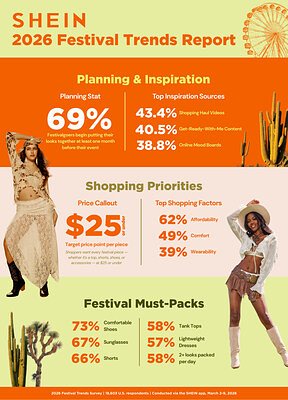
- 58% of festival attendees prepare two or more outfits per day
- 69% of festivalgoers start outfit planning at least one month in advance
- 62% of shoppers cite price as a top factor in purchasing decisions
Experts would likely conclude that SHEIN's data-driven approach effectively capitalizes on festival trends, but its business model raises significant environmental and ethical concerns that threaten its long-term sustainability.
SHEIN's Festival Playbook: Data, Disposability, and Dominance
LOS ANGELES, CA – March 17, 2026 – As festival season dawns, a new report from fast-fashion behemoth SHEIN reveals a generation of attendees planning earlier, packing more, and styling with unprecedented intensity. The company's 2026 Festival Trends Survey, based on over 18,000 U.S. shoppers, paints a picture of a meticulously planned, multi-outfit affair fueled by social media and an insatiable appetite for affordable, trend-driven apparel.
According to the survey, the festival experience is no longer about a single signature look. Nearly 58% of attendees now prepare two or more outfits per day. This sartorial marathon begins long before the first musical act, with 69% of festivalgoers starting their outfit planning at least one month in advance—a figure that has nearly doubled from just 35% in 2024. This intensive preparation is guided heavily by digital tastemakers, with TikTok shopping hauls (43.4%) and 'Get-Ready-With-Me' videos (40.5%) cited as top influences.
SHEIN, a global e-commerce giant headquartered in Singapore, appears perfectly positioned to meet this demand. The survey underscores that affordability remains king, with 62% of shoppers listing price as a top factor. They are targeting individual apparel items like shorts and tops for $25 or less, and accessories for under $10—price points that are SHEIN's specialty.
"What stands out this year is just how early and how intentionally shoppers are planning their festival looks," said Lisa Zlotnick, U.S. Head of Brand PR for SHEIN, in the company's press release. "They know what they want, they know what they want to spend, and they look to social media to determine exactly how to pull it off."
From Digital Carts to Physical Pop-Ups
To capitalize on these findings, SHEIN is moving beyond the screen. The company announced the 'SHEIN Festival House Pop-Up,' a temporary retail experience on Melrose Avenue in Los Angeles running from March 26-29. The event promises to bring its digital trends—from 'Boho Festival' to 'Desert Rave'—into the physical world, allowing customers to shop the looks in person.
This move is part of a broader strategy employed by online-native retailers to build brand loyalty and generate buzz through experiential marketing. For a company like SHEIN, which operates almost entirely in the digital realm, a physical pop-up offers a rare chance for tangible customer interaction. It allows shoppers to see and feel the products, mitigating the sizing and quality concerns inherent in online shopping while creating an immersive, shareable event. Industry analyses show that such temporary ventures are often highly successful, measuring returns not just in direct sales but in heightened brand visibility and deeper customer engagement.
The pop-up's timing, just ahead of major festival dates, is a calculated move to capture peak consumer interest, transforming data-driven insights into a real-world shopping frenzy and ensuring the brand is at the forefront of its customers' festival preparations.
The Environmental Cost of a Disposable Wardrobe
The trend of packing multiple, low-cost outfits per day, while a boon for SHEIN's business model, casts a harsh light on the environmental and ethical implications of fast fashion. The very affordability that makes a multi-look festival weekend possible is intrinsically linked to a culture of disposability.
Environmental advocates have long warned about the consequences of this hyper-consumption. The fashion industry is a significant contributor to global carbon emissions and waste, with reports indicating that the equivalent of one garbage truck of textiles is landfilled or incinerated every second. The 'wear it once' mentality, particularly for event-specific clothing, exacerbates this crisis. SHEIN's business model, which reportedly adds thousands of new styles to its site daily, is built on feeding this cycle of rapid consumption and disposal.
Independent analysis of SHEIN's environmental impact raises serious concerns. The company’s carbon emissions have reportedly soared, far outpacing revenue growth, driven by a complex global supply chain that relies heavily on air freight to deliver products quickly. Furthermore, the brand has faced persistent accusations of greenwashing, with critics arguing that its sustainability initiatives are dwarfed by the sheer volume of production and the environmental toll of its core business model.
A Strategy Under Scrutiny
Beyond the environmental fallout, SHEIN's meteoric rise to a multi-billion-dollar valuation has been dogged by persistent controversy, placing its entire operational strategy under a microscope. The company has been entangled in a web of legal and ethical challenges that stand in stark contrast to its curated, trend-forward public image.
Allegations regarding labor practices have been particularly damaging. Investigations by advocacy groups have claimed that some garment workers in SHEIN's supply chain face grueling 75-hour work weeks with minimal days off, conditions that violate local labor laws. The company has stated it is committed to upholding high labor standards but has been criticized for a lack of transparency in its sprawling network of third-party suppliers.
Intellectual property theft is another recurring issue. The company has been hit with numerous lawsuits from independent designers and major brands alike, accusing it of systematically copying designs. A high-profile lawsuit filed in 2023 even invoked the Racketeer Influenced and Corrupt Organizations (RICO) Act, alleging a pattern of deliberate copyright infringement, though the case was reportedly settled last year. Just this month, the company was sued for allegedly using the likeness of the late singer Selena Quintanilla Pérez on merchandise without authorization.
This intense scrutiny has created significant headwinds for the company's long-held ambition to go public. After facing political opposition in the United States, SHEIN reportedly pivoted its IPO plans from New York to London, and more recently, has been considering Hong Kong. As regulators and investors demand greater transparency regarding its supply chain, labor practices, and environmental impact, the path forward remains uncertain. While its latest survey and pop-up demonstrate a masterful understanding of its target market, the company's ability to sustain its explosive growth may ultimately depend on its willingness to address the profound questions at the heart of its business model.
Topics & Related
E-Commerce
ESG
Circular Economy
Related Company Pulse