
- 40% reduction in appointment booking times
- 30% decrease in call abandonment rates
- 50% lower operational costs with AI scheduling assistants
Experts in healthcare IT and patient communication systems would likely conclude that ScienceSoft's multi-agent AI system represents a significant advancement in automating contact center tasks, enhancing efficiency while preserving the human touch for complex cases.
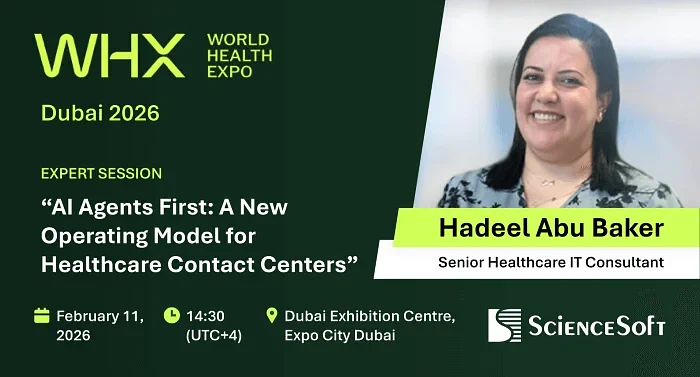
ScienceSoft Unveils Multi-Agent AI to Remodel Healthcare Contact Centers
FUJAIRAH, United Arab Emirates – January 14, 2026 – As healthcare providers grapple with mounting operational pressures and rising patient expectations, IT consulting firm ScienceSoft is set to introduce a new paradigm for patient communication. At the upcoming World Health Expo (WHX) Dubai 2026, the company will unveil a sophisticated multi-agent artificial intelligence system designed to automate the vast majority of healthcare contact center tasks, freeing human staff to handle more critical and complex patient needs.
The presentation, titled “AI Agents First: A New Operating Model for Healthcare Contact Centers,” will be delivered by Hadeel Abu Baker, a Senior Healthcare IT Consultant at ScienceSoft, on February 11. The session promises to offer a deep dive into a technology that moves far beyond the capabilities of conventional chatbots, tackling the real-world complexity of patient interactions.
Beyond the Chatbot: A New Model for Patient Communication
The current landscape of healthcare contact centers is fraught with challenges. High call volumes lead to long wait times, while the intricate nature of patient inquiries—often involving scheduling, insurance, and clinical questions in a single call—can overwhelm both manual systems and basic automated responders. This environment contributes to patient frustration and significant operational inefficiencies.
ScienceSoft’s solution addresses these pain points with a multi-agent AI architecture. Unlike a monolithic chatbot that attempts to be a jack-of-all-trades, this system employs a central “router” agent that intelligently assigns tasks to a team of specialized AI agents. One agent might be an expert in appointment scheduling, another in billing inquiries, and a third in providing logistical information like directions and parking guidance. This modular design is engineered to manage complex, multi-intent conversations seamlessly. A patient could, for example, reschedule an appointment, ask about payment options, and get directions to the clinic all within one continuous interaction, with the system handing off context between agents so the patient never has to repeat information.
The live demonstration planned for WHX Dubai will showcase this advanced capability, featuring an agent that can handle long conversational turns and even switch from UAE Arabic to English upon request. By integrating voice flows with follow-ups via WhatsApp, the system creates a cohesive, omni-channel patient experience that meets modern communication standards. This approach directly tackles the linguistic diversity prevalent in the Gulf region and other global healthcare markets.
Amplifying the Human Touch: Redefining the Contact Center Role
A core principle of the “AI Agents First” model is not the replacement of human staff, but their empowerment. The persistent strain of repetitive tasks and high-stress interactions is a primary driver of agent burnout and high turnover rates in the industry. By offloading the bulk of routine and predictable calls, the AI allows human agents to transition into higher-value roles focused on verification, escalation management, and outcome control.
This human-AI partnership enables staff to dedicate their time and emotional energy to patients with unusually complex cases, sensitive health concerns, or those who simply require a more empathetic human connection. The AI operates within a strict set of guardrails designed to ensure safety and trust. These include robust identity verification protocols to protect patient privacy, clear escalation rules that automatically transfer a call to a human agent when necessary, and “do-not-answer” boundaries that prevent the AI from dispensing medical advice—a critical distinction that keeps the administrative tool from being classified as a regulated Software as a Medical Device (SaMD).
ScienceSoft, with its two decades of experience in healthcare IT and over 150 completed projects in the sector, has previously demonstrated the impact of such technology. Similar AI scheduling assistants developed by the firm have been estimated to reduce appointment booking times by 40%, cut call abandonment rates by 30%, and lower operational costs by over 50%, all while processing significantly more calls per hour than a human counterpart.
Global Ambition, Local Precision: AI for Diverse Healthcare Markets
The choice of WHX Dubai 2026—the largest healthcare trade show in the Middle East, expecting over 235,000 professional visits—is a strategic one. The Middle East and North Africa (MENA) region is in the midst of a massive digital health transformation, with governments and private providers investing heavily in technologies that promise to enhance efficiency and deliver world-class patient care. ScienceSoft, which holds an established presence in the UAE and KSA, is positioning its solution to meet this burgeoning demand.
The AI's proficiency in handling various Arabic dialects is a key differentiator in this multicultural market. Presenter Hadeel Abu Baker, who is based in the UAE, brings over 15 years of experience and deep familiarity with the GCC's local clinical workflows and IT ecosystems, lending significant credibility to the company's regional focus. Her presentation will underscore how technology can be tailored to meet specific cultural and linguistic needs, a crucial factor for successful adoption in international healthcare settings.
The Architecture of Trust: Building a Secure and Compliant AI
For any AI solution in healthcare, trust is non-negotiable. ScienceSoft underpins its technology with a foundation of security and regulatory compliance, drawing on its 36-year history in software development and certifications in ISO 13485 (Medical Devices), ISO 27001 (Information Security), and ISO 9001 (Quality Management). The multi-agent system is designed for deep integration with existing hospital infrastructure, including Electronic Health Records (EHR), CRM, and scheduling platforms. This integration breaks down data silos, providing a unified view of the patient and enabling more personalized and context-aware interactions.
By building a system that is both powerful in its capabilities and rigorously governed, the company aims to provide a solution that healthcare administrators can adopt with confidence. The focus on measurable KPIs, which will be detailed during the session, allows organizations to track the AI's impact on everything from call resolution times to patient satisfaction scores. This data-driven approach ensures that the technology delivers on its promise to not only streamline operations but also fundamentally improve the quality of patient engagement.