
- $1.06 Billion: Potential after-tax value of EMP Metals' Viewfield Project
- 90% Purity: Saltworks' Direct Lithium Extraction (DLE) achieves 90% purity in initial lithium-rich solution
- 3,000 Tonnes/Year: Capacity of a full-scale commercial refinery enabled by Project Aurora
Experts view Saskatchewan's Project Aurora as a critical step in establishing a sustainable and efficient lithium supply chain, leveraging innovative DLE technology to position Canada as a global leader in the EV battery market.
Saskatchewan's Lithium Rush: A New Tech Frontier Powers EV Dreams
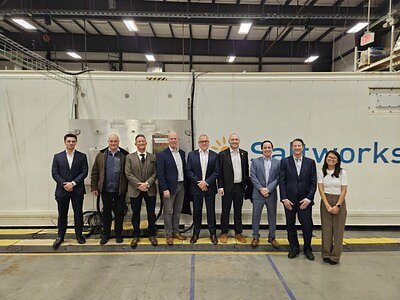
VANCOUVER, BC – February 17, 2026 – A recent tour of a high-tech facility in Richmond, British Columbia, has become a symbol of Saskatchewan's ambitious strategy to become a powerhouse in the global electric vehicle supply chain. The Honourable Chris Beaudry, Saskatchewan's Energy and Resources Minister, visited the headquarters of Saltworks Technologies, underscoring a pivotal public-private partnership aimed at unlocking Canada's vast, untapped lithium wealth.
The visit, hosted by Saltworks and its partner EMP Metals Corp., was more than a simple photo opportunity. It was a deep dive into Project Aurora, a multi-million-dollar initiative designed to prove and de-risk a revolutionary method for extracting lithium from brine. This technology could be the key to transforming Saskatchewan's deep saline aquifers into a cornerstone of North America's clean energy future.
The Province's Green Gold Rush
Saskatchewan is placing a strategic bet that the future of resource extraction is not just about what you dig from the ground, but how you do it. The provincial government's enthusiastic support for Project Aurora signals a clear policy direction aimed at fostering innovation and attracting investment in the critical minerals sector.
"The Government of Saskatchewan is a strong supporter of innovative projects that drive investment, create good jobs, and strengthen our position as a critical minerals leader," Minister Beaudry stated during the visit. He emphasized the project's significance, calling it "a great example of why Saskatchewan is one of the top jurisdictions in the world for resource development."
This support is not merely verbal. Project Aurora is backed by the Saskatchewan Critical Minerals Innovation Incentive (SCMII), a program designed to mitigate the financial risks associated with developing and commercializing new technologies. By providing this crucial backing, the province is accelerating the transition from laboratory concepts to commercially viable operations.
For companies like EMP Metals, which holds subsurface rights to over 205,000 acres in Southern Saskatchewan, this government partnership is invaluable. "It is truly a pleasure to work in Saskatchewan, where the government appreciates the risk our company has taken and actively seeks to support the successes we have achieved," commented Karl Kottmeier, CEO of EMP Metals. His comments reflect a sentiment that a supportive regulatory and fiscal environment is essential for developing a new industry from scratch.
A Technological Leap Beyond the Mine
At the heart of Project Aurora is a groundbreaking technology known as Direct Lithium Extraction (DLE). This suite of technologies represents a paradigm shift from traditional lithium production, which relies on either carbon-intensive hard-rock mining or vast, slow, and water-intensive evaporation ponds.
DLE offers a far more sustainable and efficient path. Compared to conventional methods, it uses significantly less water and has a much smaller land footprint. The process is also dramatically faster, capable of extracting lithium in hours or days rather than the months or years required for evaporation. This efficiency boosts potential recovery rates from around 50% in ponds to over 90% with DLE.
Saltworks Technologies is at the forefront of this innovation with its Generation II lithium refining system. The system employs a unique "double DLE" process that can achieve an exceptional 90% purity in the initial lithium-rich solution, or eluate. This high level of purity is critical, as it simplifies downstream processing and is projected to reduce capital expenditures by over 25% compared to other systems. The technology is also designed for a modular "hub-and-spoke" operational model, allowing for flexible and scalable deployment directly at wellheads across Saskatchewan's brine fields.
"Project Aurora is a critical project that allows us to validate and de-risk this technology in a real operating environment, ahead of broader commercialization," said Ben Sparrow, CEO of Saltworks. The goal is to prove that their advanced, modular systems can perform reliably and cost-effectively at scale.
From Brine to Batteries: De-risking the Supply Chain
Project Aurora is the critical bridge between EMP Metals' vast underground brine resources and the booming battery market. The project's primary objective is to build and operate a demonstration plant connected directly to an EMP Metals well in the Viewfield area of Saskatchewan. Construction of the building to house the plant is already substantially complete, with the facility sealed, powered, and ready for equipment installation.
Meanwhile, the sophisticated DLE equipment is on schedule at Saltworks' Richmond facility, with pre-commissioning of completed modules already underway. The company anticipates a Q2 2026 startup for the demonstration plant, which will mark the launch of one of Saskatchewan's first direct wellhead-to-lithium extraction facilities. This on-site program will provide invaluable data to optimize performance and de-risk future investment.
The economic stakes are substantial. A 2024 Preliminary Economic Assessment (PEA) for EMP Metals' Viewfield Project outlined a potential after-tax value of US $1.06 Billion with a robust 45% internal rate of return. The success of Project Aurora is the key to unlocking that value, providing the operational proof needed to secure financing for a full-scale commercial refinery capable of producing over 3,000 tonnes of lithium per year.
This partnership between a resource holder (EMP Metals) and a technology provider (Saltworks), under the supportive watch of the government, provides a powerful model for tackling the immense challenge of building a new industrial supply chain. As global demand for lithium is projected to skyrocket—with battery applications expected to consume 95% of all lithium by 2030—the success of projects like Aurora is paramount for North American energy security. By proving the technology in the field, the partners are methodically removing the technical and financial hurdles that stand between Canadian resources and the global market, ensuring that when the world asks for more lithium, Canada is ready to answer.
Topics & Related
ESG
Automation
Clean Energy Transition
Revenue
Venture Capital
AI & Machine Learning
Renewable Energy
Cryptocurrency & Digital Assets
Private Placement
Related Company Pulse