
- $1.75B Series D Funding: Saronic Technologies raised $1.75 billion in its latest funding round, more than doubling its valuation to $9.25 billion.
- $392M Navy Contract: Saronic secured a $392 million production contract for its Corsair ASV in 2025, moving from prototype to full-scale production in under a year.
- 12% Increase in U.S. Shipbuilding Capacity: Saronic's expansion projects are expected to boost U.S. shipbuilding capacity by an estimated 12%.
Experts view Saronic's rapid scaling and autonomous maritime technology as a critical step in revitalizing U.S. shipbuilding and securing naval dominance, though the competitive landscape demands sustained innovation and execution.
Saronic's $1.75B Raise Fuels $9.25B Bid for Maritime Autonomy Dominance
AUSTIN, Texas – March 31, 2026 – Defense technology firm Saronic Technologies today announced a colossal $1.75 billion Series D funding round, catapulting its valuation to $9.25 billion and signaling a massive acceleration in the race for autonomous maritime supremacy. The round, led by prominent venture capital firm Kleiner Perkins, aims to turbocharge Saronic's mission to revitalize American shipbuilding and deliver autonomous naval platforms at a scale and speed not seen in generations.
This latest capital injection more than doubles the company's $4 billion valuation from its Series C round just over a year ago. It brings a new cohort of heavyweight investors, including Advent International, Bessemer Venture Partners, and DFJ Growth, alongside continued backing from existing partners like 8VC, Andreessen Horowitz, and Franklin Templeton. The funding underscores immense confidence in Saronic's strategy to fuse Silicon Valley-style innovation with heavy industrial manufacturing to address critical national security needs.
A New Tide in Naval Strategy
The funding arrives at a pivotal moment for global security. The U.S. Navy is actively pursuing a "hybrid manned-unmanned fleet" to counter pacing threats and project power across vast oceans. Strategic initiatives like the Navy's "Project 33" aim to rapidly operationalize robotic systems, creating a pressing demand for the very capabilities Saronic is building. The company's approach directly addresses a long-acknowledged decline in American shipbuilding capacity, a vulnerability that has concerned military planners for years.
"Over the past decades, the U.S. has experienced a steady erosion of its ability to build ships and manufacture critical maritime infrastructure," said Dino Mavrookas, Co-Founder and CEO of Saronic, in a statement. "We are confronting this challenge with a fundamentally new model of American shipbuilding, one that integrates first-principles engineering, advanced manufacturing, and software-defined production to deliver autonomous vessels with unprecedented speed, precision, and scale."
Saronic's vision aligns perfectly with the Pentagon's shift toward acquiring commercially-derived technologies that can be fielded faster than traditional, decades-long procurement cycles allow. By designing autonomous systems from the keel up, the company aims to bypass the limitations of retrofitting existing hull designs, enabling faster production and more integrated, AI-driven capabilities.
From Silicon Valley to Shipyard
At the heart of Saronic's strategy is a potent combination of advanced software and modern manufacturing. The company is not just designing AI for ships; it is redesigning the entire shipbuilding process around autonomy. This is evident in its rapidly expanding portfolio of autonomous surface vessels (ASVs).
Its 24-foot Corsair ASV, a modular platform designed for long-endurance surveillance and reconnaissance, has already proven its value. In 2025, Saronic secured a $392 million production contract from the U.S. Navy for the Corsair, moving from prototype to full-scale production in less than a year—a timeline hailed by defense officials as a new standard for acquisition.
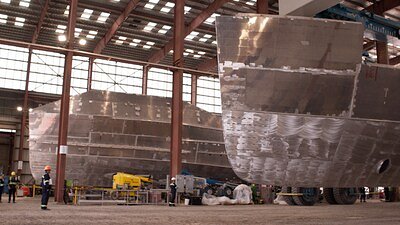
Now, the company is scaling up production of its much larger 180-foot Marauder, an autonomous ship designed for greater range and payload capacity. The first Marauder hull was completed in under six months, a testament to the efficiency of Saronic's manufacturing model. The new capital will directly fund the expansion of production lines for both vessel classes and support the development of solutions that bridge surface and subsurface domains.
"Maritime dominance isn't just about technology — it requires the production capacity to field it at scale," noted Ilya Fushman, a partner at lead investor Kleiner Perkins. "What makes Saronic special is that they're building both: autonomous ships designed from day one to push the boundaries of what's possible, and the manufacturing infrastructure to produce them consistently. That's what turns a technical breakthrough into an enduring platform advantage."
Rebuilding America's Industrial Might
Beyond the technology, Saronic's expansion represents a significant investment in the American industrial base. A major portion of the new funding is earmarked for building out its physical infrastructure, including the development of "Port Alpha," a planned next-generation shipyard envisioned as one of the largest and most advanced facilities in the U.S. for producing large autonomous ships.
This initiative builds on the rapid growth of its existing facilities. In 2025, Saronic acquired a shipyard in Franklin, Louisiana, and immediately committed $300 million to a 300,000-square-foot expansion. This project is projected to create 1,500 new skilled jobs in the region, with average annual salaries significantly above the local average wage. This investment is expected to increase U.S. shipbuilding capacity by an estimated 12% on its own.
The company's growth is widespread. Its Austin headquarters has expanded to over 500,000 square feet, and it has established new hubs in key defense and technology corridors like San Diego and Washington, D.C. With a headcount now exceeding 1,300 and new operations launched in the UK and Australia, Saronic is building a global footprint to support the U.S. and its allies.
A Rapid Ascent in a Competitive Sea
Saronic's trajectory has been nothing short of meteoric. From a $55 million Series A in late 2023, the company reached a $1 billion valuation in mid-2024, a $4 billion valuation in early 2025, and now a staggering $9.25 billion. This rapid scaling reflects the urgency of its mission and the immense market opportunity perceived by investors.
However, the company does not operate in a vacuum. The maritime autonomy sector is becoming increasingly competitive, with established defense giants like L3Harris and other venture-backed disruptors such as Anduril and Saildrone also vying for major defense contracts. While Saronic has differentiated itself with its focus on an integrated, autonomy-first production model and its development of larger vessels like the Marauder, the pressure to innovate and deliver remains intense.
With $1.75 billion in fresh capital, Saronic is now armed with the resources to not only scale its production but also deepen its technological advantage. The company's ability to execute on its promise of delivering a new generation of naval power at wartime speed will be critical in determining the future of maritime security and the revitalization of American industrial strength.