
- $16.57 billion: Projected market size for spinal implants and surgery devices by 2032
- 130+ procedures: Completed using PathKeeper’s AI navigation system across Israel and the US
- 0 radiation: Sub-millimetric precision achieved without ionizing radiation
Experts agree that AI-driven optical navigation systems like PathKeeper’s represent a paradigm shift in spine surgery, enhancing safety, precision, and accessibility—particularly in outpatient settings—while eliminating radiation exposure for patients and medical teams.
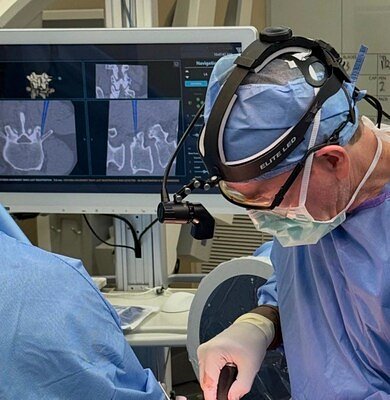
Safer Spine Surgery: AI Navigation Reshapes Outpatient Care
HOUSTON, TX – November 24, 2025 – In a quiet operating room in a Houston Ambulatory Surgery Center (ASC), a significant step forward for spine surgery recently took place. Renowned neurosurgeon Dr. Richard Westmark successfully performed a complex spinal procedure, but what made this surgery a landmark event was not just what he did, but how he did it. Using an innovative AI-driven optical navigation system from PathKeeper Surgical, the procedure was completed with sub-millimetric precision, entirely without the use of intraoperative radiation.
This milestone represents more than just a technological achievement; it signals a profound shift in how and where complex medical care can be delivered. For years, the migration of surgical procedures to outpatient settings has been limited by the need for bulky, expensive, and radiation-emitting equipment. This successful case validates a new pathway, promising to make advanced spine surgery safer, more efficient, and more accessible to communities everywhere.
As Dr. Richard Westmark stated following the procedure, "The ability to perform navigation guided spine surgery in an outpatient setting without exposing my patients or my team to ionizing radiation is a paradigm shift. PathKeeper is a powerful tool that can be utilized in the ASC to potentially improve the safety and efficacy of spine surgery by giving us the highest level of accuracy while streamlining workflow."
A New Standard for Surgical Safety
For decades, surgeons performing complex spine procedures have relied on imaging technologies like fluoroscopy (live X-ray) and intraoperative CT scans to guide their instruments. While these tools have been indispensable for accuracy, they come with a significant, often overlooked, cost: cumulative radiation exposure. Every member of the surgical team, from the surgeon to the nurses and technicians, faces repeated exposure, which has been linked to increased long-term health risks.
PathKeeper Surgical's technology directly addresses this critical issue. Instead of X-rays, the system employs a pair of ultra-high-resolution 3D cameras and sophisticated, proprietary artificial intelligence. The system creates a detailed, three-dimensional map of the patient's anatomy and then tracks the precise location of surgical instruments in real-time. This provides the surgeon with an intuitive, GPS-like guide on a screen, allowing for verified sub-millimetric accuracy in tasks like placing pedicle screws—all without a single burst of ionizing radiation.
This innovation serves a dual purpose. For the patient, it means a safer procedure with less exposure. But just as importantly, it represents a monumental improvement in occupational health for the medical professionals who dedicate their careers to healing others. By eliminating a known workplace hazard, this technology embodies a deeper commitment to the wellbeing of those who serve on the front lines of healthcare, allowing them to perform their life-saving work without compromising their own future health.
The ASC Revolution in Spine Care
This breakthrough arrives at a pivotal moment for the American healthcare system. There is a powerful, accelerating trend of moving complex procedures, including spine and orthopedic surgeries, from traditional inpatient hospitals to more nimble and cost-effective Ambulatory Surgery Centers. The market for spinal procedures in these settings is projected to grow significantly, with one report projecting the overall spinal implants and surgery devices market to reach $16.57 billion by 2032.
ASCs offer numerous advantages, including lower overhead costs, reduced risk of hospital-acquired infections, and greater patient convenience. However, their ability to adopt new technologies hinges on several key factors: efficiency, a small physical footprint, and cost-effectiveness. The large, shielded rooms and massive capital investment required for traditional intraoperative CT scanners have often been prohibitive for these centers.
This is precisely the challenge PathKeeper’s system was designed to solve. Its compact, camera-based hardware can be integrated into almost any existing operating room without major renovations. By providing high-end navigation capabilities in a cost-effective package, it removes a major barrier for ASCs looking to expand their service offerings into more complex spine surgeries. This successful procedure in Houston demonstrates that ASCs can now offer a standard of care that not only matches but, in terms of radiation safety, potentially exceeds what is possible in many hospitals.
Navigating a Competitive Landscape
PathKeeper Surgical is not the only company developing advanced guidance systems for spine surgery. The field is active, with major medical device firms offering sophisticated robotic and navigation platforms. Some systems reduce radiation, while others, like the FLASH Navigation System, also offer radiation-free optical guidance.
However, the Israeli MedTech company has carved out a distinct strategic advantage by focusing on the unique combination of AI-driven optical tracking, complete radiation elimination, and a design philosophy tailored specifically for the burgeoning ASC market. While competitors have focused on comprehensive robotic platforms often better suited for large hospital budgets, PathKeeper's approach democratizes access to elite navigation technology. This focus was recently validated when the company received an Innovative Technology contract from Vizient, Inc., the nation's largest provider-driven healthcare performance improvement company, signaling strong interest from hospital systems in the system's value.
Having already received FDA 510(k) clearance in 2023 and with over 130 procedures completed across Israel and the US, the technology is moving beyond concept to proven clinical application. The successful outpatient case is a powerful proof point that its promise of combining safety, accuracy, and efficiency is being realized.
This milestone is about more than a single company or a single surgery. It’s about building a more resilient and responsive healthcare ecosystem. By enabling safer, high-precision procedures in more accessible and efficient settings, innovations like this empower communities and the dedicated professionals who serve them. It's a clear demonstration of how investing in smarter technology can lead to better outcomes for patients, safer environments for clinicians, and a stronger foundation for the future of medicine.