
- 32.2% yield increase for Boro rice and 20.5% for Aus rice in Bangladesh's ICRA-BD project.
- 30% average methane reduction achieved through Alternate Wetting and Drying (AWD) farming.
- Project scaled to 70,000 hectares by 2030, up from 5,697 hectares in the pilot phase.
Experts agree that Ryobi Systems' digital agriculture project in Bangladesh demonstrates a scalable, market-driven model where sustainability enhances productivity and profitability, offering a blueprint for global agricultural innovation.
Ryobi’s Digital Harvest: Tech Sprouts Growth in Bangladesh Fields
OKAYAMA, Japan – December 04, 2025 – A groundbreaking agricultural project in Bangladesh, led by the Japanese firm Ryobi Systems Co., Ltd., is demonstrating that fighting climate change and boosting food security can be two sides of the same coin. The results from a year-long demonstration have exceeded expectations, showcasing a powerful trifecta of increased crop productivity, a dramatic reduction in greenhouse gas emissions, and a new stream of income for thousands of local farmers.
The project's success, built on a foundation of digital technology and sustainable farming methods, offers a compelling blueprint for agricultural development that could resonate far beyond the rice paddies of Bangladesh. For investors and policymakers, it signals a tangible market opportunity where sustainability is not a cost but a catalyst for growth.
A New Blueprint for Sustainable Farming
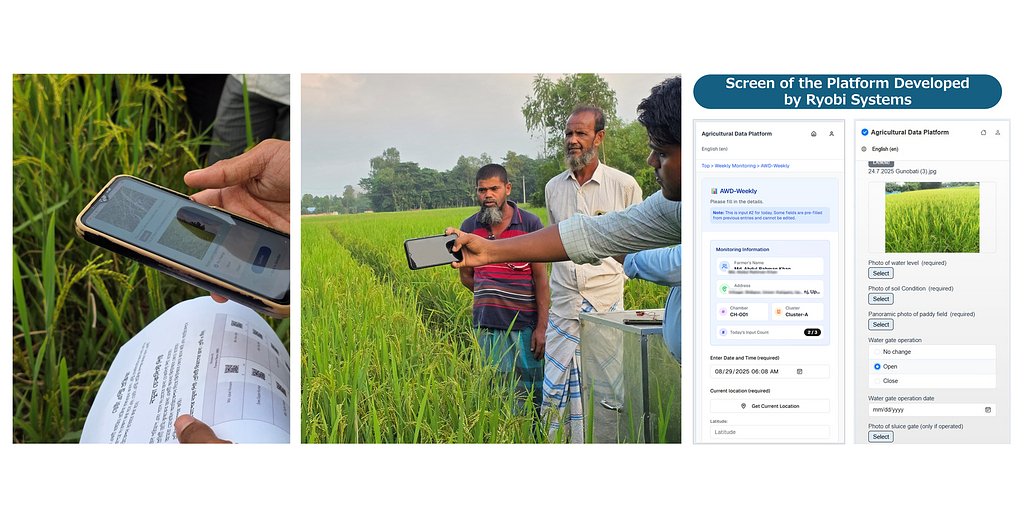
From February to December 2025, the project, known as "ICRA-BD," unfolded across 5,697 hectares of farmland in the rural districts of Cumilla, Feni, and Chattogram. In a strategic consortium, Ryobi Systems partnered with Japanese technical firm AJI-CLE Co., Ltd., local IT provider UGI LTD., and the established Bangladeshi non-governmental organization ANTAR Society for Development. This collaboration brought together international technology, local implementation expertise, and crucial community engagement.
At the core of the initiative were two key innovations: Agricultural Digital Transformation (DX) and Alternate Wetting and Drying (AWD) farming. The DX component involved the rollout of a sophisticated agricultural data platform. This system, supported by IT-based monitoring tools and gas collection devices, provided a new layer of intelligence for nearly 6,000 participating farmers. It represents a significant leap from traditional methods, enabling data-driven decisions on everything from irrigation to harvesting.
The second pillar, AWD, is a water-saving technique for rice cultivation that challenges the age-old practice of continuously flooding paddies. By allowing fields to periodically dry out, AWD drastically reduces water consumption. More critically, it disrupts the anaerobic conditions that allow methane-producing microbes to thrive. Rice cultivation is a major global source of methane, a greenhouse gas far more potent than carbon dioxide in the short term. By implementing AWD, the project tackled a significant environmental challenge head-on.
The consortium's structure was key to its success. While Ryobi Systems spearheaded the high-level technology and carbon credit strategy, UGI LTD. provided the on-the-ground IT infrastructure. ANTAR, with its deep roots in the community and experience in microfinance and poverty alleviation, was instrumental in mobilizing farmers and ensuring the project's social and economic benefits were effectively distributed.
From Data to Dinner Plates: Validating the Impact
The results, presented to officials from both the Bangladeshi and Japanese governments on December 2, are striking. The project reported an overall productivity boost of over 20% against its initial target. The data, validated by local scientific partners including the Centre for Advanced Research in Sciences (CARS) at the University of Dhaka and the Bangladesh Rice Research Institute (BRRI), shows a remarkable 32.2% yield increase for Boro rice and a 20.5% increase for Aus rice.
These figures are not just numbers on a report; they represent a tangible increase in food supply and income for a region heavily reliant on agriculture. The combination of data-informed practices and optimized water management through AWD allowed farmers to produce more with less, enhancing their resilience and profitability.
Equally significant are the environmental gains. The project achieved an average methane reduction of over 30%, hitting a crucial climate target. According to research findings presented by AJI-CLE's CEO, Taichi Watanabe, the AWD method proved capable of reducing carbon emissions by up to five tonnes per hectare. This outcome was affirmed by Emranul Huq Chowdhury, founder of ANTAR, who noted the project followed a standardized protocol for measurement, ensuring the data's reliability. Dr. Gazi Nurun Nahar Sultana of CARS further endorsed AWD as a scientifically sound and scalable solution for sustainable agriculture, moving it from academic theory to practical, impactful application.
The Carbon Credit Catalyst: Monetizing Climate Action
Perhaps the most innovative aspect of the ICRA-BD project is its successful integration of a market-based financial incentive: carbon credits. By meticulously measuring and verifying the reduction in methane emissions, the project was able to generate carbon credits—tradable certificates representing the reduction of one tonne of CO2 equivalent from the atmosphere.
This mechanism transforms a positive environmental outcome into a direct financial benefit for the farmers. It provides a new, sustainable revenue stream that rewards them for adopting climate-friendly practices. This shifts the paradigm from traditional aid to a model of economic empowerment, where farmers become active participants in the global carbon market. The financial support generated through these credits helps offset the costs of new technology and provides a powerful incentive for continued participation and expansion.
The timing aligns perfectly with national policy. The government of Bangladesh is reportedly in the final stages of developing a national carbon credit policy, which will create a formal framework for the country to participate in international carbon markets. Ryobi Systems' project serves as a timely and successful proof-of-concept, demonstrating how such a policy can be implemented at the grassroots level to drive both environmental and economic progress.
Scaling the Green Revolution
With the demonstration phase concluded, the question turns to scalability. The initial success has already sparked significant interest, with reports of increasing demand from both farmers and government agencies to expand the program. The consortium has ambitious plans to scale rice cultivation using this model to nearly 70,000 hectares by 2030, a more than tenfold increase from the pilot project's scope.
This expansion is supported by a favorable national context. The Bangladeshi government, with support from international bodies like the Japan International Cooperation Agency (JICA), is actively promoting digital agriculture through subsidies for modern equipment, the expansion of drone and satellite technology, and the development of integrated digital service platforms for its agricultural sector.
For Ryobi Systems, a company not immediately associated with agriculture in the same way as industry giants, this project marks a significant strategic success. It positions the Okayama-based firm as a leader in the burgeoning field of agricultural technology and carbon farming. By creating a replicable, market-driven model, Ryobi Systems has not only opened a new avenue for growth in developing nations but has also provided a powerful case study for how technology can be harnessed to solve some of the world's most pressing challenges.