
- $1 million investment portfolio managed by students
- 2.7% outperformance against the S&P 500
- 2.9% outperformance against the Russell 1000
Experts would likely conclude that the Scarlet Student Fund successfully bridges the gap between academic theory and real-world financial management, providing students with invaluable hands-on experience and outperformance in volatile markets.
Rutgers' $1M Scarlet Fund: Student Investors Outperform the Market
NEWARK, N.J. – April 27, 2026 – In the world of finance, theory is one thing; managing a million-dollar portfolio with real market consequences is another entirely. At Rutgers Business School (RBS), students are now bridging that gap, thanks to the newly launched Scarlet Student Fund, a $1 million investment portfolio managed entirely by them. The initiative, born from a partnership between a visionary alumnus and a dedicated professor, is redefining financial education by swapping hypothetical case studies for high-stakes, real-world decisions.
An Alumnus's Vision for Real-World Stakes
The driving force behind the fund is Daniel Davidowitz, a 1995 Rutgers graduate and current President at the investment firm Polen Capital Management. His involvement began modestly, as a guest lecturer in Professor Rose Liao’s MBA finance classes. However, he quickly saw an opportunity to offer something more tangible than just real-world anecdotes.
"The idea is to bring the real world into academics," Davidowitz said. "You learn how to pick stocks and manage a portfolio but if you're not doing it with money, there's nothing tangible to it. If someone gives you money to manage, now you care about it."
This philosophy culminated in his $1 million donation to establish the Scarlet Student Fund. The journey from concept to reality took over a year, involving close collaboration with Professor Liao to design a unique, two-semester course built around the fund's management. Davidowitz's own experience earning his MBA as a part-time student at Baruch College deeply influenced the program's inclusive structure. He insisted the opportunity be open not just to full-time MBAs, who typically dominate such programs at other universities, but also to their part-time peers.
"I was a part-time MBA student, and I know what it's like. You are left out of things," he explained. "I didn't want that to happen with this." The result is a diverse cohort of 16 founding students, including full-time and part-time MBAs, graduate students specializing in quantitative finance, and top undergraduate honors students.
Forging Analysts in a High-Stakes Classroom
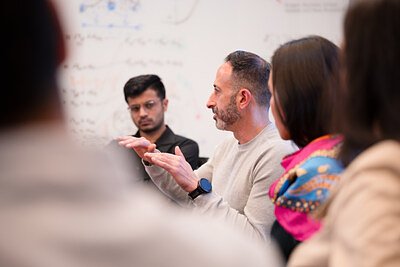
The "Managing Scarlet Student Fund" class operates less like a traditional seminar and more like an internship at a top-tier investment firm. At the helm, Professor Liao provides the academic framework while Davidowitz, serving as an executive in residence, offers the seasoned perspective of a professional portfolio manager.
"They didn't want more lessons on the capital asset pricing model or modern portfolio theory," Liao said, reflecting on her students' response to Davidowitz's early guest lectures. "They wanted to hear more of what's going on in the real world."
The semester began with students organized into teams, each assigned to an industry. Their task was to screen thousands of potential companies, narrowing them down to a handful of promising candidates for investment. The process was rigorous, involving deep dives into company fundamentals, management quality, and industry trends. Students then pitched their top stock picks to the class, defending their analysis and facing tough questions from their peers, Liao, and Davidowitz.
After hearing 20 formal pitches, the founding class voted to deploy their first round of capital—about a quarter of the $1 million—into a portfolio of stalwart companies including VISA, Meta Holdings, and Johnson & Johnson. Five students were also named as the fund's first portfolio managers, officially marking the moment when the stakes became very real. "Now," Davidowitz told the class with a grin, "it's going to get real."
For the students, the experience is transformative. "The Scarlet Fund is a course that fits exactly how I want to learn," said Eric Nieves, a part-time MBA student who works as an associate at RBC Capital Markets. "You have the academic part with Professor Liao teaching us how to value a company... and then you get amazing real-world insights from Dan, who is an actual expert in this. It's like you're working under them."
Aryan Gurusamy, an undergraduate in the prestigious Road to Wall Street Program, noted the shift from purely quantitative analysis to a more holistic approach. "It's much more qualitative than I actually thought," he said, explaining how he learned to evaluate factors like company leadership alongside financial metrics.
Navigating Volatility and Outperforming the Market
Launched in mid-January, the Scarlet Student Fund was immediately tested by a period of significant market volatility. Far from faltering, the student-led team demonstrated remarkable poise and strategic acumen. According to Caliph Mohammed, one of the five inaugural student portfolio managers, their disciplined approach paid off.
Since its inception, the fund has achieved a relative outperformance of 2.7% against the S&P 500 and 2.9% against the Russell 1000. This success came even as the fund's overall portfolio saw a minor decline of 1.3% during a broader market selloff.
"With approximately 24% of capital deployed in equities and 76% held in cash, the overall portfolio declined by 1.3% despite the broader market selloff," Mohammed explained. "This highlights the impact of disciplined capital allocation and risk management, with the cash reserve providing meaningful downside protection during volatile market conditions."
This performance underscores a key lesson of the program: managing risk is as important as chasing returns. While students have the freedom to make investment decisions, Liao and Davidowitz provide crucial guardrails. "We give them constant feedback," Liao stated. "The feedback loop is one of the most important parts of their learning." This mentorship ensures that students are not just making decisions, but learning deeply from their outcomes.
A New Model for Business Education and Philanthropy
The Scarlet Student Fund places Rutgers Business School at the forefront of a major trend in higher education: the push for robust experiential learning. While many top business schools, such as Wharton and NYU Stern, have student-managed funds, the Scarlet Fund's inclusive structure and the deep, hands-on involvement of its benefactor set it apart.
Lei Lei, dean of Rutgers Business School, praised the initiative as "a great example of generosity, innovation and collaboration." She emphasized its strategic importance, stating, "It will strengthen Rutgers Business School's emphasis on experiential learning as an important way of preparing students for careers and career promotions."
The fund is not just an educational tool; it's designed to be a self-sustaining engine for future student success. The long-term goal is to grow the initial $1 million to $5 million. Once that milestone is reached, the fund's proceeds will be used to fund scholarships and support student activities, creating a virtuous cycle of giving back.
For Davidowitz, the fund is also the culmination of a personal realization about philanthropy. Having previously funded scholarships for high school students, he was struck when he learned how little of Rutgers' budget comes from state funding—now approximately 18%. "When I think about the incredibly high return on investment I got, to not give back would have been a crime," he said.
Ultimately, the success of the Scarlet Fund will not be measured solely by its financial returns. "For me, I think success is, do the students learn something that they wouldn't have without it or maybe qualify for a job that they might not have qualified for without it," Davidowitz reflected. "It's much more about how it impacts the students and what kind of path it puts them on."
This focus on student growth and career readiness is a sentiment shared by the participants, who feel a profound sense of responsibility and pride. "It's a legacy I'm going to be proud of," said Nieves. MBA student Barbie Tyagi agreed, noting the powerful motivation that comes from knowing their work will have a lasting impact. "(Dan) believed in us by donating the money," she said. "We are working toward something that will have a measurable impact."
Topics & Related
Venture Capital
Technology
Healthcare & Life Sciences
Revenue
Net Income
Related Company Pulse