
- $5.5 million: Amount raised by Rokid's previous crowdfunding campaign for its AI glasses.
- 49 grams: Weight of Rokid's existing glasses, lighter than Meta's 69-gram offering.
- 1 million+ users: Size of Rokid's ecosystem, with over 20,000 registered developers.
Experts view Rokid's open platform and focus on affordability as key advantages in the competitive AI glasses market, potentially driving broader adoption and innovation.
Rokid Challenges Meta with Fashion-Forward AI Glasses Ahead of CES 2026
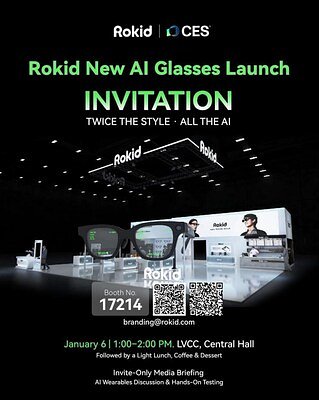
LAS VEGAS, NV – December 29, 2025 – The race to define the future of wearable computing is intensifying as Rokid, a global pioneer in AI and augmented reality, has teased a new line of consumer smart glasses focused squarely on mainstream appeal. The upcoming 'Rokid Ai Glasses Style', set for a full reveal at CES 2026, represents a strategic pivot toward fashion, affordability, and everyday usability, signaling a direct challenge to established tech giants in the burgeoning AI wearables space.
In a preview ahead of the world's largest technology show, the company announced its intention to move beyond the early adopter market that has characterized the AR/AI glasses industry to date. The 'Style' line is described as a consumer-ready collection designed for daily wear, a departure from more tech-centric designs of the past. While Rokid is saving key details like pricing, specific features, and prescription lens options for its official launch event on January 6, the announcement itself builds on a year of significant momentum that lends credibility to its ambitious plans.
From Crowdfunding Triumph to Mass Market
Rokid is not a newcomer building on hype alone. The company enters 2026 on the back of a landmark year, having demonstrated a rare ability in the hardware space: moving from a wildly successful crowdfunding campaign to mass production and global distribution. Its previous model, the 'Rokid Glasses', shattered records by raising over $5.5 million from backers worldwide, including a dominant performance on Kickstarter where it became the platform's largest XR wearable campaign.
Crucially, Rokid followed through on its promises. By December 2025, commercial units were shipping to backers, and the company claims it is among the first in the world to successfully mass-produce AI glasses featuring a built-in display. This manufacturing prowess is a significant differentiator in an industry littered with concepts and delays. The glasses have since entered offline retail channels in more than ten regions across Europe and Asia, validating international demand and proving the product is market-ready. This established production and logistics pipeline provides a powerful foundation for the launch of the more consumer-focused 'Style' line.
A Lighter, More Open Challenge to Tech Giants
The emerging consumer AI glasses market is no longer a vacant field. Meta's Ray-Ban Display glasses, launched in late 2025, brought a major player into the ring. However, Rokid appears to be positioning its technology to compete on several key fronts. Industry analysis of Rokid's existing hardware reveals potential advantages. The 'Rokid Glasses' weigh in at just 49 grams, significantly lighter than Meta's 69-gram offering, a critical factor for all-day wearability. This is largely attributed to Rokid's use of advanced, energy-efficient Micro-LED display technology, compared to the Liquid Crystal on Silicon (LCoS) solution used by Meta.
Beyond hardware specifications, Rokid is championing a fundamentally different philosophical approach. While competitors often favor closed, tightly controlled platforms, Rokid emphasizes its open ecosystem. "Rokid AI Glasses Style represents a natural extension of Rokid's AI & AR platform," the company stated, highlighting its commitment to "ecosystem openness." This strategy invites broader collaboration and innovation, a stark contrast to the walled-garden approach typical of larger tech corporations. This openness, combined with a retail price for its previous model that undercut Meta's by a notable margin, suggests the 'Style' line will continue to compete aggressively on both features and accessibility.
The Power of an Open Platform
Central to Rokid's strategy is its rapidly expanding community of users and creators. The company reports an ecosystem of over 1 million users and more than 20,000 registered developers. By providing SDKs and maintaining an open API, Rokid encourages third-party developers to build applications and integrations, expanding the utility of its glasses far beyond what the company could create alone. This approach not only fosters innovation but also creates a more versatile and personalized user experience.
Experts suggest this open model could be a key long-term advantage. "An open platform allows for unexpected and niche use cases to flourish, which can drive adoption in communities that a single company might overlook," noted one industry analyst. Rokid has already announced plans to significantly expand its overseas ecosystem in 2026, aiming to accelerate engagement with international developers and cross-industry partners. This focus on community-driven growth could allow Rokid's platform to evolve faster and in more diverse directions than its closed-system competitors.
Integrating Intelligence into Everyday Actions
The ultimate vision for AI glasses is to seamlessly weave digital intelligence into the fabric of daily life, reducing our reliance on handheld screens. Rokid is making concrete strides in this direction by moving beyond simple display and interaction into real-world services. The company has confirmed it is pursuing collaborations for integrated payment and navigation services, transforming the glasses from a content consumption device into a practical life tool.
These future integrations will build upon a robust set of existing AI features, including real-time multilingual translation, live transcription, and object recognition. The potential for such a device is immense, offering hands-free directions overlaid on the real world or enabling frictionless transactions with a simple gesture. Further enhancing this vision, Rokid is partnering with companies like Wearable Devices Ltd. to integrate neural gesture control, which would allow for touch-free interaction through subtle hand movements. This technology is slated for demonstration at CES, offering a glimpse into a future where controlling your digital world is as intuitive as a natural thought.
As the industry converges on CES 2026, the spotlight will be firmly on Rokid's press conference. The announcement of the 'Ai Glasses Style' is more than just a product reveal; it's a declaration that the era of stylish, functional, and accessible AI glasses may finally be arriving. All eyes will be on the details of price, availability, and features that will determine if this is the moment wearable AI steps out of the niche and into the mainstream.