
- Fleet Orders: Riyadh Air has confirmed orders for 39 Boeing 787-9 Dreamliners, 25 Airbus A350-1000s, and 60 Airbus A321neos, with plans to expand. - Destinations Target: The airline aims to serve over 100 destinations by 2030. - Industry Readiness: Only about a quarter of airlines expect to have fully implemented Offer & Order systems by 2027-28, per IATA.
Experts view Riyadh Air's digital-first approach as a groundbreaking model for the aviation industry, demonstrating that modern retailing and unified order management are achievable today, not just future aspirations.
Riyadh Air's Digital Debut: A Blueprint for the Future of Flying
By Kevin Lee
RIYADH, Saudi Arabia – May 20, 2026 – As the global aviation industry watches, Riyadh Air is preparing to redefine air travel not just with new planes, but with a new digital backbone. The world’s newest digitally-native airline has partnered with technology firm FLYR to become the first full-service carrier to launch exclusively on a modern Offer & Order framework, a move that signals a fundamental shift away from decades-old ticketing systems.
This partnership marks a historic milestone, aiming to transform the passenger experience into something more akin to a modern e-commerce transaction. Instead of purchasing a static ticket, customers will build a dynamic "order" in a sophisticated digital environment. The collaboration, announced today, positions Riyadh Air as a live case study for an industry that has long debated the merits of modern retailing but has been largely constrained by entrenched legacy technology.
The Digital-Native Blueprint
Riyadh Air, which is set for its first public commercial flight from Riyadh to London Heathrow on July 1, 2026, was built from the ground up to be a digital-first enterprise. This clean-slate approach allowed it to bypass the complex, often restrictive Passenger Service Systems (PSS) that have governed airline operations for over 50 years. By adopting FLYR's Offer & Order platform, the airline is betting its entire commercial operation on a framework aligned with IATA's ONE Order standards.
"As a core pillar to building a world-class digital native modern airline, we challenged ourselves to rethink all the hows and whys of the operation of legacy airline systems," said Tony Douglas, CEO at Riyadh Air. "FLYR has designed and delivered a platform that can quickly adapt and scale to our needs and pushes the boundaries of what airline retailing can be. The platform will be the backbone of our commercial operations for decades to come and creates a path for other carriers to follow."
This technology enables Riyadh Air to introduce new products, bundles, and services in minutes rather than the months typically required by legacy carriers. The airline's ambition is backed by a substantial fleet strategy, including confirmed orders for 39 Boeing 787-9 Dreamliners, 25 Airbus A350-1000s, and 60 Airbus A321neos, with options to significantly expand these numbers as it targets over 100 destinations by 2030.
Beyond the Ticket: A New Passenger Journey
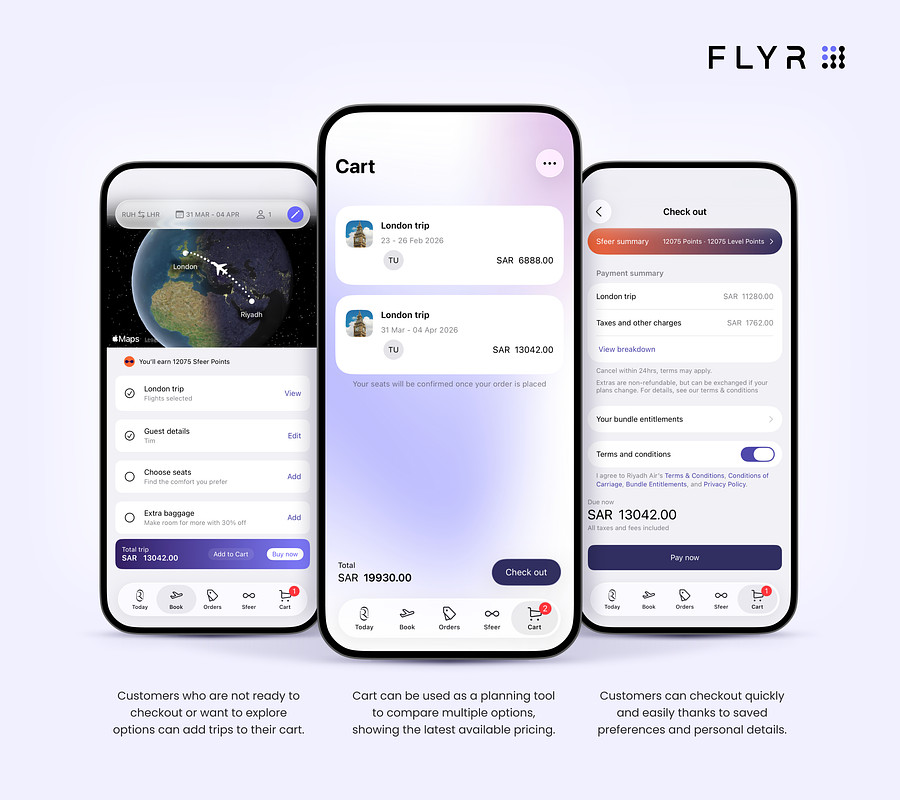
For travelers, the shift from a traditional ticket to a unified order promises a radically different booking and management experience. The Riyadh Air app and website will feature an advanced shopping cart, allowing users to save searches and itineraries, receive personalized offers relevant to their trip, and seamlessly add services. This functionality mirrors the intuitive experience customers expect from major online retailers.
Post-booking changes, often a point of friction for passengers, are simplified as the entire journey—including flights, ancillaries, and eventually third-party services—is managed within a single, real-time order record. Future enhancements plan to introduce collaborative trip planning, where friends and family can jointly build and customize an itinerary within the same shopping cart.
"Airlines have long aspired to become retailers but have been largely confined to selling tickets. That’s no longer true,” said Alex Mans, Founder and CEO of FLYR. “Riyadh Air shows that a different approach is now possible, even within an industry shaped by entrenched systems. They are a live case study for a sector that has debated modern retailing for more than a decade.”
The platform is designed to extend far beyond the flight itself. By unifying the booking process, Riyadh Air plans to natively incorporate hotels, ground transportation, and in-destination experiences, effectively becoming a one-stop shop for the entire travel journey.
A Wake-Up Call for a Legacy Industry
Riyadh Air's launch serves as a stark contrast to the slow pace of digital transformation at many established airlines. According to IATA's own readiness reports, only about a quarter of airlines expect to have fully implemented Offer & Order systems by 2027-28. The primary hurdle remains the immense challenge of migrating away from deeply integrated, decades-old legacy systems that handle everything from reservations to departure control.
The industry's journey began with the New Distribution Capability (NDC) standard, introduced in 2012 to enable richer, more dynamic offers. While NDC adoption has reached a critical mass, it primarily addresses the "Offer" side of the equation. The more complex "Order" side—which involves unifying the entire customer record and streamlining servicing and settlement—has remained a distant goal for most. Riyadh Air's debut proves that a full-stack modern retailing strategy is not just an aspiration but a present-day reality.
This move is expected to put significant competitive pressure on other carriers, particularly in the Middle East, a region known for its high standards of airline service. As customers experience the flexibility and convenience of Riyadh Air's platform, expectations are likely to shift across the industry, potentially accelerating digital transformation timelines for reluctant airlines.
The Technology Under the Hood
Powering this transformation is a sophisticated and layered technology ecosystem. FLYR's platform is modular, with a core Offer Management system for creating dynamic products and a corresponding Order Management system to unify the customer record. A key component is its proprietary "Legacy Translator" technology, which allows the modern platform to communicate with older systems like a Global Distribution System (GDS), a crucial feature for airlines undergoing a phased transition.
However, FLYR is just one piece of a much larger puzzle orchestrated by IBM, which serves as Riyadh Air's lead systems integrator. In a massive undertaking, IBM Consulting is coordinating over 60 technology partners—including Adobe, Apple, and Microsoft—across 59 distinct workstreams to build the airline's entire digital infrastructure on a hybrid cloud foundation.
"Modularity is one of the airline industry’s central challenges, particularly how multiple vendors work together without reverting to legacy monoliths,” noted Dee Waddell, Global Head of Consumer, Travel & Transportation Industries at IBM. “Riyadh Air chose partners building for the future while operating in today’s reality. FLYR’s architecture allows those partners to work together most effectively.”
IBM is also embedding artificial intelligence into every layer of the airline, from employee-facing applications built on watsonx Orchestrate to AI-powered customer service bots and real-time operational decision-making. This deep integration of AI and modern retailing from day one establishes a new benchmark for what a technologically advanced airline can achieve, setting a bold precedent as its first passengers prepare for takeoff.