
- Price: $39,900, significantly lower than competitors like the Pivotal BlackFly ($190,000).
- Weight: Under 254 pounds (empty), complying with FAA Part 103 ultralight regulations.
- Noise Level: Operational noise below 65 decibels, comparable to a normal conversation.
Experts view RICTOR's X4 as a groundbreaking yet controversial step toward accessible personal flight, with concerns about safety, regulation, and public acceptance.
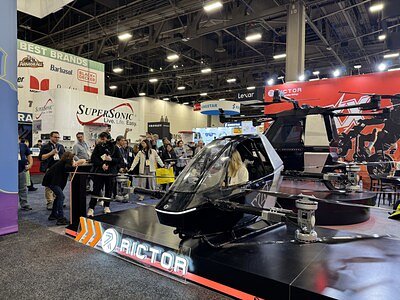
RICTOR's $39,900 Flying Pod: The Sky's New Limit or a Risky Gamble?
LAS VEGAS, NV – January 07, 2026 – The floor of CES 2026 is a familiar cacophony of ambitious technology, but one announcement from smart mobility company RICTOR has managed to cut through the noise. The firm unveiled the X4 "Air Mobility Pod," a personal electric vertical take-off and landing (eVTOL) vehicle with a stunningly low price tag of $39,900. More disruptive than the price, however, is the promise that owners can fly it legally without a pilot's license.
By designing the X4 to comply with the U.S. Federal Aviation Administration's (FAA) Part 103 regulations for ultralight vehicles, RICTOR aims to shatter the barrier to personal flight. "Our goal is not to compete with giants in the complex manned aviation track, but to pioneer a completely new, accessible market for 'light aerial mobility,'" stated the CEO of Kuickwheel Technology, RICTOR's parent company, at the launch. With deposits being taken and first deliveries slated for the second quarter of 2026, the dream of a personal flying machine seems closer than ever. Yet, this leap toward democratizing the skies raises profound questions about safety, regulation, and the practical reality of a world with unlicensed pilots overhead.
The Promise of an Everyday Aircraft
At its core, the RICTOR X4 is engineered for accessibility. It’s a single-seat craft propelled by a 4-axis, 8-propeller configuration using 63-inch carbon-fiber blades. The company claims it can carry a payload of 100kg (220 lbs) while keeping operational noise below 65 decibels—comparable to a normal conversation. For portability, the entire vehicle folds down to a compact 1.2 cubic meters, small enough to fit in the bed of a standard pickup truck, and can even be charged from the vehicle.
The technical specifications paint a picture of a user-friendly device. A proprietary "Dynamic Balance Algorithm" constantly adjusts motor output to maintain stability, even in moderate side winds. Safety is addressed through a semi-solid-state battery pack with a dual-redundancy design, ensuring the craft can land safely even if one battery module fails. This combination of features, coupled with the radical price point, positions the X4 as a potential market disruptor.
Its closest competitors, like the Pivotal BlackFly, also operate under ultralight rules but come with a price tag starting at $190,000. RICTOR's sub-$40,000 offering is a direct challenge, aiming to create a new category of consumer who may have dreamed of flying but was deterred by the immense cost and training requirements of traditional aviation. This is the "Tesla moment" for personal flight that futurists have long predicted—a product that aims to transform a niche hobby into a mainstream possibility.
Navigating a Regulatory Gray Zone
The key to the X4's license-free operation is its strict adherence to FAA Part 103. Established in 1982 for simple, recreational aircraft, this regulation exempts vehicles from airworthiness certification and pilot licensing provided they meet a rigid set of criteria. The vehicle must be for a single occupant, weigh less than 254 pounds empty, have a fuel capacity under five gallons (or a battery equivalent), and be incapable of flying faster than 63 mph.
While this regulatory loophole makes the X4 possible, it also imposes severe limitations that temper the vision of urban air commuting. Part 103 explicitly forbids the operation of ultralight vehicles "over any congested area of a city, town, or settlement, or over any open-air assembly of persons." This rule effectively grounds the X4 in urban and suburban environments, restricting its legal use to rural, unpopulated areas for recreational purposes only. Flying from a suburban home to an urban office, as some marketing might suggest, remains firmly outside the bounds of the law.
Furthermore, while no license is required, the responsibility for safe operation falls entirely on the pilot. They must yield the right-of-way to all other aircraft and are restricted to flying during daylight hours in uncontrolled airspace (Class G), unless they receive specific authorization from Air Traffic Control. The emergence of vehicles like the X4, the recently announced Coolfly aircraft, and the established Pivotal BlackFly creates a new class of aviator—one without the mandatory training and testing that has been the bedrock of aviation safety for a century. While manufacturers like Pivotal mandate their own in-house training, the ultimate enforcement and public safety implications of widespread adoption remain a critical, unanswered question.
From E-Bikes to eVTOLs
The ambitious timeline for the X4, with deliveries promised in a matter of months, is backed by the significant manufacturing history of RICTOR's parent company, Kuickwheel Technology. Founded in 2014, the Chinese firm has become a major player in the "last five kilometers" ground mobility market, exporting e-bikes and e-scooters to over 80 countries. With a factory spanning nearly 30,000 square meters and a claimed monthly production capacity of 50,000 scooters, Kuickwheel has proven expertise in mass-producing electric vehicles.
The company holds nearly 500 patents in smart transportation, centered on its proprietary KL.tech Expert System, which integrates motor control, gyroscope stabilization, and battery management technologies. This foundation in high-volume electronics and vehicle dynamics provides a credible basis for their move into the air.
However, the leap from a two-wheeled scooter to a flying machine is monumental. Aerospace manufacturing demands a far more rigorous standard of quality control, material science, and system redundancy. While Kuickwheel has the infrastructure for volume, producing an aircraft that is consistently safe and reliable presents an entirely new set of supply chain and production challenges. The X4's success will depend not just on its design, but on whether a consumer electronics manufacturing powerhouse can successfully adopt the stringent safety culture of the aviation industry.
Hurdles Beyond the Horizon
Beyond regulatory constraints and manufacturing challenges, the ultimate success of the X4 and similar vehicles hinges on public acceptance and the development of supporting infrastructure. Safety remains the paramount concern for the public when considering urban air mobility. The idea of unlicensed pilots operating overhead, even in designated areas, is likely to face significant pushback.
Noise is another critical factor. While the claimed 65-decibel level is far quieter than a helicopter, the unique high-frequency whine of electric propellers can be highly noticeable and irritating, especially in otherwise quiet rural or suburban landscapes. Widespread use would also introduce issues of visual pollution and privacy, as low-flying vehicles become a common sight.
Finally, the vision of "fly anywhere, anytime" requires an ecosystem that does not yet exist. While the X4's ability to charge from a truck is a clever solution for portability, a true mobility network would demand a grid of dedicated landing and charging pads, or "vertipads." This would necessitate not only massive investment but also significant upgrades to local power grids and the development of a sophisticated, low-altitude air traffic management system to prevent collisions. RICTOR's X4 may have arrived, but the world it was designed for is still very much on the drawing board.