
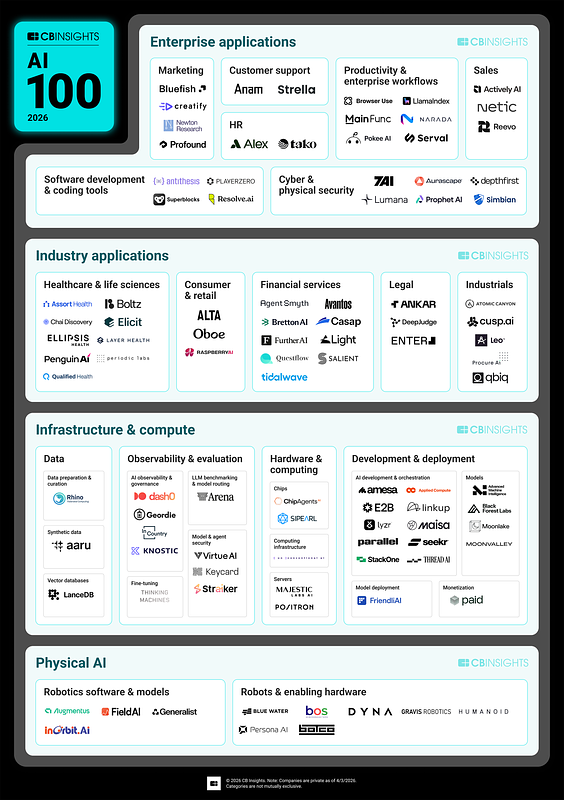
- 2026 CB Insights AI 100: Rhino Federated Computing named among the world’s most innovative private AI startups.
- $10.9 billion: Total equity funding raised by the 2026 AI 100 cohort, with over $2 billion secured in the first four months of 2026.
- Federated AI Applications: Technology used in healthcare, life sciences, and finance for secure, decentralized AI computation.
Experts agree that Rhino Federated Computing’s inclusion in the 2026 CB Insights AI 100 underscores the growing industry shift toward privacy-preserving, decentralized AI models as essential for secure and scalable enterprise applications.
Rhino Computing Joins AI Elite with Privacy-Preserving Technology
NEW YORK, NY – May 05, 2026 – In a significant nod to the growing importance of data privacy in artificial intelligence, Rhino Federated Computing has been named to the 2026 CB Insights AI 100, a prestigious annual list showcasing the world’s most innovative private AI startups. The recognition highlights a pivotal shift in the industry, moving away from traditional, centralized data models toward secure, decentralized approaches that are redefining what’s possible in enterprise AI.
CB Insights, a market intelligence firm, uses a rigorous, data-driven process to select its cohort from thousands of contenders. “The 2026 AI 100 identifies emerging, high-momentum startups worth watching in an increasingly crowded market,” said Adya Pandey, an AI Analyst at CB Insights. Pandey noted that what unites the winners is “proof of real traction outside a demo environment,” a critical milestone for any technology company.
For Rhino Federated Computing, the honor validates its mission to solve the inherent conflict between AI innovation and data privacy. The company specializes in federated AI, a technique that brings computation directly to where data resides rather than moving sensitive information to a central server. This approach is crucial for highly regulated sectors like healthcare, life sciences, and finance.
“This recognition reflects the growing urgency among enterprises to move beyond traditional, centralized AI approaches that can’t meet the demands of privacy, regulation, and scale,” said Dr. Ittai Dayan, CEO and Co-Founder of Rhino Federated Computing. “Rhino was built to solve this challenge, helping organizations unlock the full value of their data through federated AI. We believe this approach will define the next era of enterprise AI, and we’re excited to be leading the charge.”
The New Mandate for Privacy in AI
For years, the standard AI development model involved pooling vast amounts of data into a central repository to train machine learning models. While powerful, this method creates significant vulnerabilities, exposing sensitive information to potential breaches and creating complex compliance challenges with regulations like GDPR and HIPAA. As a result, many organizations have been unable to use their most valuable data, leaving critical insights locked away in siloed systems.
Federated computing fundamentally inverts this paradigm. By training AI models locally on distributed datasets—whether across different hospital networks, bank branches, or even continents—the technology ensures that raw data never leaves its secure environment. Only the anonymized, aggregated insights from the models are shared, allowing for powerful collaborative intelligence without compromising privacy or intellectual property.
This privacy-native framework is not just a theoretical advantage; it is rapidly becoming an operational necessity. The inclusion of a federated AI specialist like Rhino on the AI 100 list signals that the market is prioritizing solutions that enable responsible and secure AI adoption. The technology addresses the core challenge of building trust in AI systems, a prerequisite for their deployment at scale in mission-critical applications.
A Data-Driven Nod to a High-Momentum Startup
Inclusion in the CB Insights AI 100 is more than a symbolic honor; it is a data-backed endorsement of a company's health, momentum, and market potential. The selection process is famously rigorous, relying on proprietary metrics like the Mosaic Score, which evaluates a company's financial health, investor quality, market traction, and industry momentum based on news sentiment, web traffic, and partnerships.
CB Insights analyzes deal activity, team strength, and a startup's proprietary Commercial Maturity score to identify companies that are not only innovative but also commercially viable. The 2026 AI 100 cohort reflects this, having collectively raised $10.9 billion in equity funding, with over $2 billion secured in the first four months of 2026 alone. This financial backing underscores strong investor confidence in the technologies and business models shaping the future of AI.
For Rhino, this recognition places it among an elite group of innovators with demonstrated market fit and significant growth potential. The startup's ability to secure a spot on the list validates its status as a 'high-momentum' player, one that has successfully translated a complex technological concept into a commercially viable platform with proven applications.
From Pandemic Prediction to Cancer Research
Rhino Federated Computing’s journey from a groundbreaking academic study to an enterprise-grade platform illustrates the real-world impact of its technology. The company was founded following a landmark multi-continental federated study that accurately predicted COVID-19 outcomes by securely analyzing patient data from hospitals around the world without centralizing it. This initiative demonstrated that collaborative AI could yield life-saving insights while respecting patient privacy on a global scale.
Building on this success, the company has become the technological backbone for several other landmark initiatives. Its Federated Computing Platform (Rhino FCP) powers the federated infrastructure for Lilly TuneLab, a project focused on advancing drug discovery. It is also a key partner in the FAITE Consortium, which applies federated learning to complex challenges, and the Cancer AI Alliance (CAIA), a collaborative effort to accelerate breakthroughs in oncology.
These collaborations are prime examples of the “real traction” mentioned by CB Insights. They show federated AI moving beyond the lab and into complex, real-world ecosystems where it enables secure, large-scale research. By transforming fragmented data environments into continuously learning networks, Rhino is helping to accelerate scientific discovery and fuel smarter, faster decisions in critical fields. This ability to facilitate secure collaboration is unlocking new possibilities for solving some of society’s most pressing problems.
Defining the Next Era of Enterprise AI
The ascent of federated AI, underscored by Rhino's industry recognition, signals a broader maturation of the artificial intelligence market. As enterprises move from experimental AI projects to full-scale deployment, the focus is shifting from raw performance to practical considerations of security, governance, and compliance. The 'move computation to the data' model is no longer a niche concept but an emerging standard for any organization handling sensitive information.
This shift positions federated computing not just as an alternative, but as the essential foundation for the next generation of trustworthy and impactful artificial intelligence.