
- 3 domains of operation: The platform enables autonomy across air, land, and sea environments.
- Decentralized intelligence: The system allows robots to operate cohesively without constant connectivity, using edge computing and distributed decision-making.
- Proven in defense: The TEMPO software has been validated in multiple government programs for large-scale unmanned fleet management.
Experts would likely conclude that this partnership represents a significant advancement in autonomous systems, enabling scalable, multi-domain autonomy through a deeply integrated solution that addresses networking, edge computing, and collaborative control.
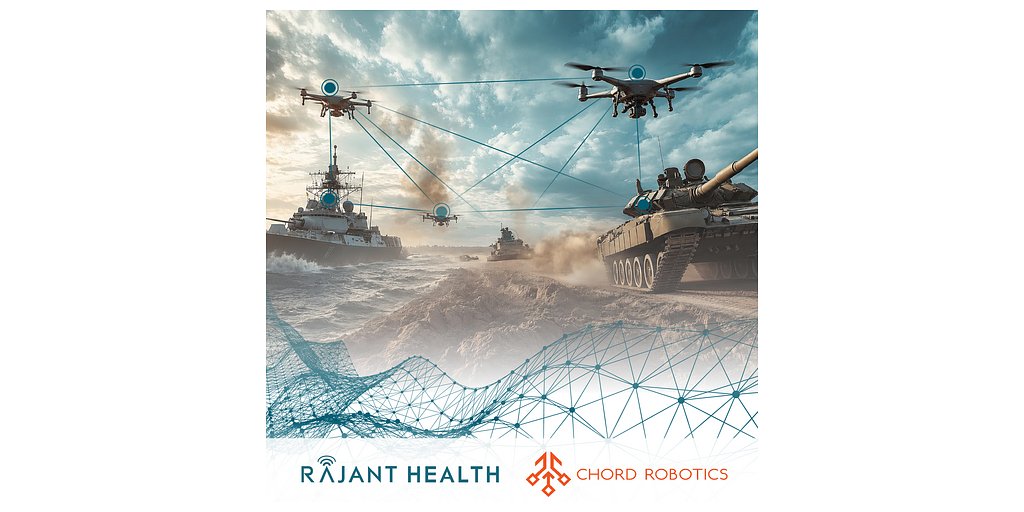
RHI & Chord Robotics Forge New Era of Collaborative Autonomy
MALVERN, Pa. & MELBOURNE, Fla. – May 21, 2026 – A groundbreaking partnership is set to redefine the limits of autonomous systems, moving beyond simple remote control to enable fleets of robots to think, collaborate, and operate as a single, intelligent entity. Rajant Health (RHI), a subsidiary of networking pioneer Rajant Corporation, and Chord Robotics, a specialist in collaborative control software, have expanded their collaboration to launch “Flying Cowbell,” an integrated platform designed to deliver scalable, multi-domain autonomy across air, land, and sea.
This initiative integrates RHI’s Cowbell distributed edge compute platform with Chord Robotics' TEMPO™ orchestration software, creating a system where unmanned aerial systems (UAS), ground vehicles (UGVs), and surface vessels (USVs) can operate cohesively, even in the most challenging and disconnected environments. The move signals a fundamental shift from systems dependent on constant connectivity to a future of truly distributed, mobility-native intelligence.
A New Architecture for Autonomous Fleets
The core innovation of “Flying Cowbell” lies in its unique architecture that weaves together three critical technologies into a unified fabric. It dismantles the traditional model of a central command center directing individual assets, replacing it with a decentralized system where intelligence and decision-making reside at the very edge of operations—on the moving robots themselves.
At the foundation is Rajant’s patented InstaMesh® networking protocol. Unlike conventional mesh networks that can falter when nodes are in motion, InstaMesh creates a self-healing, peer-to-peer Kinetic Mesh® where every node can act as a router. It uses a “make-never-break” approach, making packet-by-packet routing decisions to find the most reliable path in real-time. This ensures robust, low-latency connectivity even when an entire fleet of robots is moving simultaneously through radio-frequency congested or contested environments, eliminating the single point of failure inherent in hub-and-spoke networks.
Layered on this resilient network is RHI’s Cowbell platform. More than just a connectivity solution, Cowbell is a distributed execution layer. The new “Flying Cowbell” is a SWaP-optimized (Size, Weight, and Power) compute module, built on a Raspberry Pi CM5, that can be embedded directly into drones and other mobile robots. This transforms them from passive network relays into active compute nodes. They become participants in a dynamic, elastic cluster, capable of running containerized applications, processing sensor data, and executing AI workloads locally. This on-device processing is critical for maintaining autonomy when connections to a central command are intermittent or completely severed.
Orchestrating this distributed intelligence is Chord Robotics’ TEMPO™ software. TEMPO provides the “one-to-many” control that allows a single human operator to manage a large, mixed fleet. However, its true power is enabling fully distributed autonomy. Each vehicle equipped with the system understands the overall mission objective and can make independent, coordinated decisions to achieve it. This platform-agnostic software synchronizes the tasks of diverse machines, allowing them to act as a coordinated force that can be deployed, tasked, and re-tasked in real time without constant human intervention.
Strategic Synergy in a Competitive Market
The collaboration between Rajant Health and Chord Robotics is a calculated move in the rapidly evolving autonomous systems market. While many companies offer solutions for resilient networking, edge AI, or fleet management, this partnership creates a rare, deeply integrated system that addresses all three challenges simultaneously. This holistic approach provides a significant competitive advantage over fragmented solutions that require complex and often fragile custom integration.
By combining Rajant's battle-tested networking hardware and RHI's edge compute framework with Chord’s advanced autonomy software, the partnership delivers a pre-validated, robust solution engineered for the world's most demanding sectors. The primary market is clearly defense, where Multi-Domain Operations (MDO) and the ability to function in electronically contested environments are top priorities. The TEMPO software has already been proven across multiple government programs, commanding large-scale unmanned fleets in complex scenarios.
“Built on Rajant’s Kinetic Mesh® networking platform, RHI’s Cowbell was designed as a distributed execution layer at the edge, not just a connectivity solution,” said Robert J. Schena, CEO of Rajant Health, in a recent announcement. “With ‘Flying Cowbell,’ we are extending that execution fabric across mobile systems, enabling applications, autonomy, and data to move with the mission rather than depend on fixed infrastructure.”
This synergy allows the companies to target a critical gap in the market: enabling sophisticated, collaborative autonomy that scales seamlessly. “By combining TEMPO with Rajant’s proven InstaMesh® scalable networking capabilities and their embedded Cowbell edge platform, we’re able to scale autonomous heterogeneous fleets across challenging, infrastructure-denied environments,” noted James Cooney, Chord Robotics CEO. “This partnership brings together the connectivity, compute, and collaborative autonomy needed to let a single operator orchestrate mixed fleets across all domains.”
Beyond the Battlefield: Transforming Civilian Industries
While its defense applications are clear, the potential of the “Flying Cowbell” platform extends far into the civilian and commercial spheres. The ability to deploy self-organizing fleets of robots in areas without reliable infrastructure could revolutionize industries reliant on safety, efficiency, and data in remote locations.
In disaster response, for example, a mixed fleet of drones and ground robots could be deployed into a hurricane-ravaged area to perform search and rescue, map damage, and identify safe routes for first responders, all while operating independently of downed cell towers and power grids. For large-scale industrial operations, such as mining—a sector where Rajant’s technology is already well-established—the platform could enable fully autonomous haulage, surveying, and equipment monitoring, drastically improving safety and operational efficiency.
Other potential applications include the persistent environmental monitoring of vast coastlines or forests, automated inspection of sprawling infrastructure like pipelines and power lines, and optimizing complex logistics in large ports or construction sites. In each case, the core value proposition is the same: enabling resilient, intelligent, and collaborative robotic operations at a scale and in environments that were previously out of reach.
However, the path to widespread adoption is not without its challenges. A distributed network of intelligent, mobile devices creates a broad cybersecurity attack surface, requiring robust security measures on every node. Furthermore, navigating the complex and often siloed regulatory frameworks governing air, land, and sea operations for autonomous systems will require close collaboration with agencies like the FAA and Coast Guard. Finally, ensuring true interoperability with the vast array of legacy systems and proprietary platforms used across different industries remains a significant engineering hurdle, despite the platform's agnostic design.
Even with these challenges, the “Flying Cowbell” represents a fundamental shift in thinking about autonomous systems. It moves the industry from simply connecting robots to a central brain towards creating a collective robotic consciousness, where the fleet itself becomes a resilient, sensing, and thinking fabric capable of adapting to and overcoming the most dynamic operational challenges.