
- Copper Reduction: CCA MC cable uses approximately one-sixth the amount of copper compared to solid copper conductors.
- Theft Deterrent: Minimal copper content reduces scrap value, lowering theft risks on job sites.
- Energy Efficiency: Lower resistance in CCA conductors reduces voltage drop, improving energy efficiency by up to 10-15% in large facilities.
Experts agree that Copper-Clad Aluminum (CCA) Metal-Clad cable offers a viable solution to construction challenges, balancing cost stability, theft prevention, and sustainability without compromising electrical performance or safety standards.
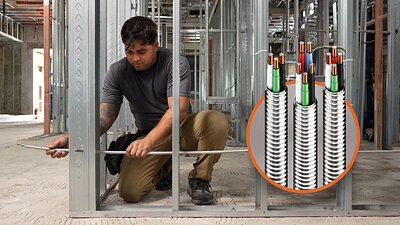
Rewiring Construction: Bimetallic Cable Tackles Cost, Theft, and CO2
By Michelle Bell
BRENTWOOD, TN – December 16, 2025 – In the high-stakes world of commercial construction, project success often hinges on a delicate balance of tight budgets, accelerated schedules, and mounting sustainability demands. Amidst the concrete, steel, and glass, a component often specified early and installed late is quietly undergoing a revolution: electrical wire. Facing wild fluctuations in copper prices and persistent job-site theft, architects, engineers, and contractors are increasingly looking for smarter alternatives. One such innovation, Copper-Clad Aluminum (CCA) Metal-Clad (MC) cable, is gaining traction as a strategic solution to these systemic challenges.
Leading the charge is Copperweld, a company with over a century of experience in bimetallic materials. Their CCA MC cable, which bonds a layer of copper to an aluminum core, is being positioned as a key enabler for more efficient, predictable, and sustainable construction projects. By combining the conductivity and connection reliability of copper with the light weight and cost stability of aluminum, this hybrid approach aims to fundamentally change how projects are planned and executed.
Taming Market Volatility and Job-Site Risks
For any long-cycle commercial project, the volatility of the copper market presents a significant financial risk. Prices have swung dramatically in recent years, making it difficult to maintain budgets from the initial bid to final procurement. A spike in copper costs can force costly mid-stream specification changes or erode already thin profit margins.
Copperweld’s bimetallic solution directly confronts this issue. According to the company, its CCA MC cable uses approximately one-sixth the amount of copper as an equivalently rated solid copper conductor. This drastic reduction in copper content significantly insulates project budgets from market swings. “That stability provides added confidence,” the company stated in a recent announcement, allowing project teams to reduce hedging pressure and free up capital that might otherwise be tied up in stockpiled materials.
Beyond market economics, the cable addresses a pervasive on-the-ground problem: theft. The high scrap value of copper makes bundles of traditional wire a prime target on unsecured job sites. These incidents result not only in material loss but also in costly project delays and replacement labor. CCA cable, with its minimal copper content and low scrap value, offers little incentive to thieves. One project manager for a large urban development firm noted anonymously that switching to a low-scrap-value wire “changed the risk calculation” for their sites, leading to fewer disruptions and better workflow continuity.
A Lighter Load for Labor and Logistics
Efficiency in construction is measured in time and labor. The physical properties of CCA cable offer tangible benefits on the job site. Being significantly lighter than solid copper wire, it is easier for crews to transport, pull through conduit, and manage during installation, particularly over long runs and complex pathways. This reduction in physical strain can lead to less fatigue, faster installation times, and a safer work environment.
Crucially, the adoption of this technology does not require a steep learning curve or investment in new equipment. Electricians can use the same standard tools, connectors, and fittings they already have for copper MC cable. Research and industry standards confirm this compatibility. Underwriters Laboratories (UL) fact-finding studies have shown that CCA performs equivalently to copper for electrical connections, and it is recognized within the National Electrical Code (NEC). Unlike pure aluminum wiring, which requires special oxide inhibitors at termination points, Copperweld’s CCA is engineered to connect like copper, with no special compounds or retorquing required for the life of the installation, provided standard procedures are followed.
“It pulls easier and handles well, which saves time,” commented an electrical contractor with experience using the material. “When you’re wiring a multi-story building, those small efficiencies add up to significant labor savings by the end of the project.”
Building a Greener Footprint
As the construction industry faces increasing pressure to adopt sustainable practices, material selection has come under intense scrutiny. The choice of electrical conductor can impact a building's environmental footprint in two key ways: resource consumption and long-term energy efficiency.
By drastically reducing the amount of copper required for electrical circuits, CCA cable supports resource conservation. With copper being a finite resource and a critical component in renewable energy technologies like electric vehicles and wind turbines, optimizing its use in building construction helps ensure its availability for the broader green energy transition.
Furthermore, the bimetallic design can enhance a building's energy performance. While CCA conductors must often be sized up one gauge compared to copper for the same ampacity, as required by the NEC, this upsizing results in a conductor with lower resistance. This lower resistance translates to reduced voltage drop over the length of the circuit. Less energy is wasted as heat in the wiring, meaning more efficient power delivery to lights, equipment, and appliances. For large commercial facilities, data centers, or multi-tenant properties, these incremental energy savings can accumulate into substantial operational cost reductions over the building’s lifespan, contributing to a lower overall carbon footprint.
Navigating Code, Compliance, and Industry Perception
Despite its benefits, the term “aluminum wiring” can still trigger caution among some industry veterans who recall issues with single-metal aluminum branch circuit wiring from the 1970s. However, it is critical to distinguish modern, engineered CCA from its problematic predecessor. Copper-Clad Aluminum conductors have been recognized and regulated by the National Electrical Code for over 50 years, with articles dating back to 1971 detailing their safe application.
Today’s CCA building wire is manufactured to stringent standards, such as ASTM B-566, and is listed by Nationally Recognized Test Laboratories (NRTLs) for safety and compliance with standards like UL 1569 for MC cable. The key is the permanent metallurgical bond between the copper and aluminum, which provides a safe, reliable, copper-to-copper connection point at terminals. This eliminates the risks of oxidation and thermal expansion mismatch that plagued earlier aluminum alloys when improperly installed.
As architects and engineers continue to push the boundaries of design and performance, the strategic specification of materials like CCA Metal-Clad cable is becoming less of a simple substitution and more of a comprehensive value proposition. It represents a shift where the choice of wire is no longer just an electrical consideration but a pivotal decision that influences a project's financial stability, operational efficiency, and long-term sustainability. In an industry defined by complexity, this silent revolution in material science is proving that smarter building truly starts from the wire up.