
- $1.28 billion: Projected market size for total ankle replacement by 2032, up from $750 million in 2024
- 250+ procedures: Completed during the limited market release with positive surgeon feedback
- 80% porosity: Aeros system's 3D-printed titanium structure for enhanced osseointegration
Experts view restor3d's Aeros system as a significant advancement in total ankle replacement, offering improved stability, bone preservation, and surgical efficiency through innovative 3D printing technology and modular design.
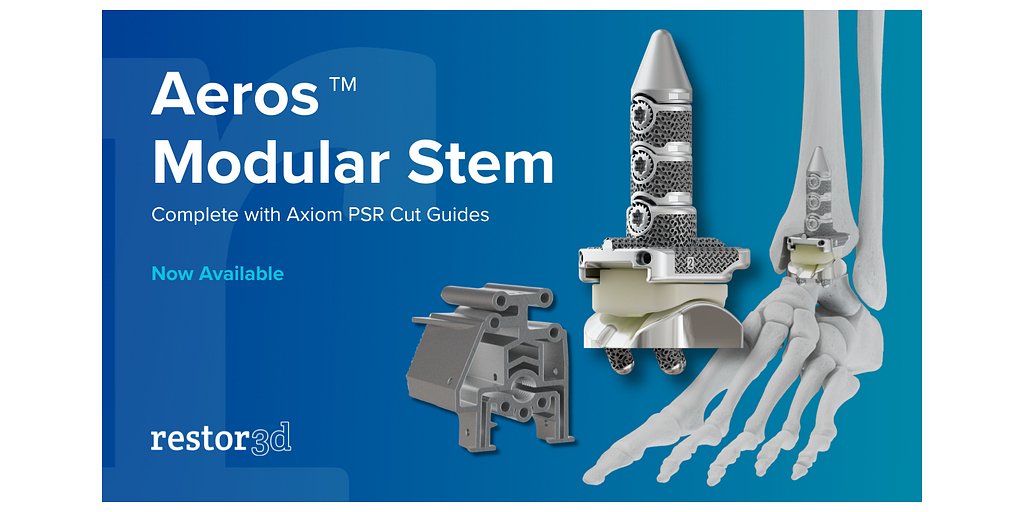
restor3d's New 3D-Printed Ankle System Aims for Market Disruption
DURHAM, NC – April 02, 2026 – Orthopedic technology firm restor3d today announced the full U.S. commercial launch of its Aeros™ Modular Stem System, a sophisticated total ankle replacement platform that could signal a significant shift in how surgeons approach debilitating ankle arthritis. The launch follows a highly successful limited market release and positions the company to challenge established players in the rapidly growing orthopedic device sector.
restor3d, a company specializing in 3D-printed and personalized medical devices, has designed the Aeros system to address long-standing challenges in total ankle replacement (TAR). By focusing on enhancing implant stability, preserving the patient's natural bone, and improving surgical efficiency, the company aims to set a new standard for patient outcomes and surgeon experience.
A New Approach to Ankle Replacement
For decades, surgeons performing total ankle replacements have faced a difficult trade-off between achieving robust implant fixation and minimizing the invasiveness of the procedure. Securing a stable, long-lasting implant often required more extensive surgical exposures or sacrificing more of the patient's bone. The Aeros™ Modular Stem System is engineered to overcome this dilemma.
Its primary innovation is a modular stemmed tibial implant that can be placed using a standard anterior incision—a familiar and less disruptive approach for most orthopedic surgeons. This design avoids the need for bulky external hardware or violating nearby anatomy like the calcaneus and subtalar joint, which can complicate recovery. By combining the stability of a stemmed implant with a minimally invasive technique, Aeros aims to deliver the best of both worlds.
This approach has been validated during a limited market release that began in May 2025, during which over 250 procedures were completed by more than 50 surgeons. The feedback from this initial cohort has been overwhelmingly positive.
“Fixation has always been one of the most important drivers of long-term success in total ankle replacement, but historically that has required tradeoffs in exposure or bone preservation,” said Samuel Ford, MD, of OrthoCarolina, who was part of the system's design team. “The ability to place a modular stem through a standard anterior approach gives me the stability I want without increasing surgical morbidity. In practice it feels familiar, efficient, and reproducible, and my early patients have recovered very well.”
The 3D Printing Advantage: TIDAL Technology™
At the core of the Aeros system is restor3d’s proprietary TIDAL Technology™, a sophisticated 3D printing process that creates implants with an optimized porous architecture. Unlike traditionally manufactured implants, which are often solid blocks of metal, the Aeros tibial and talar components are built layer-by-layer from medical-grade titanium alloy (Ti6Al4V ELI) into a structure that mimics natural bone.
This technology creates a unique gyroid-sheet lattice with up to 80% porosity and 100% interconnectivity. This intricate, web-like internal structure maximizes surface area and is designed to encourage osseointegration—the process where the patient's own bone grows into and fuses with the implant. This biological fixation is critical for achieving durable, long-term stability and reducing the risk of implant loosening over time.
This level of customization and biomimetic design is a key advantage of 3D printing. restor3d leverages AI-based planning tools to help surgeons map out procedures, further personalizing care and enhancing surgical precision. The move from one-size-fits-all implants to patient-specific solutions represents a major trend in modern orthopedics, promising better fits, reduced complications, and potentially faster recovery times for patients.
Navigating a Competitive Market
The launch of the Aeros system comes at a pivotal time for the total ankle replacement market. Valued at nearly $750 million in 2024, the market is projected to grow to $1.28 billion by 2032, fueled by an aging population and a growing preference for motion-preserving alternatives to ankle fusion. This growth has attracted intense competition from orthopedic giants.
Stryker, a market leader, offers multiple systems, including its widely used Infinity® system and the recently cleared Incompass™ Total Ankle System, which also utilizes 3D-printed components. Similarly, Zimmer Biomet’s Trabecular Metal™ Total Ankle system is known for its unique lateral surgical approach and advanced material designed for bone integration.
Against this backdrop, restor3d is carving out its niche by focusing on a unique combination of features. While competitors also offer 3D-printed and modular components, the Aeros system's distinction lies in being the first to integrate a modular stem with a standard anterior surgical approach. This targeted innovation addresses a specific clinical need and offers a clear point of differentiation in a crowded field.
From Limited Release to Full Launch
restor3d's path to market has been both strategic and well-capitalized. The company’s decision to conduct an extensive limited release before the full launch allowed it to gather crucial real-world data and surgeon feedback, refining the system and building a base of clinical support.
This deliberate strategy is backed by significant investor confidence. In 2025, restor3d secured two major funding rounds, totaling over $140 million, with the express purpose of accelerating the commercialization of its 3D-printed solutions and expanding patient access. With FDA clearance already secured for the Aeros system for both primary and revision surgeries, the company has the regulatory green light and the financial resources to support a robust national rollout.
The firm's expanding footprint, which included partnerships with over 500 surgeons across more than 700 hospitals in 2024, provides a strong foundation for introducing this new technology. By offering a system that is not only technologically advanced but also surgically efficient and reproducible, restor3d is making a compelling case for adoption to healthcare providers who are constantly balancing clinical outcomes with operational demands. The introduction of the Aeros Modular Stem System is more than just a new product; it represents the ongoing evolution of orthopedic surgery, where advanced manufacturing and data-driven design converge to redefine the standards of patient care.