
- $19 billion: The Proptech market value in 2023, projected to grow to $87 billion by 2031. - 25%: The portion of commercial real estate finance teams that identify manual, repetitive tasks as their primary cash management challenge. - 4% APY: The potential yield on previously idle cash with modern treasury solutions.
Experts agree that idle cash in fragmented banking systems is a significant, often overlooked, drain on profitability for commercial real estate operators, and modern treasury technology offers a strategic solution to optimize liquidity and enhance financial performance.
Real Estate's Hidden Cost: Idle Cash Drains Millions from Portfolios
NEW YORK, NY – May 20, 2026 – In an industry defined by tangible assets and billion-dollar deals, one of the most significant drains on profitability for commercial real estate operators is proving to be almost invisible: idle cash. A new analysis released by treasury management platform Balance Cash reveals that firms managing multi-property portfolios are unknowingly forfeiting substantial annual revenue due to fragmented banking systems and manual cash management workflows.
The findings highlight a critical inefficiency that has long been accepted as a cost of doing business. As portfolios grow through acquisitions and development, so does the web of bank accounts required by lenders, partners, and property-level operating structures. The result is a sprawling financial footprint where cash often sits idle in dozens, or even hundreds, of disconnected accounts, earning minimal to zero yield.
This issue has become particularly acute in the current higher-interest-rate environment, where the opportunity cost of dormant cash is more pronounced than ever. While operators have sophisticated systems for acquisitions and asset management, the treasury function has often lagged, remaining a maze of spreadsheets and manual fund transfers.
The High Cost of Complexity
The root of the problem lies in operational complexity. A typical real estate firm may manage separate legal entities for each property, each with its own set of bank accounts for operating expenses, security deposits, and capital reserves. This structure, often dictated by lender requirements and liability protection, inherently creates financial silos.
Finance teams are left to navigate this fragmented landscape with inadequate tools. A recent industry survey noted that a quarter of commercial real estate finance teams identify manual, repetitive tasks as their primary cash management challenge. This reliance on manual tracking and reconciliation across disconnected banking portals is not only inefficient and prone to error but also creates significant operational blind spots.
“Many firms are flying blind,” explained one senior finance executive at a mid-sized property group, who spoke on the condition of anonymity. “Our banking platforms show us balances by account, and our accounting system tracks everything by entity, but neither gives us a complete, real-time picture of our total liquidity. We know there’s money being left on the table, but identifying it and moving it efficiently is a constant struggle.”
This operational drag translates directly into financial loss. Cash that could be earning competitive returns in money market funds or other short-term investments instead languishes in non-interest-bearing checking accounts. The inefficiency prevents firms from optimizing their liquidity, forcing them to either hold excessive cash buffers or draw on expensive lines of credit when a more holistic view would have revealed available funds elsewhere in the portfolio.
A New Layer in the Financial Stack
Addressing this challenge is a new wave of financial technology designed to operate above the existing banking layer, providing a unified view and automated control without the massive operational disruption of changing banks. Balance Cash, which authored the recent analysis, is positioning itself at the forefront of this movement.
“Many real estate operators have sophisticated systems for acquisitions, leasing, construction, and asset management, but treasury is still frequently managed through fragmented workflows that create inefficiency and lost yield opportunity,” said Stan Markuze, CEO of Balance, in the press release. “What we’re seeing is that idle cash is no longer just a passive operational reality. Increasingly, firms recognize that cash itself is an asset class that should be actively optimized.”
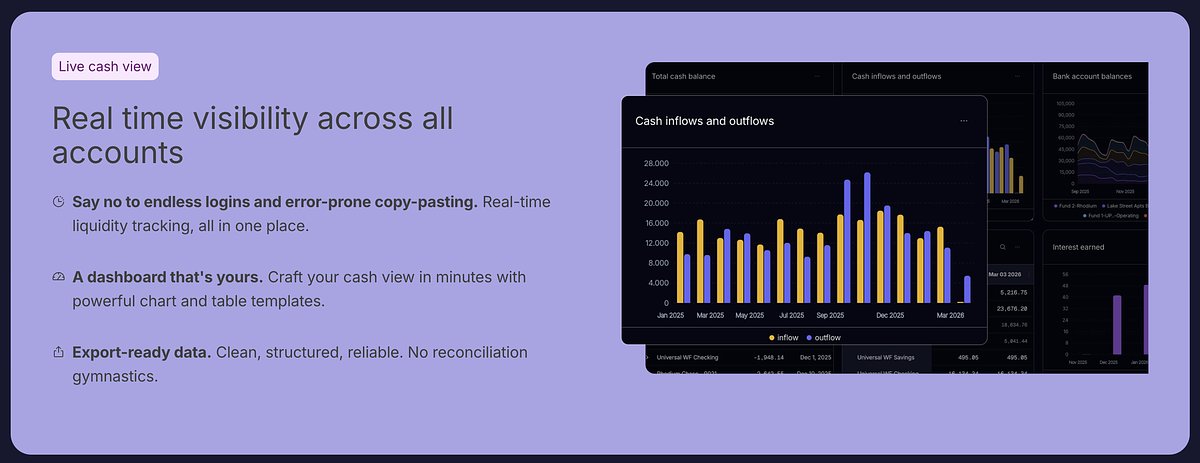
The model these platforms propose is one of aggregation and automation. By connecting to a firm's existing bank accounts, the software provides a centralized dashboard for real-time visibility. More importantly, it can execute automated strategies, such as “sweeping” excess cash from operating accounts into higher-yield investment vehicles overnight, and returning it automatically when needed. This allows operational cash to remain fully liquid while still generating a meaningful return.
This approach is critical for an industry that has built its financial infrastructure organically over decades. Forcing a firm to consolidate all its relationships into a single bank is often a non-starter due to lender covenants, joint venture agreements, and entrenched operational processes. A solution that complements, rather than replaces, this infrastructure is therefore far more palatable.
The Evolving Proptech Landscape
This focus on treasury modernization is part of a much larger digital transformation sweeping the real estate industry. The broader “Proptech” market, valued at over $19 billion in 2023, is projected to surge to nearly $87 billion by 2031 as firms increasingly adopt technology to drive efficiency and data-driven decision-making.
While Balance Cash focuses on yield optimization, it operates in a growing competitive landscape. Firms like Arpari and Panax are also offering modern treasury platforms designed to help real estate operators aggregate bank data, automate reporting, and streamline money movement. While their features overlap, the emergence of multiple players validates the market need and signals a definitive shift away from legacy processes.
This technological arms race is fueled by the clear return on investment. The ability to earn upwards of 4% APY on previously idle cash can materially impact a portfolio's annual performance, turning a long-standing operational cost center into a new source of revenue. The adoption is also driven by a demand for better risk management and more accurate financial forecasting, capabilities that are nearly impossible to achieve with siloed data and manual spreadsheets.
From Operational Drag to Strategic Advantage
The conversation around cash management in real estate is fundamentally changing. What was once a back-office, administrative function is now being viewed as a strategic lever for financial performance. CFOs and finance leaders are no longer content with the status quo.
“Most firms don’t wake up thinking, ‘We have a treasury problem,’” noted Markuze. “They experience it operationally. Too many accounts. Too little visibility. Cash sitting in different places earning inconsistent returns. Teams manually moving funds between institutions. Over time, that creates both operational drag and financial inefficiency.”
By implementing modern treasury infrastructure, firms can transform that drag into a strategic advantage. Real-time visibility allows for smarter, faster decisions about capital allocation. Automated yield generation directly enhances the bottom line. Furthermore, freeing up finance teams from the drudgery of manual reconciliation allows them to focus on higher-value activities like forecasting, analysis, and strategic planning.
The industry's path forward seems clear. As real estate portfolios continue to grow in scale and complexity, the treasury challenges will only intensify. Operators are now actively seeking infrastructure that provides the visibility, flexibility, and performance needed to manage a modern financial footprint without being forced to rebuild decades-old banking relationships from the ground up.