
- <100ms latency: The system processes data in under 100 milliseconds for real-time responses.
- No cameras, no cloud, no personal data: The technology preserves privacy by analyzing radio waves instead of images.
- Three core applications: Elderly care monitoring, industrial safety, and anonymous people counting.
Experts would likely conclude that this radar-AI system represents a significant advancement in privacy-preserving human sensing, offering a versatile, ethical alternative to camera-based monitoring with broad applications in care and industry.
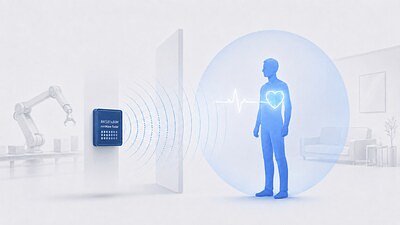
Radar and AI Unite for Privacy-First Human Sensing Without Cameras
CAMPBELL, Calif. – May 19, 2026 – A groundbreaking partnership announced today aims to redefine how machines understand and interact with people, promising a future of enhanced safety and care without the privacy trade-offs of traditional cameras. Physical AI company Algorized and Japanese semiconductor giant Asahi Kasei Microdevices (AKM) are integrating a sophisticated AI model with advanced millimeter-wave (mmWave) radar, creating a system that can sense a person's presence, posture, and even their breathing from across a room, through dust, darkness, and physical obstructions.
The collaboration pairs Algorized’s edge-AI foundation model with AKM’s AK581xAIM mmWave radar module. The combined solution is poised to address critical needs in industrial automation and elderly care, offering a new paradigm of “awareness, not surveillance” that could set a new global standard for ethical, human-centric technology.
A New Paradigm: Sensing Without Seeing
For decades, the primary way for machines to perceive the visual world has been through cameras. However, this approach has significant limitations, especially in environments where privacy is paramount or conditions are challenging. Cameras fail in low light, are easily blocked by clutter, and capture personally identifiable information, raising significant ethical and regulatory concerns in sensitive settings like hospitals, care homes, and factory floors.
The solution from Algorized and AKM bypasses these issues entirely by relying on radio waves. The AKM radar module emits high-frequency signals that bounce off objects in the environment. Algorized's AI foundation model, running directly on the device—a concept known as edge computing—analyzes the returning signals in real time. It can detect the sub-millimeter chest movements associated with breathing and heartbeats, distinguish between a person standing, sitting, or lying down, and track their movement through a space.
This process happens with a latency of less than 100 milliseconds, enabling immediate responses for safety-critical applications. Because the system interprets raw physics data and not images, privacy is preserved by the nature of the technology itself, not by a policy that could be changed or breached.
“We are moving from sensors that watch to sensors that understand,” said Natalya Lopareva, CEO and Co-Founder of Algorized, in the announcement. “Algorized senses human life - heartbeat, breathing, posture - from raw physics, directly from radio waves, with no cameras, no cloud, and no record of who a person is. With Asahi Kasei Microdevices, that capability now ships on production-level silicon engineered in Japan for the customers building the next generation of safer, more responsive systems worldwide.”
Addressing Critical Needs in Care and Industry
The partnership is not a theoretical exercise; it targets immediate, real-world problems with a single, versatile platform. Algorized has demonstrated three core capabilities that showcase the system's flexibility:
Knowing Without Watching: In elderly care, the system provides continuous, non-intrusive monitoring. It can detect if a person has fallen, is in bed, or is moving around, while also tracking resting heart and breathing rates—all from a single sensor in the room. This addresses the growing desire for seniors to “age in place” while giving loved ones peace of mind, without the discomfort of being on camera or the burden of wearing a device.
Awareness on the Move: In industrial settings, autonomous mobile robots (AMRs) and forklifts operate in dynamic and often chaotic environments. The Algorized/AKM solution allows these machines to maintain constant awareness of human workers, even in dusty factories or cluttered warehouses where camera vision is unreliable. The AI model can even account for the motion of the platform itself, providing robust human tracking for collision avoidance.
Counting Without Cameras: For smart buildings and retail spaces, the technology offers a way to accurately count and track people moving through doorways or in high-traffic zones. This provides valuable data for optimizing energy use, managing crowds, and improving operational efficiency, all while completely preserving the anonymity of individuals.
Gregg Rouse, President of AKM's North American business, emphasized the hardware's purpose-built design. “The AK581xAIM was engineered for environments where privacy and reliability are non-negotiable: care facilities, factory floors, doorways,” he stated. “The Algorized foundation model is the perception layer that completes the picture - together we deliver a sensing platform that reads human life, not just motion.”
The Crowded Field of Non-Visual Monitoring
Algorized and AKM are entering a competitive but rapidly growing market for non-camera sensing technologies. Other companies, such as Xandar Kardian and Vayyar, have also made significant strides with radar-based systems for fall detection and vital sign monitoring. Meanwhile, alternative technologies like thermal imaging offer anonymous occupancy detection by sensing heat signatures, and Wi-Fi sensing uses signal disruptions to detect presence and movement.
Where the Algorized and AKM partnership aims to differentiate itself is in its unified approach. While many competitors offer application-specific products—a device for fall detection, another for people counting—Algorized provides a single, underlying AI foundation model that can power all these capabilities and more. This “infrastructure” approach means the same core intelligence watching over a care home in Osaka could also be managing robot safety in Detroit and tracking foot traffic in Düsseldorf, dramatically simplifying development and deployment for customers.
The Business and Ethics of Human-Aware AI
This technological advance arrives at a crucial moment, as societies grapple with the benefits and risks of pervasive AI. By building a system where privacy is a physical constant rather than a software setting, the partnership directly addresses regulatory frameworks like Europe's GDPR and the U.S.'s HIPAA, which place strict controls on personal and health data. This “privacy-by-design” philosophy could significantly lower the barrier to adoption for monitoring technologies in highly regulated sectors.
The collaboration also highlights a powerful trend in global technology: the fusion of Silicon Valley's AI software expertise with Japan's deep-seated excellence in precision hardware engineering. This synergy is creating solutions that are not only intelligent but also exceptionally reliable and built for mass production.
Ultimately, the broader impact may be felt in the acceleration of human-robot collaboration. For robots to truly become helpful partners in our homes, hospitals, and workplaces, they must have a deep, intuitive, and safe awareness of the people around them. By providing a sense of perception that is both highly detailed and fundamentally respectful of human privacy, this new technology may be a critical step toward building a future where automation works seamlessly and safely alongside us.