
- QwikOS is designed to support any humanoid robot with an open-source SDK, aiming to standardize the fragmented robotics market.
- The platform has already completed production validation on Unitree Robotics G1 EDU models, positioning itself as the only third-party OS for this series.
- QwikOS's App Store is touted as the industry's first and largest catalog of third-party features for humanoid robots.
Experts would likely conclude that QwikOS represents a significant step toward democratizing humanoid robotics by creating an open, standardized platform, though its long-term success will depend on widespread adoption by hardware manufacturers and developers.
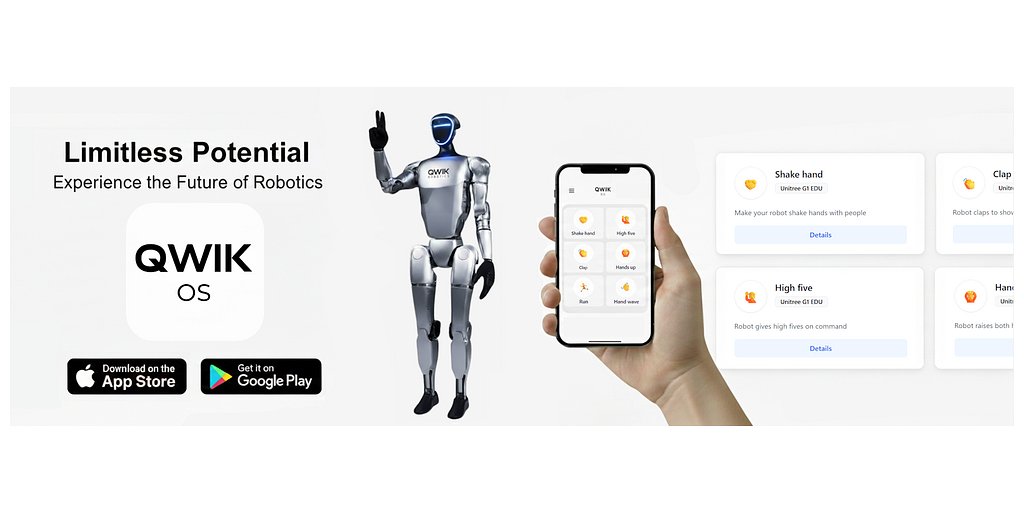
QwikOS Aims to Be the 'Android' for Humanoid Robots with New OS
PALO ALTO, CA – January 07, 2026 – A new contender has entered the burgeoning field of humanoid robotics, focusing not on gears and actuators, but on the software that will bring them to life. Today, QwikOS officially launched what it bills as the world's first universal operating system and app store for humanoid robots, a platform designed to create a standardized ecosystem in a market currently defined by proprietary, fragmented systems.
Available now for download on Apple's App Store and Google Play, the QwikOS mobile application acts as a central hub, providing a single, consistent interface to control a diverse range of humanoid robots. The company's vision is ambitious: to do for robotics what Android did for smartphones—unleash a wave of innovation by creating a common ground for developers and making advanced technology accessible to everyday users.
The 'Android Moment' for Robotics?
For years, the robotics industry has been characterized by walled gardens. Manufacturers like Boston Dynamics and Agility Robotics build highly advanced machines, but they run on closed, proprietary software. This forces developers to choose a single hardware platform, limiting the reach of their creations and slowing down the cross-pollination of ideas.
QwikOS aims to tear down these walls. The platform is built to connect with any humanoid robot that offers an open-source Software Developer Kit (SDK). According to the company, this hardware-agnostic approach means that capabilities developed on QwikOS can be “published and deployed across any open-SDK humanoid hardware.” This shift could significantly lower the barrier to entry for software developers, allowing them to write an application once and potentially run it on robots from multiple manufacturers. By abstracting the hardware differences, QwikOS hopes to foster a collaborative environment where innovation can flourish.
The strategy mirrors the early days of the mobile phone industry, where the emergence of standardized operating systems like Android led to an explosion of third-party applications, transforming the smartphone from a communication device into a pocket-sized computer. QwikOS is betting that a similar dynamic will play out with humanoid robots, turning them from niche research projects into versatile platforms with limitless potential.
Bridging the Hardware Gap
QwikOS's claim of being "universal" is backed by a growing list of hardware partners. The company has already completed production validation on the Unitree Robotics G1 EDU models, positioning itself as the only third-party operating system to support the G1 series. The platform is also designed for compatibility with a range of current and upcoming open-SDK hardware from manufacturers like Pollen Robotics, Booster Robotics, Agibot Tech, MagicLabs Robotics, EngineAI, and LimX Dynamics.
The technical implementation is designed to complement, not replace, the manufacturer's own systems. QwikOS provides a standardized user experience and application layer, while the robot's fundamental behaviors and motor controls are still managed by its native SDK. This architecture allows QwikOS to offer a consistent interface for users and a stable target for developers, without interfering with the core engineering that makes each robot unique.
To facilitate this integration, the company is providing a detailed whitepaper and developer resources, including API references and guides, to help hardware makers and software creators connect to its ecosystem. The success of this strategy will depend on how seamlessly it can integrate new hardware and how many manufacturers embrace this open approach over a proprietary one.
Building the App Economy for Bots
At the heart of the QwikOS platform is its App Store, touted as the industry's first and largest catalog of third-party features for humanoid robots. This is where the company's vision of an open ecosystem truly takes shape. A centralized developer console allows creators to submit new features and applications, and more importantly, to monetize their work.
The platform enables various revenue models, including optional paid features, licensing agreements, and commercial distribution opportunities. This financial incentive is critical for attracting and retaining talent. QwikOS hopes that by allowing developers to earn from their creations, it can foster a community dedicated to maintaining, improving, and supporting a library of high-quality applications. This stands in contrast to many open-source projects that rely purely on volunteer contributions.
The platform also supports integrations with powerful third-party technologies. For instance, developers can extend a robot's capabilities by connecting it to Large Language Models (LLMs) like ChatGPT for more natural conversation, or to external hardware like Meta Quest VR headsets for immersive telepresence and control. These integrations are presented to the end-user within the single QwikOS interface, streamlining configuration and making complex new functions easy to access.
From Lab to Living Room: The Consumer Challenge
While the developer-centric model is crucial, the ultimate goal for QwikOS is to make humanoid robots useful and accessible to non-technical users. The mobile app's promise of a “single, consistent interface” is designed to remove the steep learning curve often associated with advanced robotics. The idea is that a robot owner shouldn't need a degree in software engineering to make their robot perform a new task; they should be able to simply download an app.
However, significant hurdles to mainstream consumer adoption remain, many of which are outside of QwikOS's direct control. The cost of humanoid hardware is chief among them. While prices are slowly decreasing, with some developer kits entering the sub-$10,000 range, they remain far too expensive for a mass market. Until the hardware becomes more affordable, the primary audience will likely remain researchers, businesses, and wealthy early adopters.
Furthermore, the “killer app” for a consumer-grade humanoid robot has yet to emerge. While the potential is vast—from elder care and household chores to education and entertainment—the specific, compelling use cases that will convince millions of people to invite a robot into their homes are still being defined. QwikOS provides the stage, but it will be up to the community of developers it hopes to build to write the hit shows.