
- 20x lower Global Warming Potential (GWP): Isobloc ZERO's carbon footprint is 20 times lower than conventional concrete.
- 20% cost reduction: CarbiCrete's process can reduce material costs by up to 20% by replacing cement with steel slag.
- $250,000 annual savings: Buildings using Isobloc's insulated products saved an estimated $250,000 annually in heating costs.
Experts would likely conclude that Isobloc ZERO represents a significant advancement in sustainable construction, combining carbon-negative material with superior insulation to drastically reduce both embodied and operational carbon emissions in buildings.
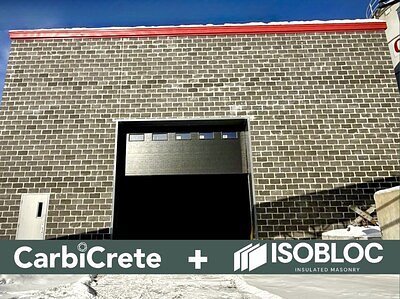
Quebec Innovators Debut Cement-Free Blocks in World-First Project
DRUMMONDVILLE, QC – February 20, 2026 – In a quiet industrial park in Quebec, a newly completed building expansion stands as a potential landmark for the future of global construction. This isn't just another structure; it's the world's first full-scale project built with Isobloc ZERO, a revolutionary cement-free, insulated masonry unit that promises to drastically cut the carbon footprint of the buildings we live and work in.
The project, an expansion for masonry manufacturer Patio Drummond, is the culmination of a strategic partnership between two Quebec-based companies: CarbiCrete, a leader in decarbonized concrete technology, and Isobloc, a veteran manufacturer of high-performance insulated blocks. Together, they have created a building material designed to tackle two of the construction industry's most significant environmental challenges at once: embodied carbon and operational carbon.
A Double Win for Decarbonization
The construction sector is a major contributor to global greenhouse gas emissions, with cement production alone accounting for approximately 8% of the world's CO2 output. Isobloc ZERO directly confronts this issue by leveraging CarbiCrete's patented, cement-free technology. The process completely replaces cement in the concrete mix with steel slag, a plentiful by-product of the steel-making industry. This substitution alone eliminates the significant emissions tied to cement manufacturing.
But the innovation doesn't stop there. During the curing phase, instead of using traditional heat and steam, the blocks are injected with captured carbon dioxide. The CO2 chemically reacts with the steel slag and is permanently mineralized within the concrete, effectively locking it away forever. This makes the material itself carbon-negative, turning a building block into a carbon sink. According to a verified Environmental Product Declaration (EPD), CarbiCrete's concrete masonry units have a Global Warming Potential (GWP) that is a staggering 20 times lower than the industry average for conventional concrete.
This tackles the embodied carbon—the emissions generated from manufacturing and transporting building materials. The second part of the equation, operational carbon, which stems from a building's energy use for heating, cooling, and lighting, is addressed by Isobloc's proven design. Founded in 1984, the company specializes in blocks that integrate a core of high-performance insulation between concrete layers. This "all-in-one" system provides structure, insulation, and interior/exterior finish in a single step, significantly improving a building's thermal efficiency. By minimizing heat loss, buildings constructed with these blocks require far less energy to maintain comfortable temperatures, leading to substantial long-term reductions in both energy costs and emissions.
From Local Innovation to Global Ambition
The completion of the Patio Drummond expansion is a homecoming of sorts for the technology. "The first deployment of CarbiCrete's technology was here at Patio Drummond," said CarbiCrete CEO Gary Belisle in a recent announcement. "And so, I find it fitting that the first use of Isobloc ZERO in a construction project is here, at the very site where the blocks themselves were manufactured."
This local synergy underscores a key part of the business model. CarbiCrete's technology is designed to be retrofitted into existing concrete manufacturing plants, allowing producers like Patio Drummond to switch to carbon-negative production without the prohibitive cost of building entirely new facilities. This approach is key to rapid scalability and market adoption.
For Isobloc, the partnership represents the next evolution of its mission. "Isobloc ZERO is our solution for reducing carbon emissions in the construction industry and building more sustainably, right here at home," stated CEO Eric Dionne.
While its roots are firmly planted in Quebec, the partnership's ambitions are global. CarbiCrete is already making inroads into the U.S. and European markets, with plans to launch France's first cement-free concrete block production line later this year. With Isobloc ZERO now proven in a full-scale application, the combined solution is poised for wider release, initially for pilot projects before a broader offering expected in late 2026.
The Practical Path to Greener Buildings
For any green technology to succeed, it must be practical and economically viable. The developers of Isobloc ZERO have positioned their product to clear this crucial hurdle. A significant barrier for many sustainable materials is a high upfront cost, often referred to as the "green premium." However, company representatives state that Isobloc ZERO is "priced comparably to conventional materials," a claim supported by the underlying economics. By replacing expensive cement with less costly steel slag, CarbiCrete's process can reduce material costs for manufacturers by as much as 20%.
For building owners and developers, the long-term return on investment is even more compelling. The superior insulation provided by the blocks can lead to dramatic operational savings. In one documented case, a building using Isobloc's standard insulated products saved an estimated $250,000 annually in heating costs. As energy prices continue to rise and carbon taxes become more prevalent, such efficiency gains become a powerful financial incentive.
The timing is also right from a regulatory standpoint. The product already meets key industry benchmarks like the ASTM C90 performance standard, ensuring it is a reliable substitute for traditional concrete blocks. Furthermore, governments are tightening environmental rules for construction. In Quebec, the "Act Respecting the Environmental Performance of Buildings," passed in 2024, mandates energy reporting and performance ratings. The provincial building code also incorporates the National Energy Code for Buildings (NECB), setting stringent requirements for thermal insulation. Products like Isobloc ZERO not only help developers meet these new standards but also earn credits for green building certifications like LEED, making projects more attractive to tenants and investors.
Navigating a Competitive Green Landscape
CarbiCrete and Isobloc are not alone in the quest to clean up construction. A growing number of startups and established players are developing low-carbon and carbon-sequestering concrete, including companies like CarbonBuilt and Sublime Systems. The market for insulated concrete forms (ICFs) is also well-established.
However, the key differentiator for Isobloc ZERO is its integrated approach. It doesn't just offer a low-carbon material or an insulated form; it delivers both in a single, familiar masonry unit. This "perfect marriage of two sustainable solutions" provides a unique value proposition for architects and contractors seeking to maximize environmental performance without complicating the construction process. Beyond its green credentials, the product also boasts superior performance characteristics, including higher compressive strength and better durability against freeze-thaw cycles compared to traditional concrete.
The successful completion of the Drummondville project serves as a powerful proof-of-concept. It demonstrates that it is possible to construct buildings that are not just less harmful to the environment, but are actively part of the climate solution, all while remaining practical, affordable, and durable. As the world grapples with the dual needs of building more housing and infrastructure while drastically cutting emissions, this Quebec-born innovation may offer a foundational piece of the puzzle.