
- 90x Performance Increase: The iQCC algorithm achieved a 90x speed boost over traditional CPU methods, reducing computation time from days to just over an hour.
- 112-Qubit Simulation: The algorithm successfully simulated a complex greenhouse gas-capturing catalyst requiring 112 qubits on a single NVIDIA Blackwell GPU.
- 1-Hour Benchmark: The simulation was completed in just over an hour, setting a new performance target for quantum computers.
Experts agree that this breakthrough demonstrates the immediate practicality of quantum-inspired algorithms on classical hardware, setting a high-performance benchmark for future quantum computers and accelerating materials discovery.
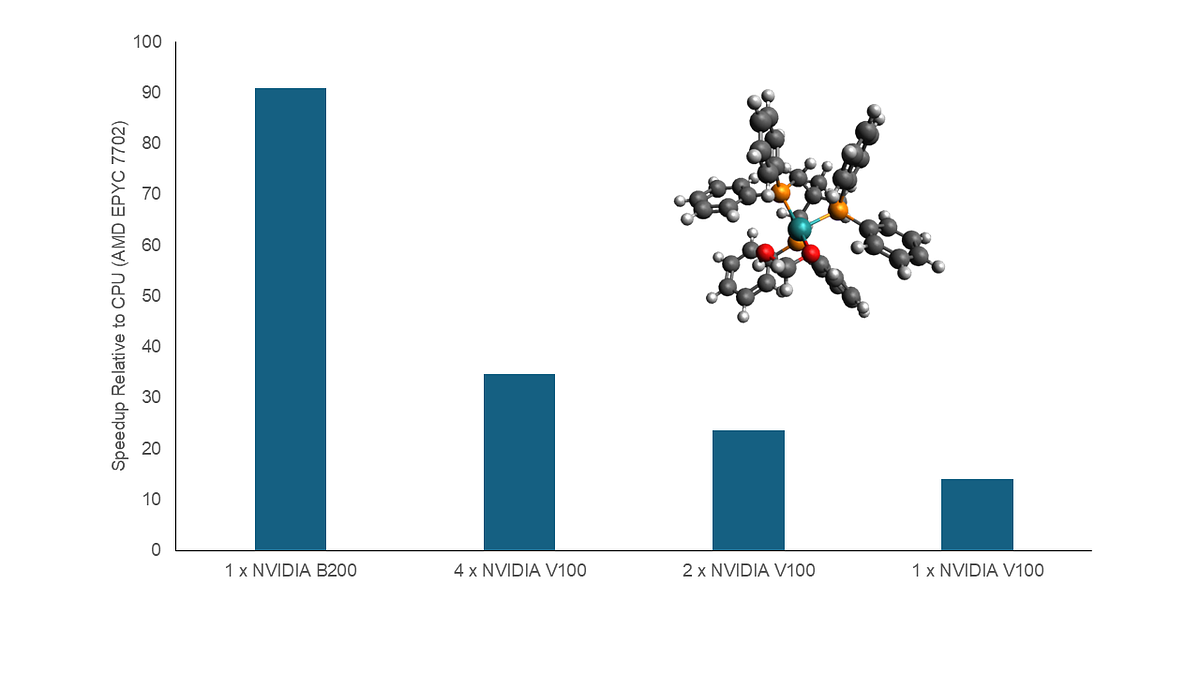
Quantum-Inspired Algorithm on NVIDIA GPU Sets New Materials Science Record
TORONTO, March 16, 2026 – In a significant development that redefines the landscape of materials science, OTI Lumionics has announced a major breakthrough in computational chemistry. The company has successfully executed its proprietary algorithm on a single high-performance NVIDIA Blackwell graphics processing unit (GPU), achieving simulation speeds and accuracy that dramatically outperform traditional methods and even set a challenging new benchmark for the quantum computers of the future.
The achievement centers on OTI's Iterative Qubit Coupled Cluster (iQCC) algorithm, which completed a complex, 112-qubit simulation of a greenhouse gas-capturing catalyst. This entire calculation was finished in just over an hour on one gaming-class GPU. This marks a staggering 90x performance increase from previous methods that required days of computation on clusters of traditional central processing units (CPUs), effectively collapsing development timelines from days to hours and making high-accuracy molecular design a practical, everyday tool.
The 'Quantum-Inspired' Advantage
The core of this breakthrough lies in a clever and pragmatic approach known as "quantum-inspired" computing. This strategy distinguishes itself from "true quantum computing," which relies on nascent and highly complex quantum hardware that is still years away from widespread, error-corrected industrial use. Instead of waiting for that hardware to mature, quantum-inspired algorithms like iQCC leverage the principles of quantum mechanics but are designed to run on powerful, existing classical hardware like GPUs.
This approach allows companies to tackle problems previously thought to be the exclusive domain of future quantum computers. By translating the iQCC code to run on NVIDIA's accelerated computing platform, OTI has demonstrated a viable path to solving complex chemistry problems today. The simulation of the 112-qubit catalyst is a case in point, as it represents a system size and complexity that is challenging for even the most robust classical methods.
"By successfully translating the iQCC code to NVIDIA accelerated computing platform, we have increased its universality to simulate complex systems that were previously inaccurately modeled by lower-level tools," said Mehdi Jenab, Senior Research Scientist at OTI Lumionics. "We computed a single ground state energy variationally of a greenhouse gas emission capturing catalyst that needs 112 qubits, surpassing DMRG in just over an hour on a single NVIDIA Blackwell gaming processing unit (GPU), a result that dramatically expands the application of iQCC."
Jenab's comparison is striking: "When you consider that a theoretical quantum computer would likely require 28 to 200 hours for a single ground state calculation, this realization proves our quantum-inspired approach is the most viable path for complex chemistry, making geometry optimization feasible.”
The Power of the GPU: NVIDIA's Blackwell Enters the Fray
This leap in computational power would not be possible without corresponding advances in hardware. The engine driving OTI's success is the NVIDIA Blackwell GPU, a chip architecture designed from the ground up for massive-scale artificial intelligence and high-performance computing (HPC). With 208 billion transistors and a fifth-generation Tensor Core technology, the Blackwell architecture delivers unprecedented speed for the complex floating-point calculations at the heart of scientific simulations.
While often marketed for generative AI, Blackwell's capabilities—including its 30% performance increase in FP64 and FP32 calculations over the previous generation—are perfectly suited for the demanding workloads of quantum chemistry. The ability to offload massive parallel calculations to a single, highly specialized chip is what enables the 90x performance jump OTI has reported. This synergy between advanced algorithms and purpose-built hardware is pushing the boundaries of scientific discovery.
"This work sets a defined benchmark for what a quantum computer at the 100 to 120-qubit scale must achieve to outperform a quantum-inspired algorithm," noted Scott Genin, VP of Materials Discovery at OTI Lumionics. "Achieving low computational times for high-end variational quantum algorithms on the Blackwell GPUs means we are making accurate material structure simulation a practical reality today. This opens up multiple different options from accurate structure determination of complex catalysts to generating high-accuracy data sets for AI in materials discovery.”
From Simulation to Real-World Impact
The implications of this accelerated computational capability extend far beyond the research lab. For industries reliant on the discovery of new materials, this breakthrough promises to radically shorten product development cycles and unlock new avenues for innovation. OTI Lumionics, already a key supplier of advanced materials for OLED displays, can now design, test, and validate next-generation materials for consumer electronics and automotive applications with unparalleled speed.
This could mean brighter, more efficient screens for smartphones and televisions, or novel materials for transparent displays in car windshields, all brought to market faster. The technology's application is not limited to electronics. The successful simulation of a catalyst for capturing greenhouse gases points directly to the potential for designing new materials to address critical environmental and sustainability challenges. By accurately predicting molecular behavior, scientists can design more efficient catalysts for chemical processes, develop better materials for batteries, or create lighter and stronger alloys for the aerospace and automotive sectors, all while reducing the need for costly and time-consuming physical experimentation.
Redefining the Race to Quantum Advantage
This achievement does not signal the end of the road for true quantum computing. Instead, it redefines the race by setting a new, incredibly high-performance target. The concept of "quantum advantage"—the point at which a quantum computer definitively solves a useful problem faster than any classical computer—now has a concrete benchmark to surpass. Any 120-qubit quantum machine will have to beat the one-hour time set by OTI's algorithm on a single GPU to claim superiority on this type of problem.
What this work truly highlights is the power of a hybrid approach in the current era. By combining quantum-inspired software with state-of-the-art classical hardware, OTI Lumionics and NVIDIA are demonstrating that immense value can be unlocked today. It proves that the path to a quantum future is not a single leap but a series of practical, powerful steps. This approach is generating high-fidelity data that can, in turn, be used to train AI models, creating a virtuous cycle of innovation. For now, the most effective path forward in materials discovery appears to be this powerful fusion of human ingenuity, quantum principles, and the raw computational force of silicon, delivering the tangible benefits of quantum-level insights to industries today and building a bridge to a future that will be run on both classical and quantum processors.