
- 25 minutes: Time to characterize and tune a 2-qubit gate using VIDYAQAR, compared to days of manual work.
- 2026: Planned global rollout of the VIDYAQAR platform.
- True Open-Architecture: VIDYAQAR allows customization of every layer of the quantum system, including core hardware components.
Experts view QuantrolOx's VIDYAQAR as a transformative step toward democratizing quantum hardware research, enabling broader access and accelerating innovation in fields like healthcare and materials science.
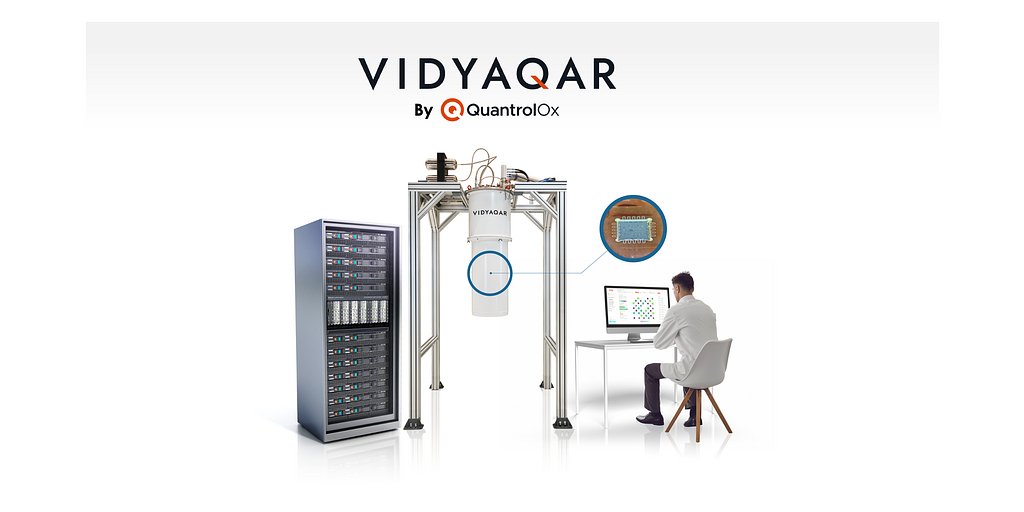
QuantrolOx's Open Platform Aims to Reshape Quantum Innovation
ESPOO, Finland & BENGALURU, India – December 10, 2025
In a move poised to ripple across the global technology landscape, quantum automation firm QuantrolOx has unveiled VIDYAQAR, a platform it bills as the world’s first “True Open-Architecture” quantum computer. Launched in India with a planned global rollout in 2026, the system is not aimed at breaking qubit count records but at something potentially more transformative: democratizing access to the fundamental building blocks of quantum hardware. By offering an integrated, fully customizable system, the company is making a strategic bid to become a foundational tool for education, research, and the development of sovereign quantum capabilities worldwide.
The name VIDYAQAR, derived from the Sanskrit for “giving knowledge,” signals a mission to lower the steep barriers to entry that have kept hands-on quantum hardware research confined to a handful of elite corporate and government labs. For industries like healthcare and materials science, where quantum computing promises to solve intractable problems in drug discovery and molecular simulation, such a shift could significantly accelerate the pace of innovation.
Deconstructing the 'True Open-Architecture' Claim
In the rapidly evolving quantum sector, the term “open” is often used but rarely means the same thing twice. Most major players, including IBM and Google, provide access to their powerful quantum processors through the cloud and offer open-source software libraries like Qiskit and Cirq. This has been instrumental in building a global community of quantum software developers. However, the underlying hardware—the intricate stack of cryogenics, control electronics, and the quantum processing unit (QPU) itself—remains a tightly controlled black box.
QuantrolOx aims to break open that box. VIDYAQAR is being presented as a complete, integrated superconducting quantum system where users can customize and experiment with every layer. This goes a step beyond the “pulse-level access” offered by competitors like Rigetti, which grants developers granular control over the signals used to manipulate qubits but doesn't typically extend to swapping out core hardware components. VIDYAQAR, in contrast, is designed as a modular testbed where a university research group or a national lab could, for example, integrate their own experimental QPU or test new cryogenic techniques within a professionally engineered and calibrated system.
This approach mirrors the spirit of government-funded open testbeds, such as Sandia National Laboratories' QSCOUT, which are designed to give researchers deep access to the system's internals. The key difference is that QuantrolOx is commercializing this concept, offering a turnkey, scalable product for any institution looking to jumpstart a serious hardware research program. By integrating its proven Quantum EDGE software, which automates the complex and time-consuming process of qubit calibration, the company is also addressing a major operational bottleneck. The platform's ability to characterize and tune a 2-qubit gate in under 25 minutes—a task that can take PhD experts days of manual work—transforms the R&D cycle from a handful of experiments per year to potentially thousands.
A Cornerstone for National Quantum Ambitions
The strategic implications of VIDYAQAR extend far beyond individual laboratories. The decision to unveil the platform in India is a clear signal of its positioning as a tool for national empowerment. India’s National Quantum Mission, like similar multi-billion-dollar initiatives in the US, EU, and UK, is focused on building indigenous capabilities to secure a competitive edge in this critical future technology. A lack of accessible, domestic hardware has been a significant hurdle for many nations.
An open, customizable platform directly addresses this strategic gap. It allows countries to foster a sovereign quantum ecosystem by enabling local universities, startups, and government labs to collaborate on developing and validating their own hardware and software solutions. Rather than being dependent on the roadmaps of a few foreign tech giants, a nation can use a system like VIDYAQAR to build a skilled quantum workforce, establish domestic supply chains for quantum components, and contribute to the development of international standards and interoperability frameworks.
This model provides a pathway for nations to move from being consumers of quantum technology to active producers and innovators. By facilitating rapid prototyping and benchmarking, the platform could become a central hub for a national network of quantum systems, accelerating the journey toward fault-tolerant quantum computers and practical applications. The market shift is subtle but significant: it’s a move away from simply providing quantum-computing-as-a-service and toward providing quantum-computing-as-an-infrastructure.
From Software Specialist to Ecosystem Architect
The launch of VIDYAQAR marks a pivotal evolution in QuantrolOx’s business strategy. The company built its reputation on Quantum EDGE, its sophisticated automation software that supercharges the efficiency of quantum R&D labs. By simplifying measurement and control, Quantum EDGE solved a critical pain point for hardware developers. Now, by wrapping that software around a complete hardware stack, the firm is transitioning from a specialized tool provider to an end-to-end ecosystem architect.
This vertical integration carries significant competitive advantages. By controlling the entire stack, from the cryostat to the Python SDK, QuantrolOx can ensure seamless integration and deliver a system that works out of the box—a crucial feature for organizations entering the quantum domain for the first time. The inclusion of the “Quantum EDGE Academy” training program further reinforces this strategy, aiming to create a pipeline of talent proficient in using their specific hardware and software environment.
This strategic pivot places the company in a different competitive arena, challenging not only other control system providers like Zurich Instruments and Q-CTRL but also full-stack system builders. The bet is that a substantial market exists in the middle ground: research institutions and R&D departments that need more than cloud access but lack the resources or desire to build an entire quantum computer from scratch. By providing the scaffolding, QuantrolOx empowers these groups to focus their efforts on novel research rather than on reinventing the fundamental infrastructure.
Fueling the Next Wave of Scientific Discovery
Ultimately, the value of democratizing quantum hardware will be measured by the discoveries it enables. For fields like medicine and materials science, the potential is immense. The design of new drugs and industrial catalysts often involves simulating complex molecular interactions, a task that is computationally prohibitive for even the most powerful classical supercomputers. Quantum computers promise to tackle these problems natively, but progress requires deep co-development of hardware and algorithms.
By giving more researchers hands-on access to a flexible quantum testbed, platforms like VIDYAQAR could dramatically accelerate this process. A biochemist could collaborate with a quantum physicist to test a new error-correction code tailored for a specific molecular simulation. A materials scientist could experiment with novel qubit layouts designed to model the properties of a new superconductor. This tight feedback loop between application, algorithm, and hardware is essential for unlocking the true potential of quantum computing.
As these systems become more accessible globally, they act as force multipliers for innovation. The platform itself is not the final answer, but rather a critical instrument that empowers a much broader community of scientists and engineers to begin asking—and answering—questions that were previously out of reach. In doing so, it may help lay the groundwork for the next generation of breakthroughs in healthcare and beyond.