
- Payload Capacity: Up to 150 kg
- Deployment Time: Stable operation in as little as 1 hour
- Market Growth: Autonomous Mobile Robot (AMR) market grew by 27% in 2023 to $4.5 billion globally
Experts view the PUDU T150 as a strategic move to democratize industrial automation by addressing key SME pain points such as cost, complexity, and deployment time.
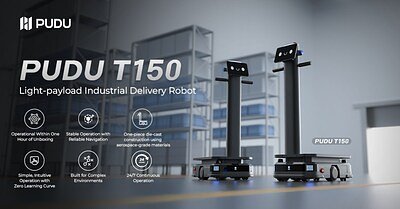
Pudu Robotics Targets SMEs with New T150 Automation Robot
SHENZHEN, China – January 09, 2026 – Pudu Robotics, a global leader in commercial service robots, has officially entered the light-payload industrial automation market with the launch of its PUDU T150 delivery robot. The new model, designed to carry payloads up to 150 kg, aims to break down the cost and complexity barriers that have historically kept advanced automation out of reach for many small and mid-sized enterprises (SMEs).
Announced today, the PUDU T150 is positioned as a highly efficient, rapidly deployable solution for internal material handling in factories and warehouses. This launch signals a strategic expansion for the Shenzhen-based firm, leveraging its success in service robotics to tackle a persistent gap in the industrial sector. The robot will initially be available in Greater China and key high-growth Asian markets, including Vietnam, Thailand, and South Korea.
Lowering the Barrier to Industrial Automation
For years, industrial automation has been synonymous with high capital expenditure, complex integration projects, and the need for specialized in-house expertise. These factors have created a significant hurdle for SMEs, which often lack the financial resources and technical staff to implement traditional automated guided vehicles (AGVs). Research indicates that high initial investment and implementation complexity are the primary deterrents for smaller manufacturers seeking to modernize their operations.
The PUDU T150 is engineered specifically to address these pain points. The company emphasizes a "straight out of the box" user experience, claiming the robot requires no environmental modifications like magnetic strips or guide rails. Its mapping process can allegedly be completed in just 10 minutes, with the robot achieving stable, productive operation in as little as one hour. This focus on rapid, non-disruptive deployment is a direct response to SME concerns about production downtime and lengthy integration timelines.
"The core challenge for many businesses isn't a lack of desire to automate, but a lack of accessible tools," noted an industry analyst specializing in logistics technology. "Solutions that minimize upfront costs, eliminate the need for infrastructure overhaul, and can be operated by existing frontline staff without extensive training are what will truly democratize this technology." The PUDU T150's intuitive, tablet-like interface and support for multi-robot collaboration without a local server infrastructure appear to be a deliberate effort to meet this very demand.
Engineered for Agility and Industrial Rigor
While designed for accessibility, the PUDU T150 does not compromise on industrial-grade performance and safety. The robot's navigation system integrates VSLAM (Visual Simultaneous Localization and Mapping) with dual LiDAR sensors, providing a full 360-degree perception of its environment. Powered by Pudu's proprietary algorithms, this system enables the robot to navigate reliably in dynamic and complex spaces, adapting to moving obstacles and layout changes common in active warehouses and factory floors.
Durability is another key design pillar. The T150 features a one-piece integrated chassis built from aerospace-grade, high-strength materials. This construction is intended to resist impact and deformation, ensuring stability during high-frequency, long-duration operations. Pudu Robotics projects a service life of up to five years for the robot, a critical factor for businesses calculating long-term return on investment (ROI).
Safety, a paramount concern in any environment where humans and robots coexist, is addressed through compliance with the ISO 3691-4 industrial safety standard. To support the relentless pace of modern logistics, the robot offers flexible power options, including automatic recharging and fast battery swapping, to enable near-continuous 24/7 operation.
A Strategic Move in a Competitive Market
The launch of the PUDU T150 is a calculated move in the rapidly expanding Autonomous Mobile Robot (AMR) market, which grew by 27% in 2023 to reach $4.5 billion globally. By adding a 150 kg payload option, Pudu Robotics extends its industrial T-series portfolio, which already includes the heavier-duty T300 and T600 models. This positions the company to offer a tiered range of solutions catering to diverse material transport needs, from small components in 3C electronics manufacturing to larger goods in general logistics.
Pudu Robotics is no stranger to scaling. The company has established itself as the top global player in the commercial service robot sector, capturing 23% of the market share by revenue, according to a 2023 Frost & Sullivan report. With over 100,000 units shipped to more than 80 countries, it has demonstrated a capacity for mass production and global distribution, primarily through its popular food service and cleaning robots. This new industrial robot represents an effort to translate that commercial success into the more demanding, but lucrative, industrial space.
However, the company is not without its challenges. Despite raising over $192 million in funding, including recent Series C rounds in 2023, reports from last year suggested the high-growth firm was facing profitability pressures. This push into the industrial AMR market, where it faces established competitors like MiR, Omron, and Geek+, can be seen as a crucial step in its long-term strategy. The PUDU T150's success will depend on its ability to deliver on its promises of simplicity and cost-effectiveness, thereby carving out a significant niche among the world's underserved small and mid-sized industrial operators.