
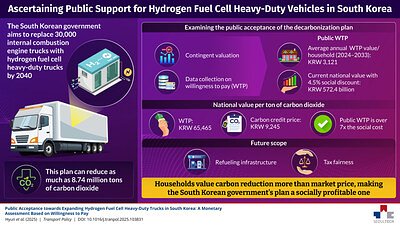
- KRW 572.4 billion (USD 418.4 million): Total present value of public willingness to pay for hydrogen truck adoption in South Korea.
- KRW 65,465 (USD 47.85) per ton of CO2: Public willingness to pay for carbon reduction, nearly seven times the market carbon credit price.
- 30,000 hydrogen fuel cell trucks by 2040: South Korea's target for decarbonizing its freight sector.
Experts conclude that strong public financial support and perceived societal benefits make hydrogen trucks a viable and economically sound investment for South Korea's decarbonization goals, despite high upfront costs.
Public Backing Makes Hydrogen Trucks a Smart Bet for South Korea
SEOUL, South Korea – January 20, 2026 – A groundbreaking study from the Seoul National University of Science and Technology (SEOULTECH) has revealed strong public financial support for transitioning the nation's heavy-duty freight sector to hydrogen fuel cell technology. Researchers found that South Korean households are willing to pay a premium for the environmental benefits, creating a compelling economic case that positions the expensive green transition as a socially profitable investment for the nation.
Published in the peer-reviewed journal Transport Policy, the research provides the first quantitative assessment of public acceptance for hydrogen fuel cell heavy-duty trucks, a critical component of South Korea's strategy to decarbonize its economy. The findings offer a powerful mandate for policymakers grappling with the high upfront costs associated with overhauling national logistics infrastructure.
The Social Profit of Green Logistics
The study's central finding is that the public values the reduction in carbon emissions far more than its current market price. Through a contingent valuation survey involving one-on-one interviews with 1,000 households, researchers determined the average annual willingness to pay per household is KRW 3,121 (approximately USD 2.28) for the next decade to support the government's plan.
When aggregated across the nation, this amounts to a total present value of KRW 572.4 billion (USD 418.4 million). More strikingly, this translates to a willingness to pay KRW 65,465 (USD 47.85) for every ton of carbon dioxide (CO2) reduced. This figure dramatically eclipses the prevailing carbon credit price on the Korea Exchange, which hovers around KRW 9,245 (USD 6.76) per ton. This significant gap indicates that from a public welfare perspective, the societal benefits of cleaner air and climate change mitigation are perceived as being worth nearly seven times the market-based cost of carbon.
This robust public backing reframes the debate around the high costs of hydrogen trucks—which can be more than double the price of conventional diesel models—and the necessary refueling infrastructure. The research suggests that when accounting for this 'social profit,' the investment is not just environmentally necessary but also economically sound from a societal standpoint.
"This is the first study to quantitatively assess public acceptance of expanding hydrogen fuel cell heavy-duty trucks, not passenger cars or buses," noted Professor Yoo, the study's lead author, highlighting the unique focus on the freight sector, which is responsible for a disproportionate share of transport emissions.
A Nation's Hydrogen Ambition
The SEOULTECH study arrives at a pivotal moment for South Korea, which has laid out one of the world's most ambitious hydrogen strategies. As part of its goal to achieve carbon neutrality by 2050, the government's Hydrogen Economy Roadmap includes a plan to deploy 30,000 hydrogen fuel cell trucks by 2040. This transition is projected to slash approximately 8.74 million tons of CO2 emissions from the mobility sector.
Heavy-duty vehicles are a primary target for decarbonization policies globally due to their high mileage and diesel fuel consumption. While passenger electric vehicles have gained significant traction, finding a viable zero-emission solution for long-haul freight has been more challenging. Hydrogen fuel cells are seen as a leading contender because they offer the long range and rapid refueling times that logistics operations depend on, overcoming some of the limitations of current battery-electric technology for heavy-duty applications.
The government has been actively fostering this transition through its 'Hydrogen Law' and '3-Up Strategy,' which provide legal frameworks, subsidies for vehicle purchases, and support for building out a national network of refueling stations, with a target of 1,200 stations by 2040.
Overcoming Roadblocks on the Hydrogen Highway
Despite the strong public support and clear government targets, the path to a hydrogen-powered logistics network is not without obstacles. The SEOULTECH research goes beyond valuation to identify practical, on-the-ground barriers that could slow adoption.
A key issue is the current state of refueling infrastructure. The study points out that many existing large-scale hydrogen refueling stations are situated within public bus depots, making them difficult for commercial freight trucks to access. This logistical mismatch creates a significant bottleneck for trucking companies looking to adopt the new technology.
To remedy this, the researchers recommend a strategic expansion and relocation of refueling stations along major logistics corridors and highways where freight traffic is concentrated. Progress is already being made, with South Korea recently opening its largest commercial hydrogen refueling station in Ulsan, a facility capable of servicing both trucks and buses. However, a broader network is essential for widespread adoption.
Furthermore, the study highlights inconsistencies in financial incentives. While hydrogen-powered buses benefit from substantial acquisition tax reductions, similar incentives for heavy-duty trucks are less generous. The researchers urge policymakers to align these tax breaks to encourage logistics companies, which operate on thin margins, to make the switch.
Citizen Power and the Path Forward
The study ultimately underscores the powerful role of public sentiment in driving large-scale environmental policy. The demonstrated willingness of citizens to contribute financially provides political capital for the government to push forward with ambitious, and costly, green initiatives.
Interestingly, the research revealed a geographical divide in this support, with residents in the densely populated Seoul Metropolitan Area showing a higher willingness to pay than those in non-metropolitan regions. This suggests a need for targeted public awareness and education campaigns to build a unified national consensus.
"In the long run, our research contributes to accelerating the decarbonization of the logistics sector," Professor Yoo concluded. "For the public, this means significantly cleaner air and delayed climate change impacts... our finding that the residents in the Seoul Metropolitan Area have a higher willingness to pay suggests that in the next 5–10 years, targeted education and promotion in non-metropolitan areas will be crucial to achieving balanced national support for carbon neutrality."
As South Korea forges ahead, this research provides a clear signal: the public is not just a passive observer but an active and willing stakeholder in building a sustainable, hydrogen-powered future for its economy.