
- 600% increase in American content in Proterra's battery packs
- $210 million acquisition of Proterra Powered by Volvo Group
- 2027 scheduled shipment start for U.S.-cell Onyx batteries
Experts would likely conclude that Proterra's strategic shift toward U.S.-manufactured battery cells is a critical move to meet regulatory requirements, reduce supply chain risks, and strengthen its position in the heavy-duty EV market.
Proterra's 'Made in America' Plan for Heavy-Duty EV Batteries
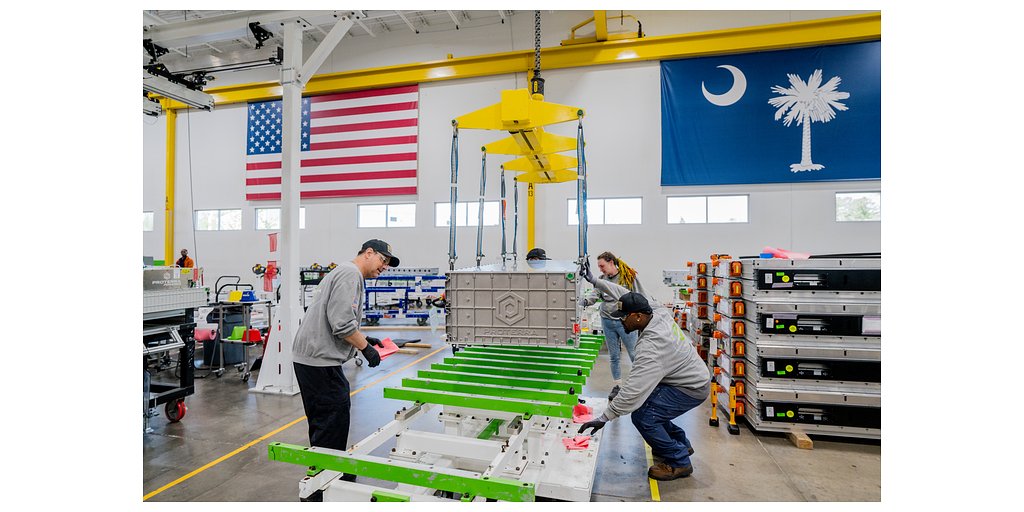
GREER, SC – May 04, 2026 – In a significant move to onshore critical components for the electric vehicle industry, battery specialist Proterra has announced its flagship Onyx battery platform will be available with a U.S.-manufactured cell option. The company is now taking orders for the new configuration, with shipments slated to begin in the first quarter of 2027.
The announcement signals a strategic pivot toward domestic supply chains, addressing escalating demands from heavy-duty vehicle manufacturers for greater supply certainty and compliance with stringent U.S. content regulations. Proterra projects the initiative will increase the American content in its battery packs by over 600%, a move designed to de-risk electrification for its partners in commercial transport and industrial equipment.
“The market is asking for greater supply chain certainty and stronger domestic content. We’re answering,” said Chris Bailey, CEO of Proterra. “This investment ensures we can deliver both while continuing to lead in performance and safety.”
Navigating the 'Buy America' Landscape
Proterra's strategy is a direct response to a shifting federal policy environment heavily favoring domestic manufacturing. The cornerstone of this landscape is the Build America, Buy America (BABA) Act, part of the 2021 Infrastructure Investment and Jobs Act (IIJA). BABA mandates that for federally funded infrastructure projects, manufactured products must contain at least 55% U.S.-sourced components by cost—a threshold that will rise to 75% by 2029.
By aggressively increasing its domestic content, Proterra is positioning its OEM customers to more easily qualify for lucrative federal grants and incentives aimed at electrifying public transit and commercial fleets. Access to funding under the IIJA and tax credits from the Inflation Reduction Act (IRA) is often contingent on meeting these domestic sourcing requirements. This move transforms regulatory hurdles into a competitive advantage, offering OEMs a clearer path to compliance and funding. The U.S. cell option, combined with broader onshoring of other pack and module components, provides a robust solution for partners navigating this complex regulatory framework.
A New Chapter After Financial Restructuring
The ambitious announcement gains significant credibility when viewed through the lens of Proterra's recent corporate transformation. In August 2023, the company filed for Chapter 11 bankruptcy, citing macroeconomic pressures and challenges in scaling its diverse business lines, which included electric buses and charging infrastructure alongside its battery division.
However, the core battery business, known as Proterra Powered, was widely seen as the company's most valuable asset. In November 2023, it was acquired by the Volvo Group for $210 million. This acquisition provided the battery division—which continues to operate under the Proterra brand from its facilities in Greer, South Carolina, and Burlingame, California—with a deleveraged balance sheet and the formidable financial backing of a global industrial giant. The sale separated the capital-intensive battery development from the bus manufacturing operations, allowing the new Proterra to focus exclusively on its core competency. This renewed financial stability is critical for executing a long-term, capital-intensive strategy like localizing the battery cell supply chain.
De-Risking the Electric Transition for OEMs
Beyond regulatory compliance, Proterra’s move is fundamentally about providing stability for its customers. In recent years, global supply chain disruptions, geopolitical tensions, and volatile shipping costs have created significant uncertainty for manufacturers of all types. For heavy-duty OEMs making multi-billion-dollar investments to transition their product lines to electric, this volatility represents a major business risk.
By establishing a U.S.-anchored supply chain for the most critical component of an EV—the battery cell—Proterra aims to offer a buffer against such disruptions. A localized supply chain promises greater cost stability, reduced lead times, and improved supply continuity. This allows OEMs to plan production schedules and manage costs with greater confidence, accelerating the adoption of zero-emission commercial vehicles. The Onyx platform, already known for its high energy density and safety architecture, will now add supply chain resilience to its list of key features, making it a more attractive proposition for risk-averse fleet operators and vehicle manufacturers.
Tapping into a Burgeoning U.S. Battery Ecosystem
Proterra is not building its domestic supply chain in a vacuum. The company is strategically tapping into a rapidly expanding U.S. battery cell manufacturing ecosystem. Spurred by federal incentives and massive private investment, numerous battery gigafactories are under construction across the country. Major players like LG Energy Solution—with whom Proterra has a long-standing supply relationship—Panasonic, and SK On are investing tens of billions of dollars to build out domestic capacity.
By 2027, when Proterra's U.S.-cell Onyx batteries are scheduled to ship, this domestic industrial base will be significantly more mature. Proterra's decision to source cells stateside rather than build its own cell manufacturing plants—a path it had previously explored—leverages this broader industrial movement. This allows the company to focus on its expertise in battery pack engineering, thermal management, and systems integration while benefiting from the scale and specialization of dedicated cell manufacturers. This symbiotic relationship strengthens the entire domestic EV supply chain, from raw material processing to final vehicle assembly. The investment in a U.S. cell option represents a key milestone in building a self-sufficient and globally competitive American battery industry for the heavy-duty sector.