
- 2 MW/8 MWh: The size of the utility-scale battery energy storage system (BESS) installed in Matsusaka, Japan.
- 50 Hz/60 Hz split: Japan's grid operates at two different frequencies, creating regional electrical islands vulnerable to disturbances.
- Millisecond-level power response: The system's ability to stabilize the grid almost instantaneously.
Experts view this project as a critical testbed for integrating renewable energy into Japan's demanding grid, demonstrating that advanced battery storage can stabilize power quality and support decarbonization goals.
Powering Japan's Future: A New Battery Boosts a Demanding Grid
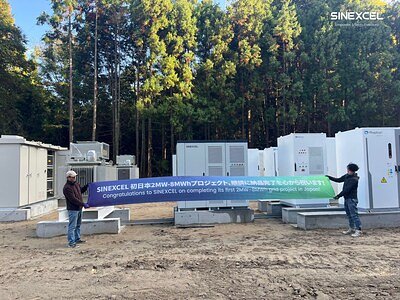
MATSUSAKA, Japan – December 11, 2025 – In the heart of one of Japan's key manufacturing clusters, a quiet but significant milestone in the nation's energy transition has been reached. Chinese power electronics firm SINEXCEL has completed the installation of a 2-megawatt/8-megawatt-hour utility-scale battery energy storage system (BESS). While the project's scale is notable, its true significance lies in its location and purpose: to stabilize the power grid in a region where even a momentary flicker can have significant economic consequences.
This installation is more than just another piece of green infrastructure; it's a testament to a five-year strategic effort to crack one of the world's most technically demanding energy markets. For Japan, a nation walking the tightrope between industrial prowess and ambitious decarbonization goals, projects like the one in Matsusaka are becoming critical testbeds for the future of its power grid.
Japan's High-Stakes Energy Puzzle
To understand the importance of the Matsusaka project, one must first appreciate the unique challenges facing Japan's energy landscape. The country is targeting carbon neutrality by 2050, a goal that requires a massive influx of intermittent renewable sources like solar and wind. However, Japan's grid was built for the predictable, centralized power of the 20th century. It is an industrial powerhouse with an exacting demand for pristine power quality and unwavering reliability.
Compounding the challenge is the grid's very structure. A historical legacy split the country's power system into two grids operating at different frequencies—50 Hz in the east and 60 Hz in the west—with limited capacity to transfer power between them. This makes each region more of an electrical island, highly susceptible to local disturbances. The integration of fluctuating renewable energy sources into this sensitive environment risks creating instability, voltage drops, and frequency deviations that can disrupt or damage the sophisticated equipment used in advanced manufacturing.
Furthermore, Japan's stringent grid codes, which include some of the world's toughest requirements for seismic resilience and safety, create a high barrier to entry for any new technology. Any energy storage solution deployed here must not only store and discharge power but also act as a sophisticated, real-time grid stabilizer. It is within this complex, high-stakes environment that SINEXCEL's technology has found its foothold.
The Digital Shock Absorber
The core of the Matsusaka project is SINEXCEL's 1375 kW Power Conversion System (PCS), the sophisticated brain that manages the flow of energy into and out of the battery. The system is engineered specifically to address the challenges of a grid like Japan's. Its most critical feature is a millisecond-level power response, allowing it to act as a digital shock absorber for the grid. When a large factory suddenly powers up a production line or a cloud bank temporarily shades a solar farm, the PCS can inject or absorb power almost instantaneously to smooth out the fluctuation before it can destabilize the local network.
Beyond this rapid response, the system provides proactive power quality management. It can precisely regulate voltage and provide reactive power compensation—akin to maintaining the ideal electrical 'pressure' in the grid's pipes. This function is crucial for industrial hubs like Matsusaka, ensuring that the power supplied to sensitive machinery remains clean and stable, thereby preventing costly disruptions and equipment damage.
This deployment validates the technology's robustness. The PCS has already secured certifications for demanding markets in North America and Europe, demonstrating its ability to meet diverse and rigorous international standards. By successfully integrating this system in Japan, the company has proven its technology can perform under the most exacting conditions, offering a solution that provides both peak shaving to lower energy costs and the critical frequency regulation needed to support a modern, renewable-heavy grid.
A Calculated Five-Year Conquest
SINEXCEL's arrival at the utility-scale level in Japan was not an overnight success. It represents the culmination of a patient, five-year strategy focused on localization and building trust. The company began its journey in the Japanese market with smaller, distributed projects, deploying 30 kW and 500 kW systems across the country. Over the course of more than 50 projects, the firm steadily built a reputation for reliability and an intimate understanding of Japan's unique regulatory and technical landscape.
This deliberate, ground-up approach allowed the company to demonstrate its capabilities and adapt its offerings, progressing from smaller commercial solutions to this milestone megawatt-level deployment. Succeeding in Japan's energy sector requires more than just advanced technology; it demands a deep commitment to local standards, a proven track record, and the ability to navigate complex grid connection protocols. This strategic patience has now paid off, positioning the firm as a credible player in a market that is notoriously difficult for foreign companies to penetrate.
The Matsusaka installation serves as a powerful case study in market entry, demonstrating that technological excellence paired with a long-term, localized strategy can overcome significant barriers. It signals a maturation of the company's delivery capabilities, particularly in the high-voltage sector, and sets the stage for further expansion.
From Matsusaka to the Global Grid
While the Matsusaka project is a regional victory, it reflects a much broader global trend. All over the world, from a massive 1200 MWh electrochemical energy station in China to a pioneering wind power storage system in Costa Rica, advanced battery systems are being deployed to modernize aging infrastructure and unlock the full potential of renewable energy. These projects, often powered by similar PCS technology, are the foundational building blocks of a more resilient, decentralized, and decarbonized global energy system.
By partnering with industry leaders like Schneider Electric and EVE Energy, companies like SINEXCEL are part of a growing ecosystem dedicated to solving the energy trilemma: the challenge of providing energy that is simultaneously secure, affordable, and sustainable. The lessons learned in Matsusaka—about integrating advanced storage into a dense industrial network with stringent rules—will undoubtedly inform future projects in other developed economies facing similar transitions.
As Japan continues its push toward a zero-carbon future, the quiet hum of the battery system in Matsusaka represents more than just stored energy. It represents a successful convergence of innovation, strategy, and real-world application, offering a tangible glimpse of how today's most pressing energy challenges are being solved, one megawatt at a time.