
- 11 gigawatts: Project Matador's full vision for a private grid to power AI infrastructure.
- 165% surge: Global data center power demand projected to increase by 2030 compared to 2023 levels (Goldman Sachs Research).
- 40% of AI data centers: Expected to face operational limits due to power availability by 2027 (Gartner).
Experts agree that the rapid growth of AI is driving an unprecedented demand for specialized energy infrastructure, necessitating private power solutions like Project Matador to ensure reliable, large-scale electricity supply.
Powering AI: Fermi's Texas Megaproject Signals New Energy Era
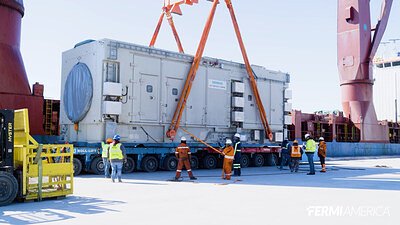
AMARILLO, TX – February 09, 2026 – The arrival of six massive gas turbines at the Port of Houston marks a critical milestone not just for a single company, but for the future of American technology. The equipment, bound for Fermi America's "Project Matador" in the Texas Panhandle, represents a tangible step in a high-stakes race to build an entirely new class of energy infrastructure dedicated to powering the voracious appetite of artificial intelligence.
The six Siemens Energy SGT-800 turbines, which required a 160-ton crane and will necessitate over 400 specialized semi-truck loads for their journey to Amarillo, are the first major power-generating components for a private energy campus of unprecedented scale. Once operational, they will provide approximately one-third of the first gigawatt of power for Project Matador. This is merely the opening act for an 11-gigawatt private grid designed to solve a problem vexing the world’s largest tech companies: the public electricity grid cannot keep up with AI.
The AI Gold Rush's Unseen Cost: Power
The explosion of artificial intelligence has created a parallel, unseen explosion in energy demand. While the world marvels at the capabilities of new AI models, data centers are quietly straining the limits of the electrical grid. Industry analysts paint a stark picture: Goldman Sachs Research projects that global data center power demand could surge by 165% by the end of the decade compared to 2023 levels.
This demand is not just about more electricity; it's about a different kind of electricity. AI workloads require immense, stable, and reliable power, often concentrated in single locations. An AI-ready data center campus can require between 100 and 300 megawatts (MW), with some hyperscale projects approaching the 1-gigawatt mark—roughly the output of a large nuclear reactor and enough to power nearly 800,000 homes.
According to Gartner, by 2027, a staggering 40% of existing AI data centers will face operational limits due to power availability. The traditional model of plugging into the local utility is proving too slow and inflexible, with grid interconnection becoming a primary bottleneck for new AI infrastructure development. This has forced hyperscalers and a new breed of energy entrepreneurs to pursue a radical solution: building their own power plants.
A Private Grid Takes Shape in the Texas Panhandle
Project Matador is the embodiment of this new paradigm. Located in Amarillo and developed in partnership with the Texas Tech University System, the campus is a direct response to the market's urgent call for power. Fermi America, co-founded by former U.S. Energy Secretary Rick Perry and energy veteran Toby Neugebauer, is not simply building a power plant; it is building a private, diversified energy ecosystem.
The full 11 GW vision for Project Matador integrates multiple power sources: the initial natural gas turbines, a future new nuclear power complex, large-scale solar arrays, and battery energy storage. This "behind-the-meter" approach is designed to deliver massive-scale, always-on power directly to AI clients, bypassing many of the constraints of the public grid.
The logistical challenge of the project underscores its ambition. The turbines and their accompanying generators arrived on seven vessels from four different countries. Moving them from the Port of Houston to the Amarillo site is a monumental undertaking in itself.
"We are moving at this pace because hyperscalers—and American consumers—demand reliable, world-class power yesterday," said Toby Neugebauer, Fermi America Co-Founder and CEO, in a statement. He framed the project not just as a business venture but as a "mission-critical commitment to our country's energy independence and national security, without our fellow Texans having to foot the bill."
Balancing Progress and the Planet
The decision to lead with natural gas highlights a central tension in the race to power AI: speed versus sustainability. While the long-term vision for Project Matador includes nuclear and renewables, the immediate need for reliable baseload power has pushed natural gas to the forefront.
To mitigate environmental concerns, Fermi America selected the Siemens SGT-800 turbines, known for their high efficiency and advanced emissions control. The units feature a Dry Low Emission (DLE) combustion system that significantly reduces nitrogen oxide (NOx) and carbon monoxide (CO) emissions to levels that comply with stringent regulations. Furthermore, the turbines are capable of burning a blend of up to 75% hydrogen, offering a potential future pathway to decarbonization.
The project is also addressing another critical resource in West Texas: water. Fermi America has entered into a water-saving hybrid cooling agreement, a move designed to protect local water resources in the arid Panhandle region. This proactive measure suggests a keen awareness of the need to secure a social license to operate alongside its physical infrastructure. The long-term plan to integrate solar and nuclear power is key to the project's claim of creating a next-generation grid, aiming to eventually shift the balance of its power portfolio toward lower-carbon sources.
Texas: The New Frontier for Private Power
Project Matador is not happening in a vacuum. Texas, with its vast land, abundant energy resources, and favorable regulatory environment, has become a global hub for these ambitious private power projects. Other major players, from energy giants like Chevron to specialized firms like Crusoe Energy Systems, are also developing dedicated power infrastructure to serve the data center boom.
This trend is fundamentally redrawing the map of American energy. For decades, large industrial users relied on a centralized public grid. Now, the largest energy consumers of the 21st century are becoming their own utilities. This shift raises new questions for grid operators like the Electric Reliability Council of Texas (ERCOT) about how these massive private islands of power will interact with the broader system.
By positioning itself as a provider of a complete, gigawatt-scale private grid, Fermi America is making a bet that the future of AI depends on a parallel energy infrastructure. The arrival of its first turbines in Houston is more than just a delivery of heavy equipment; it is a declaration that the energy landscape is being reshaped, one megawatt at a time, to meet the demands of a new technological revolution.
Topics & Related
Artificial Intelligence
Machine Learning
Decarbonization
Geopolitics & Trade
ESG
Revenue
Renewable Energy
Nuclear
AI & Machine Learning
Cloud & Infrastructure
Solar Panels
AI & Software Platforms
Corporate Finance
Related Company Pulse