
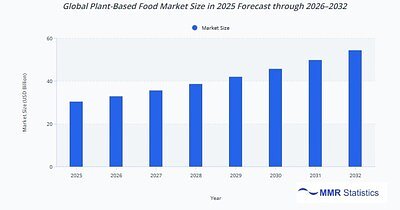
- Market Projection: The global plant-based food market is expected to grow from $30.41 billion in 2025 to $54.41 billion by 2032, with a CAGR of 8.67%.
- Consumer Adoption: 59% of U.S. households now purchase plant-based foods, with high repeat-purchase rates.
- Regional Growth: The Asia-Pacific region is poised to become the primary engine of market expansion.
Experts agree that the plant-based food market is undergoing a fundamental transformation driven by health consciousness, sustainability, and technological innovation, with long-term growth expected despite challenges like pricing and consumer preferences for clean labels.
Plant-Based Food Market to Top $54B, Fueling a Global Green Gold Rush
PUNE, India – February 02, 2026 – The global appetite for plant-based food is set to explode, with the market projected to surge from USD 30.41 billion in 2025 to over USD 54.41 billion by 2032. This forecast, detailed in a new report by MMR Statistics, signals a compound annual growth rate (CAGR) of 8.67% and underscores a profound, accelerating shift in consumer behavior and food industry investment that is moving plant-based products from niche shelves to the center of the global plate.
This rapid expansion is not a fleeting trend but a fundamental reshaping of the food landscape, propelled by a convergence of health consciousness, sustainability concerns, and relentless technological innovation. As consumers increasingly seek alternatives to traditional animal products, a new generation of companies is racing to meet the demand, transforming everything from the dairy aisle to the fast-food counter.
The Green Gold Rush: Investment and Strategy
The staggering market projections have ignited a "green gold rush," with major corporations and venture capitalists pouring billions into the sector to secure a stake in the future of food. While MMR Statistics' forecast is a significant benchmark, it aligns with a broader consensus among market analysts. Reports from firms like Fortune Business Insights and Precedence Research offer even more bullish outlooks, with some projecting the market could exceed $100 billion within the next decade.
This confidence is fueling aggressive strategic moves by industry titans. Nestlé, for instance, is investing 100 million CHF to construct a dedicated plant-based food facility in China and has been rapidly expanding its Garden Gourmet and Sweet Earth brand offerings, including vegan egg and shrimp alternatives. Similarly, Danone's acquisition of Kate Farms strengthens its formidable portfolio in plant-based and specialized nutrition, which already includes powerhouse brands like Alpro and Silk.
The competitive landscape is intensifying as legacy food giants like Kellogg's (MorningStar Farms) and Tyson Foods (Raised & Rooted) compete with disruptive pioneers such as Beyond Meat and Impossible Foods. These companies are employing a multi-pronged strategy: securing partnerships with major foodservice chains like Starbucks to drive mainstream adoption, diversifying product lines beyond burgers into categories like protein beverages, and investing heavily in research and development to maintain a competitive edge.
Innovation on the Plate: Beyond Imitation
At the heart of the market’s expansion is a wave of culinary and scientific innovation that is systematically dismantling the most significant barriers to adoption: taste, texture, and variety. The first generation of plant-based products often focused on simple imitation, but today's innovators are aiming for superiority, creating products that stand on their own merit.
The focus has shifted from merely mimicking meat to leveraging food science to create entirely new food experiences. Technologies like precision fermentation are being used to produce dairy proteins without cows, while AI-driven companies like NotCo are using algorithms to develop novel plant-based formulations for milk, ice cream, and mayonnaise. This technological push is expanding the ingredient toolkit to include everything from mycelium (the root structure of mushrooms) and algae to a wider variety of pea, chickpea, and fava bean proteins.
This innovation is also driving category expansion. The market is moving far beyond burgers and soy milk. Companies like Good Catch and OmniFoods are tackling the complexities of plant-based seafood, while Eat JUST has made significant inroads in the egg substitute market. Simultaneously, there is a growing emphasis on functional and fortified foods—plant-based products enhanced with vitamins, minerals, and probiotics to meet the demands of health-conscious consumers.
A Global Dietary Transformation
The plant-based phenomenon is a global one, though its drivers and expressions vary by region. North America currently dominates the market, holding a nearly 37% share, fueled by strong retail penetration and a growing population of "flexitarians"—consumers who are reducing their meat consumption rather than eliminating it entirely. In the United States, an estimated 59% of households now purchase plant-based foods, with a high repeat-purchase rate indicating growing loyalty.
Europe follows closely, driven by powerful consumer demand for sustainability and stricter environmental regulations. Carbon-conscious shoppers in countries like Germany, the UK, and France are increasingly choosing vegan and plant-based alternatives, pressuring retailers and food manufacturers to expand their offerings.
However, the most dynamic growth is occurring in the Asia-Pacific region, which is poised to become the market's primary engine. This expansion is powered by a confluence of factors: rapid urbanization, a rising middle class with more disposable income, and a cultural familiarity with soy-based foods like tofu and tempeh. Governments in countries like China are also signaling support for alternative proteins as a matter of national food security, creating a fertile environment for both domestic startups and international brands to thrive.
The Evolving Consumer: Balancing Priorities
Ultimately, the long-term success of the plant-based market hinges on the consumer. While motivations are diverse, health remains the primary driver. According to market analysts, nutritional benefits are over five times more important to consumers than environmental concerns when choosing plant-based foods. This puts pressure on brands to deliver not only on taste but also on nutritional value.
Despite significant progress, challenges remain. Price continues to be a major barrier, with over 40% of global consumers finding plant-based alternatives too expensive compared to their animal-based counterparts. As one industry observer noted, "Achieving price parity with conventional meat and dairy is the next major frontier for the industry."
Furthermore, as the market matures, a new consumer demand is coming into focus: the "clean label." Shoppers are increasingly scrutinizing ingredient lists and showing a preference for products that are perceived as natural and minimally processed. This has created a counter-trend to some of the high-tech innovations, boosting sales of traditional plant-based foods like tofu, lentils, and beans, and pushing developers to create next-generation products from whole-food ingredients rather than complex isolates and extracts. This balancing act—between technological sophistication and natural simplicity—will define the next chapter of the plant-based revolution.
Topics & Related
ESG
Decarbonization
Artificial Intelligence
Machine Learning
Revenue
Restaurants & Foodservice
Venture Capital
Related Company Pulse