
- Delivery Time: 4.5 minutes average after takeoff
- Payload Capacity: 8.8 pounds (enough for two large pizzas, sides, and drinks)
- Delivery Radius: Extended to 4 miles from a single restaurant location
Experts view this partnership as a significant advancement in drone delivery technology, particularly for the quick-service restaurant sector, with the potential to redefine convenience and speed in food delivery.
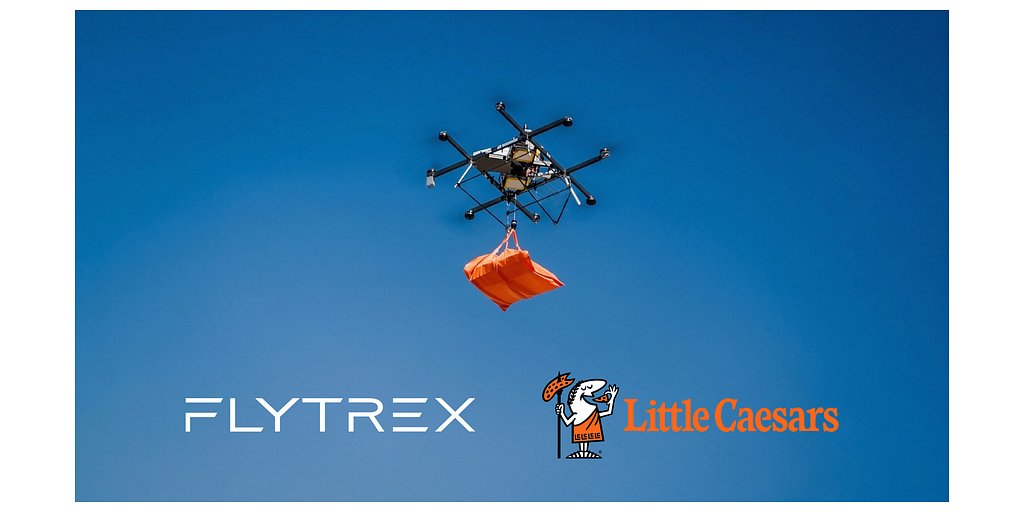
Pizza by Drone: Little Caesars and Flytrex Redefine Family Dinner
WYLIE, TX – April 23, 2026 – The familiar sight of a pizza delivery car may soon be joined by a new presence in the suburban sky. In a move that pushes the boundaries of on-demand food service, drone delivery leader Flytrex and pizza giant Little Caesars have launched a service capable of delivering an entire family meal by air. The partnership, which went live today in Wylie, Texas, marks the first time two large pizzas and sides can be delivered together in a single drone flight, arriving at customers' homes in an average of just 4.5 minutes after takeoff.
This new capability is powered by Flytrex’s newly unveiled Sky2 drone, an autonomous aircraft designed specifically to overcome a major hurdle in the food delivery market: payload capacity. The service represents a significant step toward making drone delivery a practical, everyday option for more than just single-item orders.
“Innovation at Little Caesars has always been driven by one thing—making it easier for customers to enjoy our pizza,” said Trish Heusel, Vice President of Innovation at Little Caesars. “Partnering with Flytrex to bring full family meals by drone delivery is a major leap forward, and a clear example of how we’re pushing the boundaries of convenience, speed, and accessibility in our category.”
For Flytrex, the collaboration is a cornerstone of its mission to integrate drone delivery into daily life. “Flytrex is laser-focused on making on-demand food delivery by drone a reality for everyday families,” stated Amit Regev, CEO and co-founder of Flytrex. “A big part of advancing this market is making sure people can get the food they actually want, when they want it. Until now, drones simply weren't capable of delivering a full family meal. The Sky2 changes that.”
A New Era of Aerial Delivery
The technological centerpiece of this initiative is the Flytrex Sky2 drone. Its industry-leading payload capacity of 8.8 pounds is the key that unlocks the ability to deliver a full family order, such as two large 16-inch pizzas, Crazy Bread, and drinks, in one trip. This capability directly addresses a critical limitation that has historically confined drone delivery to smaller, individual meals, limiting its overall market appeal.
Engineered for safety and efficiency, the Sky2 features an octocopter design with eight motors, providing full in-flight redundancy in the event of a motor failure. A dual-battery architecture further enhances reliability, while its navigation system uses GNSS with Real-Time Kinematic (RTK) technology for centimeter-level accuracy during flight and delivery. An onboard AI-enabled flight logic system continuously monitors and manages operations, ensuring the drone can navigate complex suburban environments safely.
With a delivery radius extended to four miles, the service can now reach more households than ever before from a single restaurant location. The operational flow is also streamlined. Orders placed through the Flytrex app are fed directly into Little Caesars' existing point-of-sale systems, and the drone collects the packaged order from a designated station outside the restaurant, minimizing restaurant workflow disruption and ensuring the food remains hot.
The Battle for the Skies Over Texas
The launch in Wylie places Flytrex and Little Caesars at the heart of an increasingly competitive and strategic market. The Dallas-Fort Worth (DFW) Metroplex has emerged as a national hub for drone delivery innovation, with major players vying to establish dominance. The area's relatively clear airspace, favorable weather, and supportive regulatory environment have made it an ideal testing ground.
Flytrex is not alone in the Texas sky. Wing, a subsidiary of Alphabet, has been aggressively expanding its own services in the DFW area, partnering with Walmart to deliver groceries and with DoorDash to deliver items from local shopping centers. Zipline, another major competitor, has partnered with Chipotle for drone deliveries in the region. Even Amazon Prime Air is conducting operations nearby. This dense concentration of activity has turned DFW into a real-world laboratory for Unmanned Aircraft System Traffic Management (UTM), where companies are collaborating to ensure safe coordination in shared airspace.
Against this backdrop, Flytrex's strategy with the Sky2 appears laser-focused. While competitors handle a variety of goods, the drone's specific design for large food orders gives Flytrex and its partners like Little Caesars a distinct advantage in the lucrative quick-service restaurant (QSR) sector. By solving the “family meal” problem, they are targeting a core consumer need that others have yet to fully address.
From High Cost to High Altitude: The Economics of Drone Delivery
For years, drone delivery has been viewed as a futuristic but costly novelty. However, recent regulatory milestones have fundamentally altered the financial equation, transforming the service from a niche experiment into a scalable business venture. The most significant of these is the Federal Aviation Administration's (FAA) approval for Beyond Visual Line of Sight (BVLOS) operations, which Flytrex secured in August 2025.
BVLOS approval is a game-changer. It allows a single remote operator in a central command hub to safely monitor and manage multiple drones simultaneously, rather than requiring a dedicated pilot for each aircraft within their direct line of sight. This shift dramatically increases delivery throughput and slashes the operational costs per flight, making the unit economics of drone delivery competitive with, and potentially superior to, traditional ground-based delivery methods.
This regulatory green light, combined with the efficiency of the Sky2 drone, underpins the commercial viability of the Little Caesars partnership. It positions Flytrex for the nationwide expansion it has planned, with the goal of serving over 100 million people across 37 major metro areas. The company’s strategic investment from Uber and partnership with DoorDash further validate this economic model, integrating Flytrex’s aerial logistics network into the platforms of the largest players in on-demand delivery.
Wylie Looks Up: A Suburb's Taste of the Future
For the residents of Wylie, Texas, this launch moves the concept of drone delivery from a headline into a tangible reality. A customer can now order a complete dinner for their family and have it lowered gently into their backyard in less time than it takes to watch a single commercial break. The promise is one of unparalleled speed and convenience, bypassing traffic and traditional delivery delays entirely.
The community's reception will be a critical test for the future of suburban logistics. Flytrex has worked to build public trust through a strong safety record, having completed over 200,000 deliveries in the U.S. before this launch, and by designing its systems with robust safety features. The low-altitude flight paths and quiet operation of modern delivery drones are intended to minimize disruption to neighborhood life.
As the first location to feature this enhanced service, Wylie becomes a case study for how communities adopt and adapt to autonomous technology. The success of this pilot will not only determine the future of the Flytrex-Little Caesars partnership but will also provide invaluable data on customer satisfaction, operational reliability, and the broader social acceptance of seeing commerce take to the skies. It is a pivotal moment, marking a concrete step toward a future where ultrafast, automated delivery is an ordinary part of suburban life.