
- IPO Details: Initial public offering priced at $4.00 per share, raising $17 million (plus $2.55 million from over-allotment).
- Stock Performance: 52-week trading range of $1.90 to $13.68, currently trading around $2.47 (as of December 18, 2025).
- Clinical Impact: Over 2,100 SynCardia Total Artificial Heart (STAH) implants performed globally, with one patient surviving over 2,900 days on the device.
Experts view Picard Medical as a pioneer in artificial heart technology, but caution that its financial stability and market success hinge on the successful development and commercialization of the next-generation Emperor system amid significant financial risks.
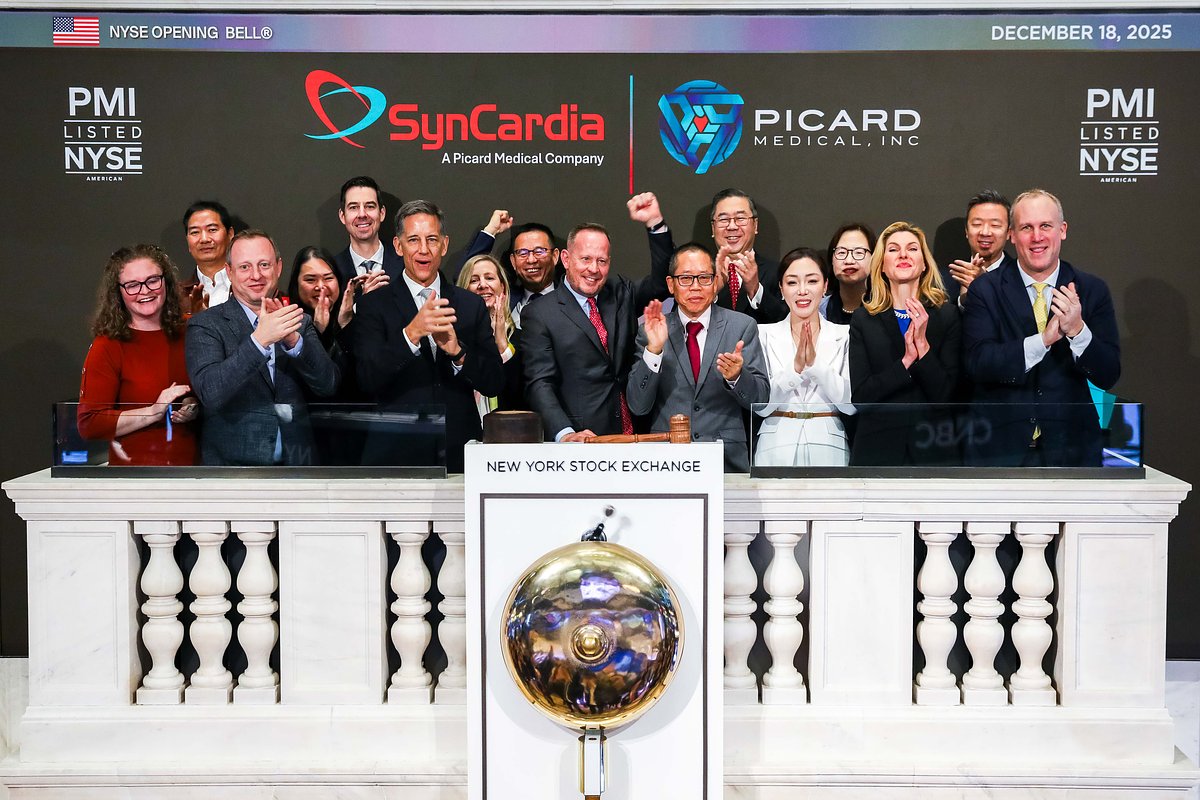
Picard's Public Debut Fuels Next-Gen Heart Amid Market Scrutiny
NEW YORK, NY – December 18, 2025 – The resonant sound of the Opening Bell at the New York Stock Exchange today marked a celebratory milestone for Picard Medical, Inc. (NYSE American: PMI), the parent of SynCardia Systems, maker of the world's only commercially approved total artificial heart. The ceremony, led by CEO Patrick NJ Schnegelsberg, symbolized the company's transition to the public markets and its renewed commitment to tackling end-stage heart failure. However, behind the fanfare lies a more complex story of a company balancing groundbreaking medical innovation with the harsh realities of market volatility and financial scrutiny.
A Public Debut Paved with Promise and Peril
While the bell-ringing took place in December, Picard Medical's journey as a public entity began months earlier. The company’s shares commenced trading on the NYSE American exchange on August 29, 2025, with an initial public offering priced at $4.00 per share. The IPO successfully raised $17 million, later supplemented by an additional $2.55 million when underwriters exercised their over-allotment option. These funds are critical for a company at the forefront of a capital-intensive industry.
Despite the initial capital injection, the market's reception has been turbulent. After opening at $4.21, the stock experienced significant volatility, with its 52-week trading range spanning a low of $1.90 to a high of $13.68. On the day of the bell-ringing ceremony, shares were trading around $2.47, well below the IPO price. This performance reflects a broader investor sentiment that weighs the company's undeniable technological promise against notable financial risks. Analysts have pointed to pre-IPO financial statements showing negative shareholder equity, high debt, and substantial operating losses. Recent SEC filings have also included a "going concern" warning, a standard but serious disclosure indicating potential financial instability, which has tempered some of the market's initial enthusiasm.
The Proven Lifeline: SynCardia's Market Dominance
Picard Medical's foundation rests on the remarkable success of the SynCardia Total Artificial Heart (STAH). As the world's first and only total artificial heart to receive approval from both the U.S. Food and Drug Administration (FDA) and Health Canada, the STAH occupies a unique and dominant position in the North American market. It is designed to completely replace a patient's failing heart, serving as a life-sustaining bridge to transplantation for individuals with end-stage biventricular heart failure.
The device's impact is not just theoretical; it's measured in lives. More than 2,100 STAH implants have been performed in leading hospitals across 27 countries, making it the most extensively used and studied device of its kind. The technology’s durability was recently highlighted by the extraordinary case of a patient who lived for over eight years - more than 2,900 days - supported by the device, a world record that underscores its reliability as a long-term solution for those awaiting a donor heart. This proven track record provides Picard Medical with a solid revenue base and a powerful clinical reputation upon which to build its future.
Engineering the Future with the 'Emperor System'
The capital raised from the IPO is primarily aimed at funding the next leap in cardiac replacement technology: the 'Emperor system'. This next-generation device represents a paradigm shift from the current STAH. It is being engineered as a fully implantable total artificial heart, designed to function without the external pneumatic driver required by its predecessor. This key innovation would untether patients from bulky external equipment, dramatically improving their mobility and quality of life.
“Our technology has supported patients worldwide and becoming a public company strengthens our ability to advance our artificial heart platform including the fully implantable Emperor system,” said Patrick NJ Schnegelsberg in a statement. This vision is backed by a clear financial strategy, with the company allocating between 45% and 55% of its IPO proceeds directly to research, development, and the eventual clinical validation of the Emperor.
The development pipeline is active and progressing. Design prototypes have undergone non-clinical bench testing, and the first in vivo animal implantations were reported as a key clinical milestone in late 2025. Data from these early stages has already been presented at major medical conferences. While the path to commercialization is long, the company is targeting FDA approval for the Emperor system as early as 2028, a goal that, if achieved, could redefine the market.
Navigating a High-Stakes Cardiovascular Market
Picard Medical operates in a landscape defined by immense human need and fierce competition. End-stage heart failure affects millions of people globally, creating a vast potential market for effective treatments. The global artificial heart market alone is projected to swell to nearly $23 billion by 2033. While the STAH currently has no direct competitors in the total artificial heart space in the U.S. and Canada, the broader mechanical circulatory support field includes powerful players offering ventricular assist devices (VADs) and other emerging technologies.
The company's leadership, helmed by CEO Schnegelsberg with his extensive background in medtech startups, is tasked with navigating this complex environment. The public listing provides the necessary fuel, but it also brings heightened expectations for growth and profitability. Furthermore, the company's structure as a "controlled company," with investment firm Hunniwell Picard I, LLC holding a majority of the stock, gives its principal backers significant influence over its strategic direction. For Picard Medical, the challenge ahead is to leverage its pioneering legacy and the promise of the Emperor system to deliver on its clinical and financial goals, ultimately transforming the future for patients with the most severe forms of heart disease.
Topics & Related
IPO
AI & Emerging Technology
Sustainability & Climate
Revenue
Medical Devices
Related Company Pulse