
- 85 pre-built and customizable metrics for tracking supply chain performance.
- 90% of industry leaders believe AI will improve organizational resilience (Penske's 2025 survey).
- Unified data layer integrating transportation and warehousing data from disparate sources.
Experts view Penske's AI-powered Supply Chain Insight as a significant advancement in supply chain management, offering real-time visibility, AI-driven intelligence, and proactive exception management to enhance operational resilience and efficiency.
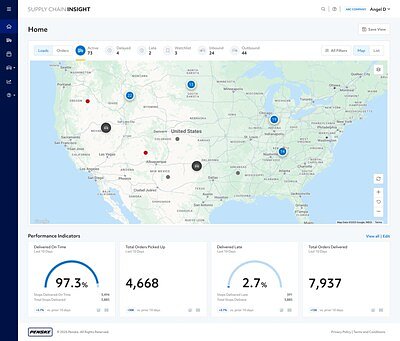
Penske Unveils AI-Powered Nerve Center for Supply Chain Control
ORLANDO, FL – May 04, 2026 – Penske Logistics today launched Supply Chain Insight, a new technology platform designed to give businesses a unified, real-time command center for their increasingly complex global operations. The announcement comes as supply chain leaders face mounting pressure from volatile fuel costs, shifting regulations, and persistent economic uncertainty, intensifying the search for greater efficiency and resilience.
The new platform, which includes a mobile application, aims to transform the vast and often disconnected streams of data from transportation and warehousing into a single, actionable view. By doing so, Penske intends to move the industry conversation beyond simple location tracking to a more sophisticated analysis of overall network performance.
"Our goal with the launch and development of Supply Chain Insight is to help our customers accelerate supply chain performance," said Jeff Jackson, president of Penske Logistics, in the official announcement. "This new platform provides customers with an unprecedented and unified view across their highly complex transportation and warehousing operations. It connects data that is often split across separate systems, giving teams a clearer picture of what's happening across their supply chain."
Taming the Fragmentation Problem
For most companies, the core challenge isn't a lack of data, but a surplus of it stored in disconnected silos. Information from a Transportation Management System (TMS), a Warehouse Management System (WMS), carrier portals, and third-party partner systems rarely communicates seamlessly. This fragmentation creates blind spots, particularly during handoffs between different stages of the supply chain, leading to delays, inefficiencies, and an inability to respond proactively to disruptions.
Penske's Supply Chain Insight is engineered specifically to address this fragmentation. Built on a modern, cloud-native architecture using Microsoft Azure with Snowflake as the core data platform, it creates a unified data layer. This architecture is designed to ingest, process, and harmonize information from disparate sources, including data from external warehouses and carriers not directly managed by Penske. The result is a single source of truth that provides a comprehensive, end-to-end view of a customer's entire network.
By unifying data, the platform empowers organizations to proactively manage exceptions, anticipate delays, and optimize inventory and load management. The choice of a robust cloud stack like Azure and Snowflake also signals a focus on enterprise-grade security, scalability, and performance, ensuring the system can handle the massive data volumes generated by modern logistics networks without faltering.
From Visibility to AI-Powered Intelligence
While real-time visibility has been a long-sought goal in logistics, Supply Chain Insight aims to push the industry further. The platform moves beyond answering "Where is my shipment?" to address the more critical question: "How is my supply chain performing?" It accomplishes this through a performance intelligence engine featuring over 85 pre-built and customizable metrics.
This allows leadership teams to track long-term performance trends and set strategic goals, while frontline operational teams gain the immediate visibility needed to identify and resolve issues as they occur. The platform's true innovation, however, lies in its embedded AI assistant. This feature allows users to make natural language queries—asking questions in plain English such as "What was our on-time delivery percentage last week?" or "Show me all late shipments to the Midwest region"—and receive instant answers without needing to build complex reports or consult a data analyst.
This capability is powered by advanced Natural Language Processing (NLP) running on its cloud foundation, which can interpret user intent and retrieve the relevant data instantly. The integration of such AI is a significant step toward democratizing data access across an organization, speeding up decision-making, and enabling a more agile response to operational challenges. According to Penske's own 2025 transportation survey, over 90% of industry leaders believe AI will improve organizational resilience, highlighting the market's readiness for such tools.
A Strategic Play in a Competitive Market
The launch positions Penske in a highly competitive market for supply chain visibility and management solutions, where established players like FourKites, Project44, and Blue Yonder have already made significant inroads. However, Penske's offering is differentiated by its deep integration of both transportation and warehousing data, coupled with its foundational model as a 4PL provider that manages entire logistics networks for its clients.
This integrated approach directly targets the core business needs of today's supply chain executives: cost reduction and operational resilience. With logistics costs representing a significant portion of national GDP—driven higher by inflation and fuel prices—the ability to find and act on efficiencies provides a tangible competitive advantage. The platform allows users to tailor the system to their unique operational needs.
"No two operations run the same, and the way teams use data should reflect that," noted Mike Medeiros, executive vice president of operations at Penske Logistics. "With Supply Chain Insight, our customers can define the metrics that matter most to their business, set performance thresholds and focus on areas that can drive increased efficiency and results."
While comprehensive adoption data is not yet available, initial feedback from early users has been positive. A logistics coordinator at a food manufacturing company reported that the platform provides a "complete story" that helps their team "stay ahead of any potential late deliveries," suggesting immediate value in proactive management and time savings. As businesses continue to navigate an unpredictable global landscape, the demand for such integrated, intelligence-driven solutions that deliver a clear return on investment is expected to grow.