
- $155 million: Global market value of EBSD systems in 2023
- Crystal Batch & Crystal Compare: New automation and visualization tools in AZtecCrystal 4.0
- Dynamic analysis: Enables real-time tracking of microstructural changes
Experts agree that AZtecCrystal 4.0's automation and visualization tools significantly enhance materials analysis, making it a game-changer for researchers in fields like metallurgy and semiconductor development.
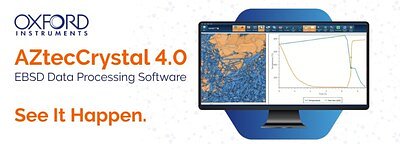
Oxford Instruments Unveils AZtecCrystal 4.0 to Automate Material Analysis
LONDON, UK – April 09, 2026 – Oxford Instruments has launched a significant update to its materials analysis software, AZtecCrystal 4.0, aiming to reshape how scientists and engineers study the microscopic world. The new version of the Electron Backscatter Diffraction (EBSD) software introduces powerful automation and visualization tools designed to streamline complex experiments and accelerate the pace of materials discovery.
The release features two major additions, Crystal Batch and Crystal Compare, which enable researchers to more easily analyze vast datasets and visualize how materials change over time or under different conditions. This move positions the company to better serve the growing demand for in-situ analysis in fields ranging from metallurgy and geology to semiconductor development, where understanding dynamic processes is critical.
Automating the Path to Discovery
In modern materials science, researchers are often inundated with data. The advent of high-speed EBSD detectors allows for the collection of massive datasets that capture the crystallographic structure of a material in minute detail. However, processing and interpreting this data deluge has remained a significant bottleneck, often requiring tedious manual handling and complex, disconnected workflows.
AZtecCrystal 4.0 directly confronts this challenge with its new Crystal Batch feature. This tool automates the process of linking EBSD data with external experimental parameters, such as temperature, time, or applied stress. For researchers conducting multi-sample studies, 3D slice-and-view experiments with a Focused Ion Beam (FIB), or in-situ heating experiments, this integration is a game-changer. Instead of manually correlating hundreds of data points, the software can automatically process an entire data stack, analyzing and reporting key metrics like grain size or phase distribution across the whole experiment.
"AZtecCrystal 4.0 reduces manual data handling through integration and automation, allowing researchers to focus on interpreting microstructural changes," said Mark Coleman, Product Manager for AZtecCrystal at Oxford Instruments, in the company's official announcement. This shift from data management to scientific interpretation is at the heart of the update, promising to enhance reproducibility and dramatically improve efficiency in research labs and quality control environments alike.
Beyond Static Snapshots: Visualizing Dynamic Materials
Traditionally, much of microstructural analysis has relied on static images, providing a snapshot of a material's state at a single moment. However, the most critical material behaviors—such as phase transformations, degradation, and failure—are dynamic processes. Understanding these requires observing how the microstructure evolves in real time.
The new Crystal Compare feature in AZtecCrystal 4.0 is engineered specifically for this purpose. It provides an intuitive visualization tool that allows users to seamlessly compare changes across multiple datasets. Researchers can now easily track time-dependent phenomena, generate compelling time-lapse imagery of microstructural evolution, and pinpoint critical events within their experiments. For instance, a metallurgist can now vividly watch the transformation of austenite to martensite in a steel sample as it cools, correlating the visual change directly with temperature data.
This capability has been well-received by early users. According to a senior technical specialist at a leading UK university, the visual representation of data in graphs is an excellent way to quickly assess quality and investigate critical events during an in-situ experiment. This ability to instantly compare data stacks and visualize dynamic changes moves EBSD analysis from a forensic tool for post-mortem analysis to a powerful method for observing materials in action. This deeper understanding is crucial for developing more durable alloys, predicting component lifetime, and preventing material failures.
A Strategic Move in a Competitive Market
The launch of AZtecCrystal 4.0 is not just a technical update; it is a strategic maneuver in the highly competitive scientific instrumentation market. The global market for EBSD systems was valued at approximately $155 million in 2023 and is projected to grow at a steady rate, fueled by advancements in nanotechnology and the relentless demand for higher-performance materials.
In this landscape, key players like Oxford Instruments, EDAX (an AMETEK company), and Bruker are in a constant race to innovate. While hardware advancements, such as faster detectors, have been a primary driver of progress, software is increasingly becoming the key differentiator. As detectors generate more data at higher speeds, the software's ability to process, analyze, and visualize this information efficiently becomes paramount.
Competitors have also focused on automation and integrated workflows. However, Oxford Instruments' specific emphasis on synchronizing EBSD data with external experimental parameters through Crystal Batch and providing dynamic comparative visualization with Crystal Compare directly targets the sophisticated needs of researchers conducting cutting-edge in-situ studies. By addressing this advanced segment of the market, the company reinforces its position as a leader in materials characterization. These features are designed to provide immediate value to core research facilities, industrial R&D labs, and quality control departments where speed, accuracy, and comprehensive reporting are non-negotiable.
The continuous innovation in software like AZtecCrystal is essential for translating complex raw data into actionable scientific knowledge. By providing more powerful and intuitive tools, developers are empowering scientists and engineers to tackle some of the most challenging problems in materials science, ultimately paving the way for the creation of next-generation materials that will define future technologies.