
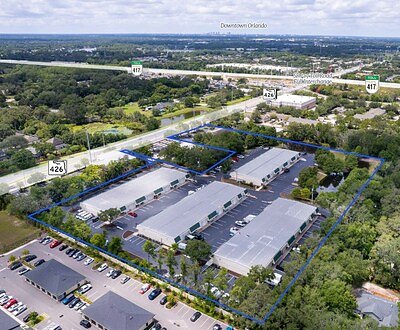
- 74,736 sq. ft.: Size of the Aloma Commerce Center I & II property sold in Oviedo, Florida.
- 96.5% occupancy: The property's occupancy rate at the time of sale, reflecting its renewed desirability.
- 40% rent growth: Estimated surge in rents for small bay industrial properties in Orlando since 2020.
Experts agree that the successful sale of Aloma Commerce Center validates the value-add strategy in Orlando's industrial market, particularly for small bay properties, where high demand and low supply drive significant rent growth and occupancy.
Orlando Industrial Sale Proves Value-Add Strategy in Hot Market
SAN JUAN CAPISTRANO, CA – March 06, 2026 – The recent sale of Aloma Commerce Center I & II in Oviedo, Florida, has cast a spotlight on the potent combination of strategic asset management and the robust demand for small bay industrial space in the greater Orlando area. ABR Capital Partners and Birtcher Anderson & Davis (BA&D) announced the successful disposition of the five-building, 74,736-square-foot property in February 2026, marking the culmination of a meticulously executed value-add business plan.
The transaction serves as a compelling case study for real estate investors, demonstrating how underperforming assets in high-growth markets can be transformed into highly profitable ventures through targeted investment and operational expertise. Acquired in September 2022, the property has become emblematic of the opportunities present within a specific, and often overlooked, segment of the industrial real estate landscape.
A Blueprint for Value Creation
When ABR Capital Partners and BA&D acquired Aloma Commerce Center as part of a larger portfolio, the property was fully occupied but was generating rental income significantly below the area's rapidly escalating market rates. This discrepancy presented a clear opportunity for the partnership to implement its signature value-add strategy.
The business plan was twofold: enhance the property's physical appeal and align its revenue with current market dynamics. Over their nearly three-and-a-half-year hold period, the ownership duo systematically invested in capital improvements designed to attract and retain a diverse tenant base. When individual units became available, they were subject to interior renovations that introduced a clean, modern aesthetic. This interior refresh was complemented by exterior upgrades, including improved tenant signage, which enhanced the property's curb appeal and professional image.
This physical transformation was paired with a disciplined asset management approach. As leases expired, rents were methodically increased to reflect the strengthening market, a move that capitalized on the intense demand for functional, well-located industrial space in the northeastern Orlando submarket. The strategy proved highly effective, as the firms succeeded in boosting rental income while maintaining consistently high occupancy levels. At the time of the sale, Aloma Commerce Center was 96.5% occupied, a testament to the property's renewed desirability.
"Aloma Commerce Center benefited from a highly functional layout and a desirable infill location within the greater Orlando market," said Evan Hanyak of Birtcher Anderson & Davis in a statement. "By combining disciplined asset management with thoughtful capital investment to support the efforts of the Lee & Associates team, we were able to maximize returns to our investors by executing the business plan efficiently through the capture of strong rent growth coupled with high occupancy."
Riding the Wave of Orlando's Industrial Boom
The success of the Aloma Commerce Center project was not achieved in a vacuum. It was amplified by powerful underlying trends that have made Central Florida one of the nation's most dynamic industrial markets. While headlines in late 2025 noted a slight rise in overall industrial vacancy in Orlando to around 7.8%, this figure was largely driven by the delivery of massive new speculative warehouses. The story for smaller, multi-tenant properties is drastically different.
The small bay industrial sector—typically comprising spaces under 50,000 square feet—is experiencing a severe supply and demand imbalance. Market analysis from the end of 2025 shows that vacancy rates for smaller warehouses in the I-4 Corridor, which bisects Orlando, hovered at a tight 3.8%. This stands in stark contrast to the double-digit vacancy rates seen in facilities larger than 500,000 square feet. This scarcity of available small units has given landlords significant pricing power.
Rent growth in the small bay segment has consistently outpaced the broader market, with some analysts estimating that rents for these properties have surged over 40% since 2020. This premium is fueled by a structural undersupply; high land and construction costs make it economically challenging for developers to build new small bay projects compared to large, single-tenant distribution centers. Consequently, existing properties like Aloma Commerce Center become increasingly valuable.
Demand stems from a diverse and growing base of tenants. Orlando's booming population fuels the need for last-mile logistics and services, while its thriving ecosystem of small businesses, e-commerce operators, contractors, and light manufacturers all seek flexible, accessible industrial space. This varied demand provides a stable foundation for properties that can cater to multiple tenants.
The Power of a Strategic Partnership
The Aloma Commerce Center transaction also underscores the effectiveness of a well-aligned partnership. The collaboration brought together the specialized expertise of ABR Capital Partners, an investment manager focused on identifying value-add opportunities in niche assets, and Birtcher Anderson & Davis, a vertically integrated real estate firm with deep experience in hands-on development and property management.
This synergy allowed the joint venture to not only identify the asset's potential but also to execute the complex, on-the-ground work required to realize it. BA&D's operational capabilities were critical in overseeing the renovations, managing tenant relations, and ensuring the property ran efficiently. This was supported by the leasing efforts of Ryan Griffiths of Lee & Associates, who navigated the market to secure and retain tenants throughout the ownership period. When it came time to sell, the disposition was expertly handled by Robyn Hurrell of Colliers International, who represented the sellers.
This model—combining sharp investment acumen with robust operational execution—is proving to be a winning formula in today's competitive real estate environment. It allows investors to create value actively rather than passively relying on market appreciation alone.
As the broader commercial real estate market continues to navigate a shifting economic landscape, the sale of Aloma Commerce Center sends a clear signal. It validates the investment thesis that well-located, functional small bay industrial properties remain a resilient and highly profitable asset class. For investors capable of executing a strategic value-add plan, the opportunities to generate significant returns by modernizing existing stock to meet insatiable market demand remain exceptionally strong.