
- 77% of subcontractors say a builder's payment history influences their decision to bid on future work.
- 57% of subcontractors admit to increasing their rates to buffer against slow or unreliable payments.
- Nearly a third of corporate collapses in Australia's construction sector are linked to payment delays.
Experts agree that slow and unreliable payments in construction are driving up costs and financial instability, but digital solutions like Payapps' Early Payment feature offer a structured way to improve cash flow and trust across the supply chain.
New Tech Aims to Fix Construction's Billion-Dollar Payment Delays
MELBOURNE, Australia – April 13, 2026 – A culture of slow and unreliable payments is quietly inflating costs and eroding trust across the construction industry, forcing subcontractors to build financial risk into their bids. New survey data reveals the extent of the problem, while a technology firm believes it has a solution by embedding early payment options directly into project workflows.
Preliminary findings from a survey of 754 subcontractors across Australia and New Zealand by Payapps, an Autodesk Company, show that a main contractor’s payment reputation has become a critical factor in business decisions. A staggering 77% of respondents said a builder's payment history influences their decision to bid on future work. More critically, 57% admitted to actively increasing their rates or adding a risk margin to their pricing specifically to buffer against the impact of slow or unreliable payments.
This practice confirms what many in the industry have long suspected: the financial instability passed down the supply chain is systematically driving up the cost of construction for everyone. In response to these deep-seated issues, Payapps has launched a new ‘Early Payment’ feature, aiming to replace informal, high-stress negotiations with a structured and transparent digital process.
The High Cost of Waiting
The consequences of delayed payments extend far beyond simple inconvenience. For subcontractors, who often operate on thin margins, waiting for payment can trigger a cascade of financial distress. The Payapps survey identified the top three impacts as tighter cash flow, increased stress and pressure, and a greater difficulty in paying their own suppliers and workforce.
This is a well-documented global phenomenon. Industry-wide data shows that payment cycles in construction can average over 57 days, leaving smaller businesses to effectively finance large portions of a project out of pocket. This chronic cash-flow crunch is a leading contributor to the sector's alarmingly high insolvency rate, which in Australia accounts for nearly a third of all corporate collapses. Subcontractors are often forced to rely on high-interest credit or personal assets to stay afloat while waiting for approved invoices to be paid.
“Timing is the critical issue,” said Scott Lockwood, Head of Customer Success at Payapps. “Traditional early payment arrangements often try to accelerate approvals and payments while adding manual administration at the same time. That combination makes them difficult to govern and even harder to scale.”
The financial strain is not only a risk to individual businesses but also a drag on the entire industry. When skilled subcontractors are forced to price in an 8% or higher risk premium to protect themselves, project costs inevitably rise. Furthermore, when a contractor’s reputation for late payments becomes known, it can shrink the pool of available talent, reducing competition and potentially impacting the quality of work.
A Digital Bridge for a Fractured Supply Chain
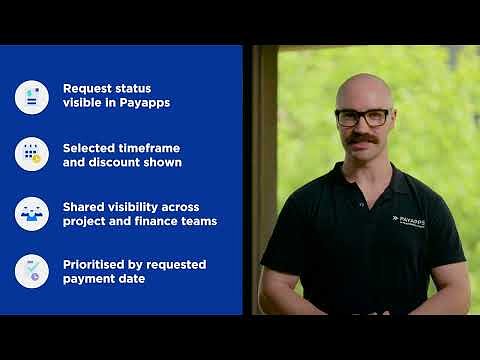
Payapps' new Early Payment feature aims to transform this dynamic by integrating a formal early payment mechanism directly into the progress claim workflow that contractors and subcontractors already use. Instead of relying on ad-hoc emails, phone calls, or separate financing arrangements, subcontractors can request early payment on an approved claim within the platform.
The system is designed to give main contractors control and visibility. They can configure the terms, including eligibility criteria, specific payment timeframes, and any associated discount settings. This structured approach replaces manual workarounds with a governed, scalable process that maintains commercial discipline.
“The Early Payment feature in Payapps changes that by embedding requests directly into the progress claim and approval workflow,” Lockwood explained. “It gives builders a practical way to support subcontractor cash flow while maintaining visibility, control and commercial discipline.”
This approach reflects a significant shift from the often-opaque world of traditional construction finance. The survey found a clear appetite for such a solution, with 40% of subcontractors indicating they would be interested in an optional early payment arrangement, even if it meant receiving a slightly reduced payment in exchange for speed and certainty.
From Risk Margins to Renewed Trust
The potential benefits of a streamlined early payment system ripple out to all project stakeholders. For subcontractors, the immediate advantage is improved cash flow and reduced financial stress, allowing them to pay their own bills on time and operate with greater stability. This financial health can, in turn, free them from the necessity of adding costly risk margins to their bids.
For main contractors, the return on investment comes from fostering a more resilient and loyal supply chain. By establishing a reputation as a reliable and prompt payer, they can attract higher-quality subcontractors and receive more competitive bids, ultimately lowering overall project costs. A financially stable supply chain is also less prone to delays caused by cash flow shortages, contributing to smoother and more predictable project timelines.
The feature has already been trialled with a select group of customers, including Sarah Constructions, to validate its effectiveness on live projects. Lewis Skittrall, Head of Commercial at Sarah Constructions, highlighted the importance of maintaining both flexibility and control.
“Our early payment approach gives subcontractors flexible access to funds when they genuinely need it, without changing underlying contract terms,” said Skittrall. “By keeping the process optional, transparent and embedded within our existing Payapps claim workflows, we're able to support our supply chain while maintaining strong commercial governance across projects.”
A Strategic Move in Construction's Digital Transformation
The launch is more than just a new feature; it represents another step in the construction industry's broader, and often slow, digital transformation. It aligns with the strategic vision of parent company Autodesk, which acquired Payapps to bolster the financial management capabilities of its Autodesk Construction Cloud platform. The move aims to connect data and workflows from project execution all the way through to financial settlement.
By digitizing and standardizing a critical financial interaction, the solution addresses a core pain point that manual processes and disconnected systems have failed to solve. It reflects a growing recognition that financial friction is a major source of inefficiency, risk, and conflict in the industry. As builders face increasing pressure to improve both internal efficiency and supply chain relationships, integrated fintech solutions are becoming less of a luxury and more of a necessity for staying competitive.
By providing a standardized and professional framework for managing early payment requests, this technology helps reduce administrative burdens and inconsistencies. This ultimately fosters a more collaborative and financially resilient ecosystem, which is essential for the long-term health and productivity of the construction sector.