
- $700,000 funding committed over two years
- First legal hub in Singapore dedicated to non-visible conditions
- Focus on autism, ADHD, intellectual disabilities, and mental health conditions
Experts agree that the Inclusive Justice Law Centre represents a critical step toward ensuring equitable access to justice for individuals with non-visible conditions, addressing long-standing systemic gaps in legal support.
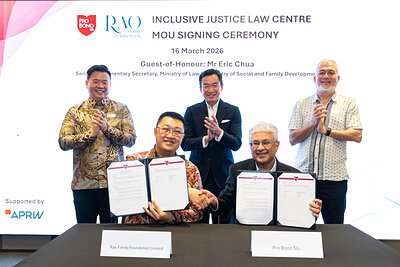
New S'pore Legal Centre to Champion Justice for 'Invisible' Conditions
SINGAPORE – March 16, 2026 – In a landmark move to bolster access to justice, the Rao Family Foundation and Pro Bono SG today launched the Inclusive Justice Law Centre, Singapore's first legal hub dedicated to individuals with non-visible conditions and their caregivers. The initiative, cemented by a Memorandum of Understanding (MOU), aims to address a long-standing gap in legal support for a community that has often navigated the justice system without specialized aid.
The Rao Family Foundation, a grantmaking organization focused on social challenges, has committed over $700,000 in funding over two years. This substantial investment will support the centre's operations, including manpower, a dedicated Legal Support Fund, and specialized training programs. The MOU signing was witnessed by Mr Eric Chua, Senior Parliamentary Secretary for the Ministry of Law and the Ministry of Social and Family Development, signaling strong governmental support for the ground-up initiative.
Addressing a Critical, Unseen Gap
The Inclusive Justice Law Centre will serve as a one-stop resource providing legal awareness, guidance, and representation for individuals with conditions that are not immediately apparent. In Singapore, this encompasses a wide spectrum, including autism spectrum disorder, attention deficit hyperactivity disorder (ADHD), intellectual disabilities, and mental health conditions such as schizophrenia. These individuals often face unique and profound barriers within the legal system.
Unlike those with visible disabilities, their challenges can be misunderstood or dismissed, leading to difficulties whether they are victims, witnesses, or accused persons. They may struggle to process complex information, articulate their experiences, or advocate for themselves during police investigations and court proceedings. The new centre is designed to bridge this critical gap.
"In our work, we have seen that access to justice is not only about having legal rights - it is about being able to understand and navigate the system," said Mr Dinesh Dhillon, Chairman of Pro Bono SG. He emphasized the centre's commitment to ensuring this community is seen and heard. "The Inclusive Justice Law Centre reflects our commitment to ensuring that individuals with non-visible conditions are seen, heard and supported throughout the legal process."
A Strategic Partnership for Systemic Change
The collaboration between the Rao Family Foundation and Pro Bono SG represents a strategic effort to create lasting systemic change. The centre will be anchored by a full-time, Singapore-qualified community lawyer specializing in the complex needs of this demographic. A key part of this lawyer's role will be to train and expand a pool of pro bono volunteer lawyers, building a robust ecosystem of specialized legal expertise.
The funding from the Rao Family Foundation, established in 2024 by gold mining magnate Jimmy Budiarto and his wife Yohana Limarno, is a significant catalyst. The foundation's focus on inclusivity was reportedly sharpened by tragic local cases involving individuals with autism, leading to a partnership with St Andrew's Autism Centre in 2024 and now this major legal initiative.
"The Rao Family Foundation believes that a truly just society cannot exist when significant segments of our community remain unseen," said Mr James Zou, Director at the foundation. "To us, inclusivity means being intersectional, all-encompassing, and exhaustive. We are confident this initiative will help ensure that everyone, regardless of whether their condition is visible, has meaningful access to justice and opportunity."
Pro Bono SG brings decades of experience in legal aid to the partnership. The organization's inaugural Access to Justice Symposium in March 2025 specifically highlighted the legal system's shortcomings for people with invisible disabilities, laying the groundwork for this new centre. The centre will offer curated workshops and seminars on legal literacy, future planning, and financial security, designed with a deep understanding of the communication and self-advocacy challenges faced by these individuals and their caregivers.
Aligning with a National Push for Inclusivity
The launch of the Inclusive Justice Law Centre does not exist in isolation. It arrives at a pivotal moment, aligning with a broader national push to build a more inclusive Singapore. The initiative complements the work of the Inclusive Justice Taskforce, which was formally launched in January 2026 to review how the criminal justice system can better support individuals with disabilities and mental health conditions.
Significantly, the taskforce is co-chaired by SPS Eric Chua, who witnessed the MOU signing, and veteran lawyer Peggy Yee, a long-time advocate for individuals with special needs. This synergy between governmental review and a ground-up service provider is seen as a powerful combination for driving meaningful reform.
The centre's mission also resonates with Singapore’s Enabling Masterplan 2030, a national roadmap for creating a more compassionate and supportive society for persons with disabilities. By focusing on equitable access to legal protection, the centre addresses a key component of full and effective participation in society.
Beyond providing direct legal services, the partnership is committed to driving strategic research. By gathering data and insights from its casework, the centre aims to inform policy and strengthen access-to-justice efforts across the legal and social service sectors, contributing to a more informed and responsive system.
This holistic approach—combining direct aid, professional training, and systemic advocacy—is designed to create a ripple effect. For families and caregivers, the centre offers a beacon of hope, providing guidance on critical issues like long-term care planning and financial security. For the legal system, it promises to build dedicated expertise and foster a culture of greater understanding and accommodation. As Mr Dhillon noted, the ultimate goal is to shape a system that is more responsive, so that justice becomes truly accessible in practice.