
- 300 ppm: Ammonia gas becomes immediately dangerous to life and health at concentrations of 300 parts per million (ppm) or higher.
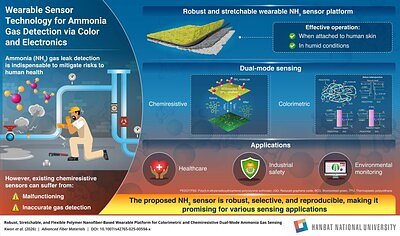
- Dual-mode sensing: The sensor combines a colorimetric layer for visual alerts and a chemiresistive layer for electronic measurement, ensuring redundancy and reliability.
- 5-10 years: The technology could become standard issue in high-risk industries within this timeframe, significantly reducing workplace injuries and fatalities.
Experts would likely conclude that this dual-mode wearable sensor represents a significant advancement in occupational safety, offering a reliable and redundant solution for detecting toxic ammonia gas in industrial settings, with potential applications extending to healthcare and environmental monitoring.
New Skin-Worn Sensor Offers Dual Protection From Toxic Ammonia Gas
CHUNGCHEONG, SOUTH KOREA – February 12, 2026 – A groundbreaking wearable sensor developed by researchers in South Korea is poised to revolutionize safety for millions of workers by providing a reliable, two-tiered warning system against toxic ammonia gas. The flexible, skin-worn patch, created by a team at Hanbat National University, overcomes the critical failures of existing detectors by combining instant visual alerts with electronic sensing, all while functioning effectively in the humid, real-world conditions where danger is most prevalent.
Ammonia (NH3) is one of the most widely produced chemicals on the planet, essential for fertilizers that feed the world, refrigerants that preserve our food, and even as a potential next-generation fuel. Yet, this utility masks a significant danger. The gas is highly toxic and corrosive. Accidental leaks in industrial settings can cause severe respiratory irritation, chemical burns, pulmonary edema, and, at concentrations of 300 parts per million (ppm) or more, can be immediately dangerous to life and health. The new technology, detailed in the journal Advanced Fiber Materials, offers a powerful new tool to prevent such tragedies.
A New Line of Defense Against a Silent Threat
For workers in agriculture, food processing, and chemical manufacturing, the threat of an ammonia leak is a constant occupational hazard. Current safety protocols rely on a patchwork of detection systems, many of which have significant drawbacks. Stationary alarms may not detect a localized leak quickly enough, while existing portable sensors often struggle in the very environments they are meant to protect.
Conventional chemiresistive sensors, which detect gases by measuring changes in electrical resistance, are known for their fast response times but are notoriously unreliable in humid conditions and can be thrown off by other gases, leading to false alarms or missed alerts. On the other hand, colorimetric sensors, which change color in the presence of a target gas, are more stable against humidity but often have slow recovery times and may lack the sensitivity for early warnings. This technological gap leaves workers vulnerable, particularly in environments like industrial refrigeration facilities where temperature and humidity fluctuate dramatically.
“Our device provides flexibility and facilitates efficient transport of NH3 between the bromocresol-green-based colorimetric and poly(3,4-ethylene dioxythiophene):poly(styrene sulfonate)-based chemiresistive sensing layers,” explains Professor Hyun Il Kang, who led the research team at Hanbat National University's Department of Electrical Engineering. “This innovative dual-mode design enables reliable NH3 detection.”
Fusing Technologies for Unprecedented Reliability
The genius of the Hanbat National University sensor lies in its integrated, dual-mode approach. It doesn't force a choice between speed and stability; it delivers both. The device is built on a stretchable, gas-permeable polymer nanofiber platform that acts as a flexible base, allowing it to be worn comfortably on the skin like a small bandage.
Embedded within this platform are two distinct sensing layers working in tandem:
A Colorimetric Layer: This provides an immediate, intuitive visual cue. In the presence of ammonia, a dye called bromocresol green changes color. A worker can see the danger at a glance, without needing to check an electronic reader—a simple but life-saving feature in a high-stress emergency.
A Chemiresistive Layer: This layer provides a quantitative, electronic readout. It continuously measures the concentration of ammonia gas down to the parts-per-million level, providing the precise data needed for risk assessment and logging exposure levels over time. This data can be wirelessly transmitted to a central monitoring system or a personal device.
Crucially, the researchers designed the platform so that the failure of one sensing mode does not compromise the other. This built-in redundancy dramatically increases the sensor's reliability. Even if the electronic component were to fail, the color change would still provide a clear warning, ensuring a fail-safe layer of protection that current single-mode sensors cannot offer.
From Factory Floor to Future Clinics
The immediate application of this technology is the creation of “smart PPE” (Personal Protective Equipment). A worker equipped with this patch would have an early warning system directly on their body, capable of alerting them to a dangerous leak long before it reaches a critical concentration. Within the next 5 to 10 years, this could become standard issue in high-risk industries, significantly reducing workplace injuries and fatalities from ammonia exposure.
However, the potential of this sensor platform extends far beyond industrial safety. The same technology holds promise for transformative applications in healthcare and environmental science.
Ammonia is a known biomarker in human breath, with elevated levels potentially indicating liver or kidney disorders. A highly sensitive, wearable sensor like this could enable non-invasive, continuous health screening, allowing for early disease detection from the comfort of a patient's home. Furthermore, the platform's core design could be adapted to detect other volatile organic compounds (VOCs), opening doors to diagnosing a range of medical conditions through breath analysis.
As Professor Kang notes, the long-term vision includes using this platform for continuous environmental monitoring. Networks of these low-cost, reliable sensors could track air quality in agricultural zones, where ammonia from fertilizer is a pollutant, or in urban environments, providing valuable data for public health and climate science.
This breakthrough from Hanbat National University is more than just a new device; it represents an innovative engineering paradigm. By successfully integrating two distinct sensing technologies into a single, robust, and wearable platform, the research team has laid the groundwork for a future where smart sensors are an invisible, indispensable part of keeping us safe at work, monitoring our health, and protecting our environment.