
- $11 million: Funding for carbon utilization and storage projects announced by the Government of Canada during its 2025 G7 Presidency.
- $130 million: Funding secured by Deep Sky for large-scale direct air capture and storage projects in Quebec.
- $170 per tonne: National carbon price set to rise by 2030, making emitting CO₂ increasingly expensive.
Experts conclude that Eastern Canada has significant and credible potential for carbon storage, with the Geological Carbon Storage Atlas providing a critical roadmap for developing large-scale and localized CCS projects to meet climate targets.
New Atlas Unlocks Carbon Storage Potential in Eastern Canada
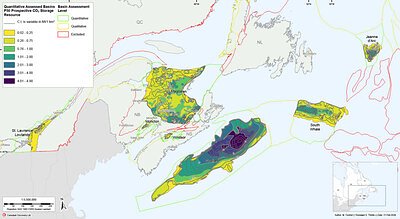
CALGARY, AB – April 21, 2026 – A groundbreaking new study is set to redefine Eastern Canada's role in the fight against climate change, detailing vast and viable opportunities for permanently storing captured carbon dioxide deep beneath the earth's surface. Canadian Discovery Ltd. (CDL) today announced the upcoming April 28 release of the Geological Carbon Storage Atlas of Eastern Canada, the first comprehensive, integrated assessment of CO₂ storage potential across Quebec and the Atlantic provinces.
The Atlas, a collaborative effort co-funded by Natural Resources Canada (NRCan) and carbon removal developer Deep Sky, provides a critical roadmap for industry, policymakers, and communities. It moves the region's decarbonization strategy from ambition to a tangible, geologically-backed plan by identifying specific opportunities in deep saline aquifers and depleted hydrocarbon reservoirs.
A Blueprint for Decarbonization
Until now, knowledge of Eastern Canada's subsurface storage capacity has been fragmented. This Atlas changes that by delivering a detailed analysis of storage opportunities, associated costs, and geological risks. The research reveals that the region possesses significant and credible potential, but with notable variations in geology, scale, and cost from one basin to another.
Researchers found that some areas are well-suited for large, hub-style Carbon Capture and Storage (CCS) developments capable of sequestering massive volumes of CO₂ from multiple industrial sources. These sites are characterized by substantial capacity and strong geological seals, ensuring long-term containment. Other locations are better aligned with smaller, bespoke projects designed to serve localized emitters with more modest storage needs. This flexibility is key to developing a robust carbon management portfolio for the region.
"Quebec and Atlantic Canada represent an enormous opportunity for carbon storage, and this Atlas is a landmark step in unlocking it," said Matt Scorah, CDL's Vice President of Decarbonization. "By combining comprehensive subsurface analysis with cost and economic modelling, we're giving stakeholders across industry, government, and communities the tools they need to move from ambition to action -- and positioning Eastern Canada as a serious player in the global decarbonization landscape."
The Policy and Investment Landscape
The release of the Atlas is timely, aligning with a significant push from federal and provincial governments to build out Canada's carbon management infrastructure. The project itself was supported by a portion of the more than $11 million in funding for carbon utilization and storage projects announced by the Government of Canada during its 2025 G7 Presidency.
This government backing is part of a broader strategy to help Canada meet its climate targets of reducing emissions by 40-45% below 2005 levels by 2030 and achieving net-zero by 2050. Economic incentives are a core component of this strategy. A national carbon price, set to rise to $170 per tonne by 2030, makes emitting CO₂ increasingly expensive, while a federal CCUS Investment Tax Credit offers to cover a significant portion of capital costs—up to 60% for direct air capture projects and 37.5% for storage infrastructure.
Provincial governments are also creating a more favorable climate for investment. In Quebec, the recent introduction of Bill 17 is establishing a clear legal framework for the underground storage of carbon. This move provides regulatory predictability, which investors and project developers see as crucial for deploying the billions of dollars required to build large-scale carbon removal facilities.
Strategic Partnerships and Industrial Ambition
The Atlas project exemplifies a new model of public-private collaboration essential for tackling complex climate challenges. It brings together the deep subsurface intelligence of CDL, a 35-year veteran in geoscience; the policy and financial backing of NRCan; and the market-driven urgency of Deep Sky, a Montreal-based developer aiming to build a gigaton-scale carbon removal industry.
Deep Sky, which has already secured $130 million in funding, is actively developing large-scale direct air capture and storage projects in Quebec. The company's support for the Atlas underscores the industry's need for rigorous, bankable data to de-risk projects and guide investment.
"Deep Sky was proud to support this work because rigorous, detailed subsurface data strengthens the entire carbon removal ecosystem," stated Mathieu Bouchard, vice-president of public policy and regulatory affairs for Québec at Deep Sky. "The Atlas provides valuable regional insight for Eastern Canada and helps inform the next phase of site-specific technical assessments required to advance safe, durable carbon storage. This comes at an important time as Québec advances the development of its carbon storage framework."
This data is critical for the region's heavy industries, such as steelmaking and oil refining, which are looking to CCS as a key pathway to decarbonize operations where electrification is not a viable option. The Atlas provides these emitters with the spatial intelligence needed to evaluate potential storage solutions.
Navigating Challenges and Opportunities
While CCS technology is a cornerstone of Canada's climate plan, it is not without challenges, including high costs and public concerns over long-term safety and the potential for "greenwashing." Proponents argue the Atlas directly addresses these issues by providing transparent, science-based data on geological risks and containment security, enabling a more informed public dialogue with communities, Indigenous groups, and municipalities.
Furthermore, the study highlights a strategic opportunity for Atlantic Canada. While provinces like Quebec and Ontario have significant industrial emissions, they may lack sufficient high-quality local storage sites. The world-class storage potential identified in basins offshore Nova Scotia and elsewhere in the Maritimes could position the region as a future CCUS hub, importing and permanently storing CO₂ from inland emitters.
The complete Atlas is being made publicly available, though the comprehensive datasets and shapefiles used in its creation can be licensed from CDL for commercial use. To share the findings, CDL will host a two-part webinar series on April 28 and May 5, with further presentations planned at industry conferences throughout the year, signaling the start of a new chapter for carbon management in Eastern Canada.