
- $50,000 annual residency: Combines a $10,000 artist stipend with full production costs for neon art fabrication.
- 7–10 day immersive program: Artists work directly with skilled craftspeople at Lite Brite Neon Studio.
- March 5, 2026 application deadline: Open to Indigenous artists in North America, with residency culminating in Fall 2026.
Experts view the Native Neon residency as a groundbreaking initiative that dismantles systemic barriers in contemporary art by providing Indigenous artists with unprecedented access to high-cost, technically demanding neon fabrication.
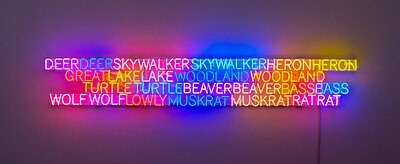
Native Neon Residency Ignites New Paths for Indigenous Artists
NEW YORK, NY – March 05, 2026 – A new partnership is set to illuminate the contemporary art world by providing Indigenous artists with unprecedented access to one of its most technically demanding mediums. The Native-led Walker Youngbird Foundation and the acclaimed Lite Brite Neon Studio have launched Native Neon, a $50,000 annual residency designed to dismantle the significant financial and technical barriers associated with neon art fabrication.
The initiative addresses a critical gap in the art world, offering a fully-funded opportunity for an Indigenous artist to create a major work in a medium synonymous with public presence and visual power, but which has remained largely out of reach for independent creators.
Breaking Down Barriers of Light and Cost
For most individual artists, working with neon is a near impossibility. The medium requires a mastery of glass bending, a deep understanding of high-voltage electrical systems, and the precise chemistry of inert gases. Beyond the steep learning curve, the physical infrastructure—specialized studios, ventilation, and expensive equipment—represents a massive financial hurdle. Consequently, neon art has historically been the domain of established studios or artists with major institutional commissions.
"Entire media remain closed to artists for creative exploration, simply because the tools and training are expensive and specialized," said Reid Walker, Founder of the Walker Youngbird Foundation. "Native Neon changes that by giving Indigenous artists full access to neon fabrication from concept to completion."
The program is structured not as an apprenticeship but as a teaching residency. The selected artist will receive a $10,000 stipend and spend 7–10 days at Lite Brite Neon Studio in Kingston, New York. There, they will be embedded in a professional fabrication environment, working alongside skilled craftspeople to realize their artistic vision. This immersive experience provides direct exposure to the entire process, from design and glass bending to gas composition and installation methods. Crucially, the finished artwork and all intellectual property rights will remain with the artist, a key provision that empowers the creator both financially and professionally.
A Partnership Forged in Equity
The residency is the result of a strategic collaboration between two organizations dedicated to expanding the possibilities of art. The Walker Youngbird Foundation, established in 2024, is a Native-led nonprofit committed to supporting emerging Indigenous artists who are reshaping cultural narratives. Native Neon is a flagship program that embodies its mission to bridge contemporary expression with cultural heritage.
Its partner, Lite Brite Neon Studio, brings over 25 years of world-class expertise to the table. The studio is responsible for some of the most iconic luminous artworks in public and private collections, having collaborated with renowned artists like Glenn Ligon, EJ Hill, and Jeffrey Gibson. In recent years, Lite Brite has shifted its operational model, deepening its commitment to artist-led projects and forming partnerships with nonprofits like Queer|Art to support creators from marginalized communities. This evolution makes it an ideal collaborator for a program centered on access and equity.
"Neon art allows energy to become visible," said matteline deVries-dilling, Founder of Lite Brite Neon Studio. "The medium is delicate and fierce at once. We are honored to help steward this access in partnership with Walker Youngbird Foundation and with the guidance of Marie Watt."
Weaving Tradition into Threads of Glass and Gas
Guiding the program's long-term vision is acclaimed artist Marie Watt (Seneca Nation), who will serve as Primary Advisor. An interdisciplinary artist whose work is held in the collections of The Metropolitan Museum of Art and the Smithsonian, Watt is known for using materials like textiles and beads to explore themes of community, history, and Indigenous teachings. Her involvement brings a profound conceptual layer to the residency, framing neon not just as a modern technology but as a continuation of older craft traditions.
Watt offers a powerful perspective on the medium, connecting it directly to her own practice and to Indigenous history. "For me, neon is an extension of beadwork. The glass itself is at once a thread and bead," Watt stated. "Like beadwork and textile work, neon is part of a long craft tradition. In an odd way both beads and neon have a relationship to trade; beads historically as currency, and neon as a sign to advertise a business. I am drawn to how both beads and neon have dazzling relationships with light, reflected and refracted."
This reframing is central to the residency's potential. It invites artists to explore neon through a lens of cultural continuity, connecting the luminous quality of glass tubes to the light-catching properties of beadwork that has adorned Indigenous bodies and regalia for generations. By placing Watt in an advisory role, the program ensures that its artistic direction is grounded in a culturally resonant and innovative vision.
A Luminous Opportunity in the Arts Landscape
Within the broader ecosystem of arts funding, the Native Neon residency represents a uniquely targeted and impactful intervention. While various grants and residencies support Indigenous artists, few offer the specialized, high-cost material and fabrication support that this program provides. The total $50,000 value—combining the artist stipend with comprehensive production costs—is a significant investment that directly addresses the systemic barriers preventing artists from working in infrastructure-heavy mediums.
This initiative arrives at a time of growing recognition for Indigenous artists in major cultural institutions, yet access to the tools of contemporary art production can still lag behind. By providing not just funding but also knowledge transfer and professional documentation, the residency is designed to have a lasting impact on the selected artist's career.
Applications for the inaugural Native Neon residency open on March 5, 2026, and are open to Indigenous artists over 18 residing in North America, including the United States and Canada. The selected artist will be announced in May 2026, with the residency taking place in the fall. The program will culminate in a finished neon work, professional photographic and film documentation of the process, and a public presentation in Fall 2026.