
- 40+ countries represented at the Moscow Dialogue forum.
- BRICS expansion to include major Global South economies as a cornerstone of Russia's strategy.
- Post-2022 pivot: Reduced Western presence at events like SPIEF, replaced by delegations from Asia, Middle East, and Africa.
Experts view Russia's push for a multipolar world order as both a geopolitical strategy to counter U.S. hegemony and a response to widespread grievances in the Global South, though Western analysts remain skeptical of its motives.
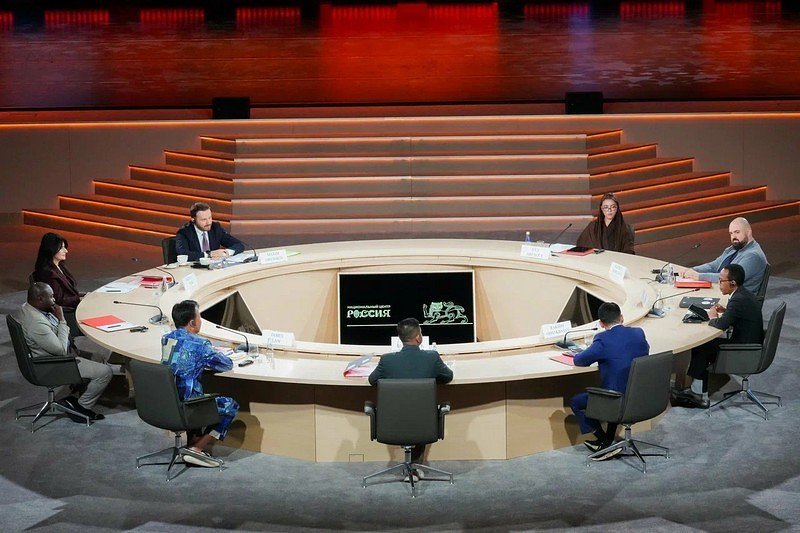
Moscow Dialogue Pushes Russian Vision for a New Global Order
MOSCOW, RUSSIA – May 01, 2026 – A recent international forum in Moscow, billed as a collaborative search for "new models of global growth," served as a high-profile platform for Russia to advance its long-held vision for a "multipolar" world order, challenging the existing global framework and courting allies from the Global South. The 2nd Open Dialogue, hosted by the Russia National Centre, gathered experts and researchers from over 40 countries to discuss economics, technology, and the environment, but the event's subtext was unmistakably geopolitical.
Beyond Economics: A Geopolitical Blueprint
While the three-day program focused on themes like "Investing in People" and "Investing in Technology," the overarching message aligned squarely with Russia's foreign policy objectives. The dialogue is a key component in a broader strategy to dismantle what Moscow views as a U.S.-centric world and establish itself as a primary pole in a new global architecture. This ambition is not new, tracing its roots to the post-Cold War "Primakov Doctrine," which advocated for countering U.S. hegemony and restoring Russian influence.
An honorary guest at the event articulated this vision, stating, "a multipolar architecture of global development is being formed before our eyes." This new order, according to the official remarks, relies on "states that understand and value national sovereignty." The core principle, as promoted throughout the event, is that "no country can develop in isolation, at the expense of other states or to their detriment."
This narrative of sovereign equality and mutual respect is designed to resonate with nations that feel marginalized by existing international institutions. By hosting events like the Open Dialogue and leveraging state-affiliated think tanks such as the Valdai Discussion Club, Russia is actively working to build a coalition of countries, particularly from Asia, Africa, and Latin America, that are receptive to an alternative to the Western-led order.
The 'Joint Development' Pitch: Tech Sovereignty without 'Colonial Rent'
A central pillar of Russia's outreach is its economic and technological proposal, which it contrasts sharply with Western practices. Russian economist Maxim Oreshkin summarized the approach at the dialogue, positioning Russia as a partner offering "joint development." He asserted that when Russian digital platforms enter foreign markets, they bring data localization, local partnerships, and personnel training.
"Russia comes to develop together, not to collect colonial rent from countries that lack access to technological solutions," Oreshkin stated, drawing a clear line against what he implied were exploitative models of engagement.
This message found a receptive audience. The winner of the event's "Investing in Technology" track, Aya Arfaoui from Morocco's Mohammed V University, directly addressed the need for developing countries to achieve digital sovereignty, arguing that current international institutions offer insufficient influence. Similarly, Solomon Gardie, an Ethiopian postgraduate student who won the "Investing in Connectivity" track, proposed a system for managing sovereign data, suggesting it could be processed and anonymized before any cross-border transfer to serve the "common good," with healthcare and epidemiological monitoring within the BRICS+ framework as a potential starting point. This focus on data control and technological independence is a powerful lure for nations wary of Silicon Valley's dominance.
Amplifying Voices from the Global South
The dialogue skillfully amplified grievances and aspirations from across the developing world, lending grassroots credibility to its agenda. Beyond digital sovereignty, participants raised fundamental questions about the metrics and systems that govern the global economy and society.
Soumya Bhowmick, a research fellow from India's Observer Research Foundation and winner in the "Investing in the Environment" track, challenged the world's near-century-long focus on GDP as a measure of progress, arguing it fails to reflect a country's "real wealth." In the "Investing in People" track, winner Lubinda Haabazoka from Zambia contended that true convergence among countries of the Global South requires more than just declarations; it demands practical changes in core systems like education to foster genuine cooperation.
This sentiment was echoed by Dr. Selina Neri, an expert from the UAE, who argued that the future should be built "around the individual, their health, agency, and a long, meaningful life, rather than around technologies and outdated systems." These perspectives, highlighted and celebrated by the event's organizers, help frame Russia's push for a new world order not just as a great-power rivalry, but as a response to a widely felt need for a more equitable and human-centric future.
From Dialogue to Diplomacy: A Strategic Pipeline
The Open Dialogue is far from a purely academic exercise. Its conclusions and the network it cultivates are intended to feed directly into Russia's key diplomatic and economic platforms. Organizers announced that the ideas discussed will be reviewed at the influential St. Petersburg International Economic Forum (SPIEF) and will be integrated into preparations for the BRICS summit and the Russia–Africa Summit.
This creates a strategic pipeline, transforming theoretical discussions into agenda items for forums where binding agreements and alliances are forged. The expansion of BRICS to include major economies from the Global South is a cornerstone of this strategy. At recent forums, Russian officials have emphasized that the bloc now represents a significant portion of the global economy and is actively working on creating alternative financial systems, including increasing the use of national currencies in trade to bypass the U.S. dollar.
Western analysts view these moves with considerable skepticism, interpreting Russia's advocacy for "multipolarity" not as a quest for a more balanced world, but as an attempt to carve out its own sphere of influence, free from the constraints of international law and Western oversight. The reduced presence of Western leaders and companies at events like SPIEF since 2022 has been widely noted, yet Moscow has successfully pivoted, drawing in delegations from across Asia, the Middle East, and Africa. These forums now serve as crucial venues for Russia to solidify its role as a self-proclaimed leader of the "world majority" and demonstrate that its isolation from the West has not translated into global isolation. The ideas seeded at the Open Dialogue are the intellectual groundwork for the political and economic architecture Russia hopes to build.