
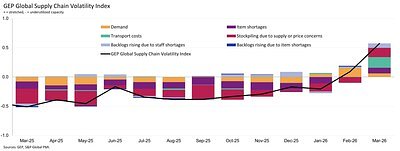
- GEP Global Supply Chain Volatility Index: Skyrocketed to 0.57 in March 2026, the highest since January 2023, up from 0.09 in February 2026.
- Brent crude oil prices: Peaked at $126 per barrel, the highest in four years, driving up transportation costs.
- U.S. Consumer Price Index (CPI): Rose 3.3% year-over-year in March 2026, with energy prices surging 10.9% monthly.
Experts warn that the Mideast war is creating severe supply chain disruptions, stockpiling, and inflation, but it has not yet caused a broad-based economic slowdown.
Mideast War Pushes Global Supply Chains to Three-Year Crisis Point
CLARK, N.J. – April 10, 2026 – The global network of trade and manufacturing is flashing its brightest warning signal in three years, as the immediate economic fallout from the war in the Middle East sends shockwaves through supply chains. A new report reveals that worldwide supply chain pressures surged to a crisis point in March, triggering widespread material shortages, a frantic rush to stockpile goods, and transportation costs not seen in nearly half a decade.
The GEP Global Supply Chain Volatility Index, a key barometer of logistics health produced by GEP and S&P Global, skyrocketed to 0.57 in March. This represents a dramatic escalation from February's relatively calm reading of 0.09 and marks the most intense strain on supply chains since January 2023. The index, based on a monthly survey of 27,000 businesses, pinpoints the escalating conflict in the Middle East as the primary driver, unleashing an energy price shock and severe maritime disruptions that are now rippling across the global economy.
The Anatomy of a Global Disruption
The sudden spike in volatility is a direct consequence of the war that erupted in the Middle East on February 28, 2026. The conflict immediately choked off critical arteries of global trade. The Strait of Hormuz, a narrow waterway through which a significant portion of the world's oil is exported, became severely restricted, effectively throttling a vital energy lifeline.
This geopolitical earthquake sent energy markets into a frenzy. Brent crude oil prices, a global benchmark, shot past the $100 per barrel mark for the first time in four years, peaking at $126. This surge directly translated into a four-year high for global transportation costs in March, as the price of fuel for ships, planes, and trucks soared.
The disruption was not confined to a single chokepoint. The conflict also saw the resumption of attacks in the Red Sea, another critical maritime corridor. This renewed threat has forced shipping companies to consider longer, more expensive routes around Africa, compounding delays and costs that are ultimately passed down the chain. The impact was felt most acutely in Asia, given its heavy reliance on Middle East oil, with nations like Taiwan, Vietnam, and South Korea reporting a sharp rise in producer price inflation.
A World of Shortages and Stockpiles
In response to the escalating crisis, manufacturers have slammed the brakes on purchasing while simultaneously hoarding essential materials. Reports of companies building "safety stockpiles" due to fears of further price hikes or supply unavailability hit a three-year high in March. This shift towards a "just-in-case" mentality is a stark reversal of the lean "just-in-time" inventory models that have dominated global manufacturing for decades.
European manufacturers have been the most aggressive in building up their inventory buffers. However, this defensive stockpiling has created a paradox: even as overall demand for new inputs weakened globally, shortages of key materials intensified, reaching their highest level in three years. The availability of crucial industrial components like polymers, PVC, and rubber, as well as energy-intensive metals such as aluminum and copper, has reportedly deteriorated significantly.
This indicates the emergence of severe bottlenecks. Companies are trying to secure what they can, when they can, creating a self-reinforcing cycle of scarcity and price inflation for the most sought-after materials.
Regional Tremors, Global Impact
While the pressure is global, its intensity varies by region, painting a picture of worldwide strain.
In Asia, the volatility index leaped to 1.16, its highest level since August 2022. The continent is caught between soaring transportation costs and weakening demand, a difficult combination for its export-driven economies.
North America saw its index jump from a state of spare capacity (-0.26) to significant pressure (0.42), a 39-month high. This signals the strongest degree of strain on the continent's supply chains since December 2022, driven primarily by rising cost pressures even as underlying demand remains soft.
Europe, heavily reliant on imported energy, is feeling the heat acutely. Its index rose to 0.64, the most intense pressure since January 2023. The energy shock is feeding directly into broader economic concerns, with Eurozone annual inflation climbing to 2.5% in March, reversing a previous cooling trend.
Even the United Kingdom is not immune, with its index ticking up to 0.16, pointing to the clear emergence of new supply bottlenecks.
The Price of Conflict Hits Home
For consumers far from the front lines, the abstract numbers of supply chain volatility are quickly translating into tangible costs. The surge in energy prices has had an immediate and painful effect on household budgets. In the United States, the Consumer Price Index (CPI) jumped 3.3% year-over-year in March, the highest annual rate in nearly two years, driven largely by a staggering 10.9% monthly leap in energy prices.
This was most visible at the gas pump, where prices soared, but economists warn the inflationary effects are just beginning to ripple through the economy. Higher fuel costs mean higher shipping costs for nearly every product, from electronics to clothing. The cost of food is particularly vulnerable, as rising diesel prices increase the expense of transporting groceries, while higher energy costs also drive up the price of fertilizers used to grow crops.
"The war is pushing up costs, triggering stockpiling and creating shortages across supply chains, but it has not yet escalated into a broad-based shock that materially slows global economic growth," said Mukund Acharya, vice president of consulting at GEP. The challenge for businesses now is navigating this treacherous landscape. "Companies need to secure supply where it matters most while avoiding broad stockpiling that can lock in higher costs."
This delicate balancing act will define the coming months as businesses and consumers alike brace for a period of sustained uncertainty and heightened costs, a direct consequence of conflict half a world away.
Topics & Related
Oil & Gas
Banking
Chemicals
Electronics Manufacturing
Revenue
Net Income
Related Company Pulse