
- $1.74 billion USD invested in Midea's auto parts base in Anqing, China, designed to produce 60 million units annually.
- 7 months to build the Monterrey plant, positioning Welling in Mexico's EV corridor.
- 18,000+ global R&D personnel backing Welling's technological innovation.
Experts view Welling's Monterrey plant as a strategic move to strengthen North America's EV supply chain, leveraging proximity, cost efficiency, and technological innovation to compete with established suppliers.
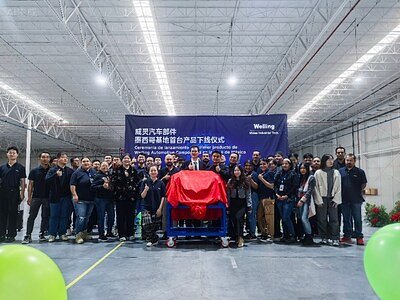
Midea's Auto Gambit: Welling Plant Opens in Mexico's EV Corridor
MONTERREY, Mexico – November 28, 2025 – While the official press release from Welling Auto Parts announced the first product rolling off its new Monterrey production line, the real story isn't just about one factory. It's a calculated and aggressive move in a high-stakes chess game for the future of the automotive supply chain. The facility, built in a remarkably swift seven months, represents a critical beachhead for its parent company, Chinese home appliance and industrial conglomerate Midea Group, as it quietly but forcefully diversifies into the booming new energy vehicle (NEV) sector.
This isn't merely an expansion; it's a statement. By planting a flag just south of the U.S. border, Welling is positioning itself at the epicenter of a tectonic shift in automotive manufacturing, challenging established component suppliers and offering a compelling new option for automakers scrambling to localize their supply chains.
A Giant Awakens: Midea's Automotive Gambit
For investors and industry watchers, understanding Welling Auto Parts requires looking past its 2018 founding date and focusing on its powerful parent. Welling is a core division of Midea Industrial Technology, one of the five major business arms of the Midea Group. This connection provides Welling with immense financial backing, a deep reservoir of R&D talent, and decades of expertise in the very technologies that are fundamental to electric vehicles: motors, compressors, and sophisticated control systems.
This is not a tentative dip into a new market. Midea has been methodically building its automotive capabilities for years. The company's stated strategy is not to build cars, but to become an indispensable Tier 1 supplier of comprehensive system solutions for NEVs. This ambition is backed by massive capital investment, including an 11 billion yuan (approx. $1.74 billion USD) auto parts base in Anqing, China, designed to churn out 60 million units annually.
Welling's portfolio targets the heart of an NEV, focusing on three critical areas: thermal management, electric drive systems, and chassis execution systems. With products like e-Compressors, integrated thermal modules, and EPS motors, the company is leveraging Midea's electromechanical prowess to compete in high-value segments. The Monterrey plant, therefore, is the logical next step in a global strategy, moving production from its domestic powerhouse to the doorstep of its target market.
The Monterrey Magnet: North America's New EV Nexus
The choice of Monterrey is strategically brilliant. The city, located in the state of Nuevo León, is rapidly becoming the undisputed capital of Mexico's burgeoning NEV ecosystem. The decision is driven by a confluence of powerful economic and geopolitical forces. The USMCA trade agreement provides largely duty-free access to the massive U.S. and Canadian markets, a crucial advantage for any supplier.
More importantly, Welling's arrival is part of a much larger trend of nearshoring. After years of pandemic-related disruptions and geopolitical tensions exposed the fragility of long-distance supply chains, automakers are aggressively seeking to bring component manufacturing closer to their North American assembly plants. Mexico offers the ideal solution: a skilled and established automotive workforce, competitive labor costs, and unparalleled logistical proximity.
The most significant validation of this trend is Tesla's Gigafactory, currently under construction just outside Monterrey. The presence of the world's leading EV maker creates a powerful gravitational pull, attracting a constellation of suppliers eager to serve it. But the opportunity extends far beyond Tesla. General Motors, Ford, Stellantis, and Volkswagen all have significant manufacturing footprints in Mexico and are pivoting their operations toward electrification. For these legacy giants, having a technologically advanced component supplier like Welling in their backyard is a major boon for supply chain resilience and cost management.
The High-Stakes Race for Thermal Management
The first product to roll off Welling's new line was a thermal management component, thrusting the company directly into one of the most competitive and technologically crucial segments of the NEV market. Effective thermal management is not an optional luxury in an electric vehicle; it is fundamental to performance, safety, and longevity. These systems are responsible for maintaining the battery, motor, and power electronics within their optimal temperature ranges, directly impacting vehicle range, charging speed, and the overall lifespan of the most expensive component—the battery pack.
The market is crowded with formidable incumbents like Denso, Hanon Systems, Mahle, and Valeo. To compete, Welling is banking on both technological innovation and the strategic advantage of its new location. The industry is rapidly moving toward highly integrated thermal modules that combine pumps, valves, and heat exchangers into compact, efficient units. Welling’s focus on these integrated systems, as highlighted in its product literature, shows it is aligned with this forward-looking trend.
By manufacturing these complex systems in Mexico, Welling can offer automakers reduced lead times, lower logistics costs, and greater agility to respond to design changes. Backed by Midea's global R&D network of over 18,000 personnel, the company has the resources to potentially undercut competitors on price while keeping pace on technology, a combination that will undoubtedly get the attention of procurement executives at every major automaker.
Forging a Resilient Supply Chain
Ultimately, the launch of Welling's Monterrey plant is a key development in the broader narrative of building a more robust and localized North American automotive supply chain. It directly addresses the vulnerabilities that have plagued the industry for the past five years. For automakers, sourcing critical components like thermal management systems from Mexico instead of Asia mitigates risks from shipping delays, port congestion, and international trade disputes.
Furthermore, local production helps automakers meet the increasingly stringent rules-of-origin requirements under the USMCA, which are necessary to qualify for preferential tariff treatment. As government incentives for EVs become more tied to domestic or regional content, the value of suppliers like Welling will only increase.
The move by Midea, through its Welling division, serves as a clear signal to the market. The race to supply the electric vehicle revolution is global, but the battles will be won regionally. By establishing a state-of-the-art manufacturing hub in the heart of North America's emerging EV corridor, Welling Auto Parts has not only secured a strategic advantage for itself but has also intensified the competitive pressure on every other component supplier vying for a piece of this multi-billion dollar market.