
- $750 million: The privately-funded cost of the new stadium set to open in 2028.
- 14-year deal: The naming rights agreement between McDonald's and Chicago Fire FC, running through 2040.
- 60,000 students: The number of Chicago Public Schools students expected to be reached by the expanded P.L.A.Y.S. program by 2028.
Experts would likely conclude that while the McDonald's Park partnership represents a strategic evolution for both the fast-food giant and Chicago Fire FC, its success will hinge on balancing corporate ambitions with community needs, particularly in addressing gentrification and infrastructure concerns.
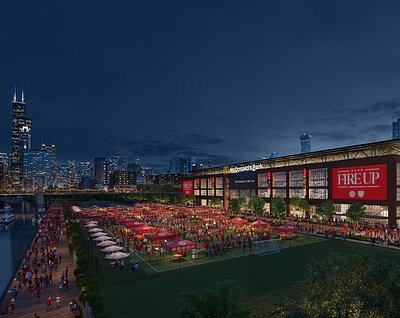
McDonald's Park: Chicago Fire's New Home Sparks Hope and Controversy
CHICAGO, IL – May 13, 2026 – Two of Chicago’s most recognizable brands, McDonald’s Corporation and Chicago Fire Football Club, have unveiled a historic partnership that will christen the soccer club's new stadium 'McDonald's Park'. The announcement marks a monumental step for both organizations, planting a massive fast-food flag in the world of major American sports venues while promising a new era for the MLS team and the city itself.
The $750 million privately-funded stadium, set to open in 2028 as the centerpiece of the ambitious 'The 78' riverfront development, is McDonald's first-ever naming rights deal for a major professional sports stadium in the United States. The long-term agreement, reported to run through 2040, goes far beyond a simple name on a building. It envisions a year-round destination complete with a flagship McDonald's restaurant, immersive fan experiences, and a deep-seated community investment strategy.
"Together, we are creating more than a stadium," said Chris Kempczinski, Chairman and CEO of McDonald's, in the official announcement. "We are building a place that serves up joy, brings together community, delivers impact, and is designed to serve generations to come."
Chicago Fire FC Owner and Chairman Joe Mansueto, who is privately financing the stadium, echoed the sentiment of a partnership rooted in shared Chicago values. "McDonald's is the perfect partner – an iconic global brand with deep Chicago roots and shared values in supporting our community," Mansueto stated. "McDonald's Park will be the stadium that Chicago deserves."
A New Playbook for the Golden Arches
For McDonald's, a company with over 45,000 locations worldwide and a marketing strategy built on global consistency and local relevance, this deal represents a significant strategic evolution. While the brand is no stranger to sports, having sponsored events like the FIFA World Cup and maintaining over 30 active sponsorships, attaching its name to a permanent, physical stadium of this scale in its home country is a bold new play.
The move places McDonald's in the high-stakes arena of stadium naming rights, a space where brands seek to embed themselves into the cultural and emotional fabric of a city. The 14-year commitment signals a long-term vision that aligns with the company’s "think global, act local" philosophy. By anchoring this major initiative in its headquarters city, McDonald's aims to create a powerful symbol of its brand that extends beyond the drive-thru window. The partnership is designed to be deeply integrated, with the fast-food giant influencing everything from in-game moments to the design of the stadium's culinary offerings, promising to bring fans together over sport and food.
Beyond the Big Mac: A Promise to Chicago's Youth
At the heart of the announcement is a landmark pledge to expand youth access to soccer across Chicago. The partnership will see McDonald's become the presenting partner of the Chicago Fire Foundation's P.L.A.Y.S. (Participate, Learn, Achieve, Youth, Soccer) Program, a move that promises to quadruple the program's reach.
Launched in 2013, the P.L.A.Y.S. program has already demonstrated significant positive impact by integrating a soccer-based curriculum with social and emotional learning for elementary school students. Data has shown that participants experience fewer disciplinary incidents and unexcused absences, with a notable 50% drop in crime reported near program spaces, many of which are in Chicago's most under-resourced neighborhoods.
The new commitment is ambitious. Beginning in 2027, the partnership will deliver co-branded "Soccer Starter Kits" to over 280 Chicago Public Schools (CPS). By the stadium's 2028 opening, the P.L.A.Y.S. program will double its footprint from 70 to 140 schools, reaching over 60,000 students. The long-term goal is to serve all CPS elementary schools identified with elevated need, ultimately reaching more than 125,000 students. The partnership will also feature extensive support for Ronald McDonald House Charities (RMHC), with stadium-wide "Round-Up" donation opportunities and a dedicated seating section for RMHC families.
A Stadium of Contention
While the partnership is being celebrated as a major win for youth sports and corporate responsibility, the stadium itself is an anchor in a development that has stoked significant community concern. 'The 78', an $8 billion, 62-acre project by developer Related Midwest, aims to create Chicago's 78th official neighborhood on a long-vacant stretch of land between the South Loop and Chinatown. However, the stadium's path to approval has not been without opposition.
Residents and community organizers from the surrounding neighborhoods of Chinatown, Pilsen, and Bronzeville have voiced strong fears that the massive development will accelerate gentrification, drive up property values, and displace long-time residents and small businesses. The "Community Benefits Agreement for 78 Coalition" has formed to demand a legally binding agreement from the developer to protect community interests.
A primary point of contention is the perception that a private sports venue is replacing what was once promised as public green space and riverfront access. Concerns over the potential loss of cultural anchors like Ping Tom Memorial Park in Chinatown are particularly acute. While a survey conducted by the South Loop Neighbors group found that 73% of its respondents were supportive of the stadium, citing its design and new public amenities like a riverwalk extension, critics argue that the community engagement process has been insufficient. They claim developers and city officials have provided vague responses to pressing questions about traffic, infrastructure, and displacement.
Further fueling the debate are infrastructure concerns. Critics point to the developer's rejection of proposals for a new CTA station within the development, raising fears of increased traffic congestion and overcrowded public transit on game days. Although the stadium is privately financed, questions linger about the use of public Tax Increment Financing (TIF) funds approved for the broader 'The 78' project, with some worried the funds will disproportionately benefit the stadium rather than the needs of existing Chicagoans. When McDonald's Park opens its gates, it will represent more than just a new home for the Chicago Fire; it will be a test case for a new model of urban development, where the goals of a global corporation, a professional sports team, and the diverse communities of a major American city intersect.