
- $31 million invested in the Massachusetts AI Hub for high-performance computing.
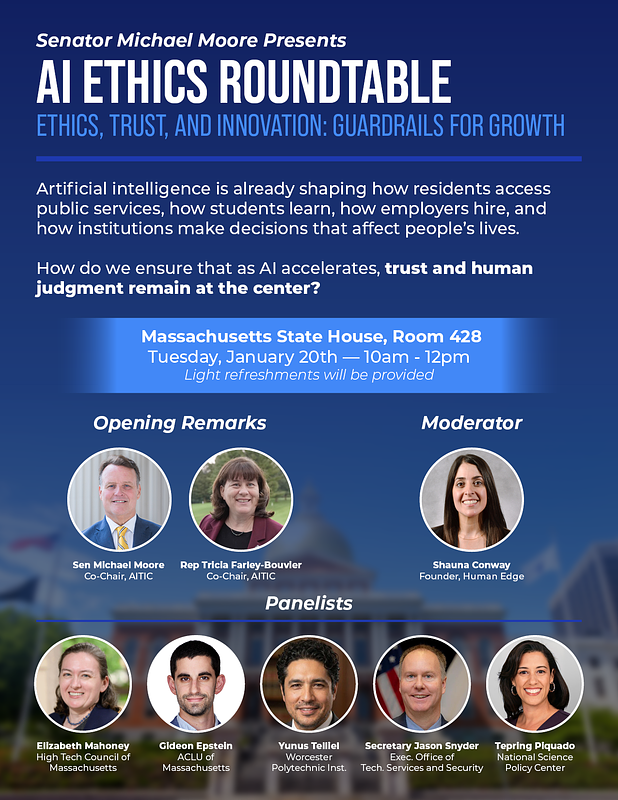
- January 20, 2026 roundtable convened by Senator Michael O. Moore to discuss ethical AI.
- 2025 saw the passage of the Massachusetts Data Privacy Act and AI healthcare regulations.
Experts agree that Massachusetts is taking a proactive, multi-stakeholder approach to balance AI innovation with ethical safeguards, setting a model for responsible AI governance.
Massachusetts Charts Ethical AI Path Amid Shifting Federal Policy
BOSTON, MA – January 13, 2026 – As artificial intelligence quietly integrates into the fabric of daily life—from public services to hiring practices—Massachusetts leaders are preparing to ask a critical question: How can the Commonwealth champion technological innovation while keeping human values and public trust firmly in the driver's seat?
Next week, on Tuesday, January 20, Senator Michael O. Moore will convene a cross-sector roundtable at the State House to address this challenge head-on. The dialogue will bring together key figures from government, the technology industry, civil liberties organizations, and academia to navigate the complex ethical terrain of AI. The goal is not to legislate on the spot, but to foster a foundational, good-faith discussion before policy positions harden and sides are chosen.
"As artificial intelligence becomes more embedded in how people experience government, education, and opportunity, it's important that policymakers listen carefully to those building, using, and studying these technologies," Senator Moore stated in a release. "This roundtable is about creating space for that dialogue, so innovation continues in ways the public can understand and trust."
A Proactive State in a Shifting Federal Landscape
The timing of the roundtable is significant, placing Massachusetts at the forefront of a national conversation where states are increasingly taking the lead. The discussion unfolds against a backdrop of a decisive federal pivot on AI regulation. In 2025, President Trump's Executive Order 14179, "Removing Barriers to American Leadership in Artificial Intelligence," signaled a move away from the previous administration's regulatory framework, directing agencies to roll back rules perceived as hindering innovation. This shift has placed greater responsibility on individual states to establish their own ethical guardrails.
Massachusetts has already embraced this role with a series of proactive measures. Governor Maura Healey's administration launched the Massachusetts AI Strategic Task Force in 2024, leading to the creation of the Massachusetts AI Hub. Backed by a significant $31 million investment in high-performance computing, the Hub aims to cement the state's position as a global leader in applied AI.
This roundtable builds on a robust legislative foundation. In 2025, the state saw the Senate pass the comprehensive Massachusetts Data Privacy Act and introduce specific rules for AI in healthcare through Senate Bill 2632. Senator Moore himself is a sponsor of related legislation, underscoring his deep engagement with the issue. These efforts, combined with new AI strategies for K-12 education and generative AI usage policies for state agencies, paint a picture of a commonwealth determined to lead not just in innovation, but in responsible implementation.
Bridging Divides: The Conveners and Their Mission
Facilitating this crucial conversation is Human Edge™, a collaborative initiative founded by the consultancy Strategic Growth & Innovation, LLC. The group specializes in bringing disparate voices to the same table to build consensus around human-centered technology adoption. The roundtable's design explicitly prioritizes listening and learning over advancing specific policy proposals.
The session will be framed and moderated by Shauna Conway, the founder of both organizations, who brings over two decades of experience in technology strategy and governance. Her role highlights a growing trend of public-private partnerships tackling complex societal challenges posed by technology.
"Ethics and innovation are often framed as being in tension, but in practice they are deeply connected," said Conway. "When people understand how AI is used and why decisions are made, trust grows. This conversation is about bringing leaders together across sectors to explore how Massachusetts can continue to lead with both innovation and integrity."
A Deliberate Dialogue: Who's in the Room and Why
The strength of the roundtable lies in the diversity of its participants, who represent the primary sectors grappling with AI's rapid ascent. Each brings a critical perspective to the table:
- Elizabeth Mahoney, from the Massachusetts High Technology Council, will represent the business and innovation engine, likely focusing on creating a climate that fosters technological growth and economic competitiveness.
- Gideon Epstein, of the ACLU of Massachusetts, will champion the civil liberties angle, raising crucial questions about algorithmic bias, surveillance, and the protection of individual rights in an automated world.
- Yunus Telliel, an assistant professor from Worcester Polytechnic Institute, brings an academic and humanistic lens, informed by research into the ethical implications of technology and the importance of human-centered design.
- Secretary Jason Snyder, the Commonwealth's Chief Information Officer, offers the pragmatic government perspective. Having co-led the Governor's AI Task Force, he is focused on the practical realities of implementing AI securely and effectively to improve public services.
- Tepring Piquado, CEO of the National Science Policy Network, will emphasize the need for evidence-based policymaking and ensuring that scientific expertise informs the governance of complex technologies like AI.
This curated group ensures the conversation will span the full spectrum of concerns, from fostering a vibrant tech economy to safeguarding the rights of the state's most vulnerable residents. The dialogue is structured to explore shared principles on transparency, human oversight in high-stakes decisions, and accountability under existing laws.
Beyond Policy to Everyday Life
While the discussion at the State House may seem high-level, its implications touch the daily lives of all Massachusetts residents. The principles of trustworthy AI are not abstract concepts; they determine whether a loan application is fairly assessed, whether a student's work is evaluated without bias, or whether a citizen can understand a decision made about their access to public benefits. The state's recent focus on AI in K-12 education and its new rules for AI in healthcare demonstrate a clear understanding of these tangible impacts.
By bringing these varied perspectives together, the roundtable aims to build a shared understanding that can guide future actions, whether in the legislature, the classroom, or the boardroom. As noted in the announcement, the session is intended as a starting point, not a conclusion. Following the meeting, a summary of key themes will be shared to support continued dialogue. This event signals that for Massachusetts, the path forward with artificial intelligence will be a journey of thoughtful dialogue, principled experimentation, and shared responsibility.