
- Market Value: Australian rail freight transport market valued at over USD 13 billion in 2025, projected to exceed USD 16 billion by 2031
- Freight Volume: Queensland’s regional network transported over 11.7 million tonnes of freight in 2021-22
- Locomotive Fleet: CRRC Ziyang has exported over 1,400 locomotives to 37 countries
Experts view Martinus' pivot to rail operations as a strategic move that could intensify competition in Australia's freight market, leveraging its integrated infrastructure expertise and modern fleet to challenge established players.
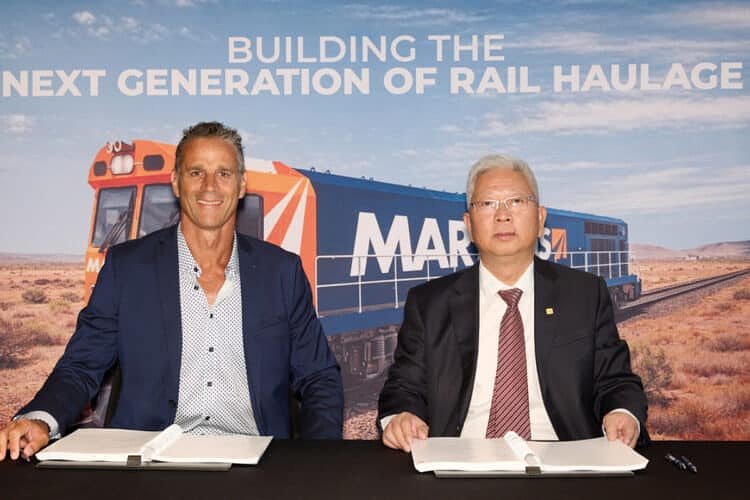
Martinus Pivots to Rail Operator, Challenging Australian Haulage Market
SYDNEY, AU – April 24, 2026 – In a bold strategic pivot, global railway infrastructure firm Martinus Group has announced its entry into the operational side of the rail industry with the launch of Martinus Haulage, a new bulk commodity transport service. The move is supported by a major locomotive partnership with Chinese manufacturing giant CRRC Ziyang, signaling a significant shake-up for Australia's established rail freight market.
This transition marks a deliberate evolution for the two-decade-old company, which built its reputation on designing and constructing complex rail projects across Australia, New Zealand, North America, and Chile. By becoming an 'above rail' operator, Martinus is vertically integrating its business to offer a complete end-to-end railway solution, a move that could reshape the competitive landscape.
From Builder to Full-Service Operator
Martinus Group is transforming from a trusted government infrastructure delivery partner into a comprehensive railway powerhouse. The company's new motto, as articulated by Chief Executive Officer Treaven Martinus, is simple and direct: “We build railways, now we operate them.” This statement encapsulates a strategy years in the making.
“This is a natural evolution for Martinus,” said Mr. Martinus in the official announcement. “Our experience designing and building railways, combined with our growing role as a government infrastructure delivery partner, has positioned us to take this next step into operations.”
The launch of Martinus Haulage, which will operate with its own fleet of locomotives and wagons, represents the final piece in the company's ambitious puzzle. “Together with our infrastructure development capability, we are building a complete railway offering across develop, design, build, own, operate and maintain,” Mr. Martinus added. “No-one else can offer the full above and below rail solution.”
This integrated model aims to provide clients with greater reliability and seamless service by controlling every aspect of the rail lifecycle. The initial focus for the new haulage service will be on Queensland’s narrow gauge bulk haulage network, with a clear strategy for expansion across Australia and into the company's international markets in North America and Chile.
A Global Partnership to Power a New Fleet
Central to Martinus Haulage's launch is a strategic partnership with CRRC Ziyang Co., Ltd., a subsidiary of the world's largest rolling stock manufacturer, CRRC Corporation Limited. The decision followed what Martinus described as a “comprehensive evaluation process,” providing the new operator with a “new-generation” fleet of locomotives.
While specific order numbers remain undisclosed, the technology involved is significant. CRRC Ziyang has developed advanced locomotives for the Australian market, such as its AC50 model. This 5000-horsepower diesel locomotive is specifically designed for Australian heavy-haul railways, featuring AC-DC-AC electric transmission technology for superior traction and lower fuel consumption. Crucially, these units are engineered for Queensland's 1067mm narrow gauge tracks and comply with UIC IIIA emission standards, a key factor in environmentally regulated markets.
CRRC Ziyang is no stranger to the global stage, having exported over 1,400 locomotives to 37 countries. The company first entered the Australian market in 2011, supplying locomotives to operators like SCT Logistics and Qube Logistics. That entry was not without challenges; some early units were temporarily sidelined in 2013-2014 due to the discovery of contained white asbestos, an issue that was subsequently remediated by the manufacturer. This new partnership with Martinus represents a continued and significant presence for the Chinese manufacturer in Australia's critical infrastructure supply chain.
Entering a Competitive and Evolving Market
Martinus Haulage is entering a highly competitive and valuable sector. The Australian rail freight transport market was valued at over USD 13 billion in 2025 and is projected to exceed USD 16 billion by 2031. The market is currently dominated by established heavyweights like Aurizon and Pacific National, particularly in the bulk commodity space which accounts for over 60% of industry revenue.
Martinus's initial focus on Queensland is strategic. The state’s regional network transported over 11.7 million tonnes of freight in the 2021-22 period, and its narrow gauge lines are essential for moving commodities from mines and farms to ports. The company aims to carve out a niche by offering what its CEO calls a “new approach” centered on reliability and long-term partnerships.
The timing of this entry coincides with a structural shift in the market. While traditional bulk commodities like coal face a long-term decline due to the global energy transition, the demand for transporting battery minerals such as lithium is creating new revenue streams. Martinus's arrival introduces a new dynamic, potentially increasing competition on price and service quality as the industry pivots toward more flexible, solution-based offerings.
Before the first Martinus Haulage train can roll, the company must navigate a stringent regulatory environment. Operations will be governed by the Office of the National Rail Safety Regulator (ONRSR), which enforces the Rail Safety National Law (RSNL) across Australia. Martinus will need to secure national accreditation and adhere to rigorous safety and reporting standards, a process designed to ensure that all operators, new and old, maintain the highest levels of safety in their rail activities. The company's investment in modern, emissions-compliant locomotives indicates an awareness of the complex regulatory and environmental landscape it is about to enter.