
- 92% of children in low-income countries cannot read a simple text by age ten (UNESCO)
- Only 18% of primary-school-aged children in sub-Saharan Africa achieve minimum proficiency in reading and mathematics
- Luminos Method helps children catch up on up to three years of schooling in just one year
Experts agree that the Luminos Fund's decentralized approach to scaling its proven educational model through local African NGOs is a critical step in addressing sub-Saharan Africa's foundational learning crisis, offering a sustainable and scalable solution to systemic educational challenges.
Luminos Fund Backs African NGOs to Scale Proven Education Model
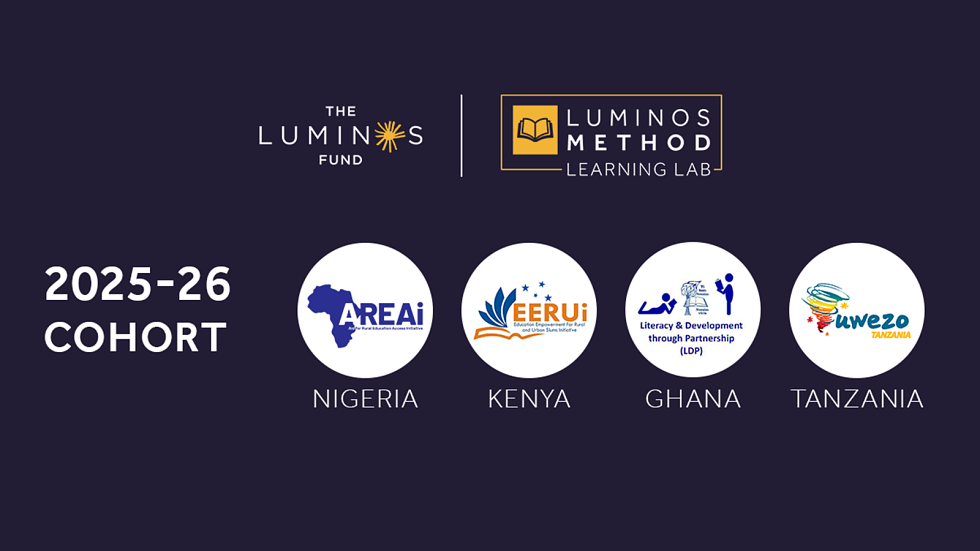
BOSTON, MA – December 09, 2025 – In a strategic move to decentralize and scale its impact, the international nonprofit Luminos Fund has announced the inaugural cohort of its Luminos Method Learning Lab. The initiative partners with four distinguished African-led organizations, providing them with training, immersive experience, and seed grants of up to $35,000 to deploy a proven educational model designed to combat the continent's deepening learning crisis.
The selected partners—Aid for Rural Education Access Initiative (AREAi) in Nigeria, Education Empowerment for Rural and Urban Slums Initiative (EERUi) in Kenya, Literacy and Development through Partnership (LDP) in Ghana, and Uwezo Tanzania—will be the first to adapt and implement the evidence-based Luminos Method within their own communities. This launch signals a pivotal shift from direct intervention to building a sustainable, locally-led network capable of transforming foundational learning for the most marginalized children across sub-Saharan Africa.
A System Under Strain: Africa's Foundational Learning Crisis
The challenge the Learning Lab aims to address is not merely social but a critical failure in human capital infrastructure. According to UNESCO, an estimated 92% of children in low-income countries are unable to read a simple text by age ten, a condition known as “learning poverty.” Sub-Saharan Africa is the epicenter of this crisis, home to over 40% of the world's 244 million out-of-school children, with Nigeria alone accounting for over 20 million.
Even for children who attend school, the outcomes are dire. In sub-Saharan Africa, only 18% of primary-school-aged children achieve minimum proficiency in reading and mathematics. The COVID-19 pandemic severely exacerbated this deficit, with extended school closures leaving a majority of adolescents struggling to catch up. This gap in foundational skills represents a systemic bottleneck, undermining future economic growth, industrial capacity, and the development of a digitally literate workforce.
Without basic literacy and numeracy, the promise of technological advancement and economic transformation remains out of reach for millions. Addressing this foundational layer is not just about education; it's about building the most essential infrastructure for a nation's future.
The Luminos Method: A Data-Driven Engine for Education
At the heart of the new initiative is the Luminos Method, a pedagogical system refined over a decade and backed by rigorous, independent data. It is not simply a curriculum but a highly structured, replicable process designed to produce specific, measurable outcomes. In just one school year, the program helps children who have fallen behind catch up on as many as three years of schooling.
The method’s effectiveness is not anecdotal. An independent randomized controlled trial (RCT) conducted by IDinsight in Liberia during the 2022-23 school year demonstrated transformational results. Students in the Luminos program could read four times as many words per minute and correctly solve twice as many addition and subtraction problems as their peers in control groups. These results have led to the Luminos program being recognized as one of only three education interventions globally that are both transformational and cost-effective by the Global Education Evidence Advisory Panel.
Further evidence comes from a 2018 longitudinal study by the University of Sussex, which tracked students in Ethiopia six years after they completed the program. It found that Luminos alumni continued to outperform their peers in government schools, completing primary school at nearly double the rate. In Ghana, a 2023-24 evaluation revealed that students improved their oral reading fluency to a level more than seven times the national average for their grade.
This system functions like a finely tuned engine, incorporating activity-based learning to maintain engagement and teacher-led assessments that act as a real-time data feedback loop. This allows educators to continuously monitor student progress and adjust their approach, optimizing the learning process for each classroom—a principle of data-driven adaptation familiar in the world of technology and AI.
From Global Blueprint to Local Implementation
The Luminos Method Learning Lab represents a strategic decision to move beyond direct implementation and empower those closest to the problem. The model is built on the belief that sustainable change requires deep local ownership. As one expert in international development noted, such “proximate leaders” bring essential “perspective, nuance, efficiency, and effectiveness” that external organizations cannot replicate.
The four inaugural partners were selected from a pool of over 70 applicants, a figure that underscores the immense demand for proven, scalable solutions. Each organization brings a unique strength to the cohort:
- AREAi (Nigeria): A grassroots organization known for leveraging technology and innovation to improve education in under-resourced communities.
- EERUi (Kenya): A community-based nonprofit focused on strengthening early childhood education and promoting sustainable, community-led learning models.
- LDP (Ghana): An organization specializing in mother tongue-based multilingual education, a critical component for effective early learning.
- Uwezo Tanzania: A respected, data-driven organization known for its nationwide assessments of learning outcomes, now poised to translate its insights into direct intervention.
Through hands-on training, immersion in active Luminos classrooms, and the catalytic power of seed funding, these organizations will not just replicate the Luminos Method but adapt it. They will integrate its core principles with their own local expertise, creating customized solutions that are culturally relevant and responsive to specific community needs.
Building a Scalable Network for Systemic Change
The long-term vision for the Learning Lab extends far beyond this first cohort. The initiative is designed as a blueprint for building a decentralized, resilient network of educational innovators. By empowering local partners, the Luminos Fund is creating a model that can scale more rapidly and sustainably than a centralized, top-down approach.
The ultimate goal is systemic integration. The Luminos Fund has already established successful partnerships with governments, such as its work in Ethiopia to adopt its model nationally and its collaboration with Ghana's Complementary Education Agency. The Learning Lab is the next logical step in this strategy, creating a groundswell of evidence and local capacity that can encourage and inform wider public sector adoption.
By investing in foundational learning, this initiative is making a long-term investment in the economic and industrial future of these nations. The children who regain their footing in these classrooms are the future technicians, entrepreneurs, and leaders who will build and manage the infrastructure of tomorrow. This first cohort of the Learning Lab is more than a project; it is a test case for a new, data-informed model of development that could unlock potential across the continent.