
- 120-degree wide-angle HD camera with real-time AI hazard judgment
- Automatic evidence capture with 'Evidence Chain Lock' for post-collision documentation
- GPS-based SOS alerts triggered by fall detection
Experts would likely view LIVALL's AI-powered system as a significant advancement in cycling safety, though its real-world effectiveness and privacy implications will require further validation.
LIVALL's AI Co-Pilot Aims for Autonomous-Grade Cycling Safety
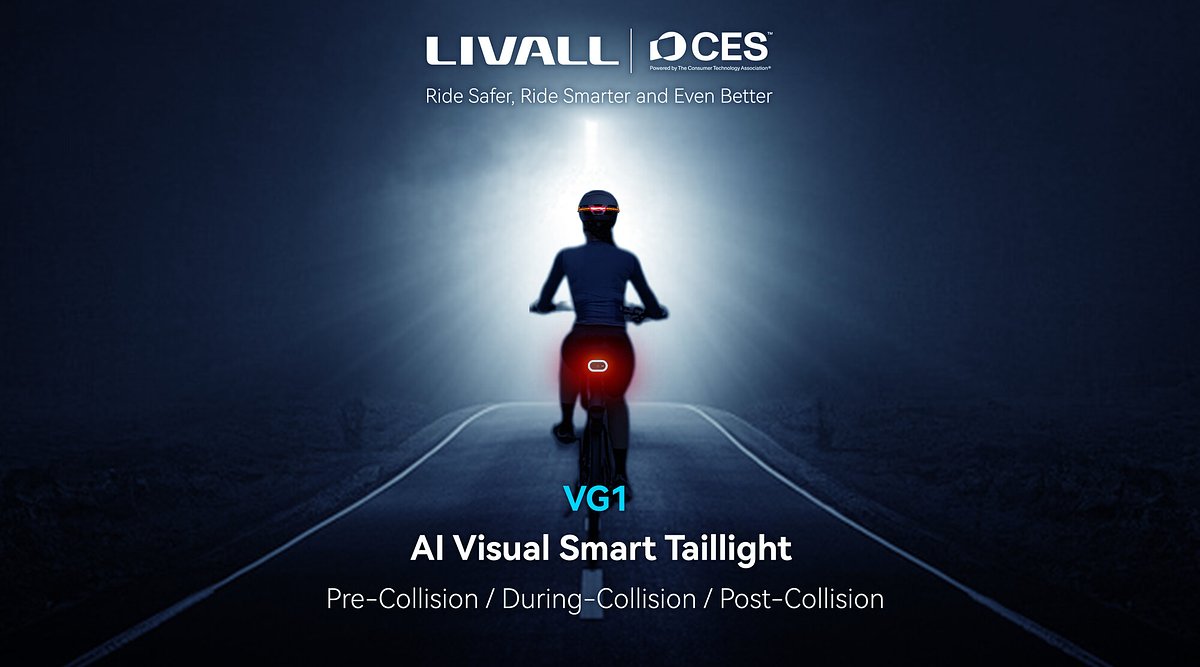
LAS VEGAS, NV – January 06, 2026 – As the doors open at CES 2026, smart cycling firm LIVALL is capturing attention with a bold new vision for two-wheel safety. The company today unveiled its groundbreaking AI Visual Smart Taillight (Model: VG1) and accompanying AI Visual Smart Helmet (Model: VGH10), a system it claims will bring active visual safety sensing—comparable to that found in four-wheel autonomous vehicles—into the cycling market for the first time.
This new ecosystem aims to fundamentally solve the critical challenge of the rider's blind spot by creating what LIVALL calls a holistic "Pre-Collision / During-Collision / Post-Collision" safety loop. The technology promises not just to react to incidents, but to actively prevent them, potentially redefining safety standards for millions of urban commuters and recreational cyclists worldwide.
An AI Co-Pilot for the Daily Commute
The centerpiece of the announcement is the VG1 AI Visual Smart Taillight. More than just a light, LIVALL positions the device as a rider's "Safety Co-pilot." It integrates a 120-degree wide-angle HD camera with an onboard AI chip that performs real-time edge computing. This allows the device to constantly analyze the traffic situation behind the cyclist and perform what the company terms "AI Visual Hazard Judgment."
When the AI identifies a potential threat, such as a vehicle approaching too quickly or straying into the bike lane, it triggers a bi-directional warning. Internally, the rider receives an immediate audio alert through the VG1's built-in buzzer or, when paired, through the VGH10 Smart Helmet's open-ear audio system. Simultaneously, the taillight initiates an external warning—an ultra-bright, pulsating light burst designed to capture the attention of the driver behind them.
The system's protection extends beyond pre-collision warnings. In the event a dangerous situation escalates, the VG1's "Evidence Chain Lock" feature automatically captures and saves critical video footage, providing what LIVALL describes as indisputable legal evidence. This function addresses a growing need among cyclists for reliable documentation in the event of a dispute or hit-and-run.
Completing the safety loop is the post-collision phase, which leverages LIVALL's well-established, patented Fall Detection & SOS Alarm. If a crash does occur, the system automatically sends an alert with the rider's GPS location to pre-selected emergency contacts, helping to secure rescue within the critical "Golden Hour."
The VGH10 helmet acts as the central hub and intuitive rider interface for this ecosystem, delivering the AI's audio warnings without obstructing ambient sounds, while also enabling features like hands-free communication and navigation audio.
Redefining Safety in a Crowded Market
LIVALL, a US-based company founded in 2014, is no stranger to the smart cycling space, having pioneered helmets with integrated fall detection and communication features. However, its new AI-powered system enters an increasingly competitive and innovative market.
For years, Garmin's Varia line has dominated the rear-detection market with radar-based systems that alert riders to approaching vehicles via a head unit. Companies like Cycliq have focused on integrated camera-and-light combos that record footage for evidence, while brands such as Lumos and Unit 1 have gained popularity with helmets featuring bright, 360-degree lighting, turn signals, and crash detection. Some of these helmets already meet the NTA 8776 certification, a Dutch standard for helmets designed to withstand higher-speed impacts common with e-bikes.
More recently, a new wave of AI-powered competitors has emerged. Systems from Hawkeye and Infinum have introduced digital rearview mirrors and multi-camera architectures that use AI to classify objects and assess risk. LIVALL's key differentiator appears to be its focus on creating a single, deeply integrated ecosystem. Where competitors often offer a piece of the puzzle—be it radar detection, video recording, or smart lighting—LIVALL is combining AI visual sensing, bi-directional warnings, automatic evidence capture, and SOS alerts into one cohesive unit that works in concert.
This holistic approach is what underpins the company's ambitious claims of providing a new tier of safety for two-wheeled transport.
The 'Autonomous-Grade' Promise and Its Hurdles
The assertion that this technology provides "four-wheel autonomous-grade safety" is a powerful marketing statement intended to draw a parallel with the most advanced safety systems in the automotive world. It's important to clarify that this does not mean the bicycle is autonomous; rather, it suggests the adoption of core principles and technologies from autonomous driving, such as advanced perception, sensor fusion, and pre-collision threat assessment.
While impressive, the system will face real-world tests that will determine its true effectiveness. The performance of visual AI is highly dependent on its algorithms and processing power to function reliably across a spectrum of challenging conditions, including the glare of direct sunlight, deep shadows, heavy rain, fog, and the chaotic visual noise of a dense urban environment. The system's ability to distinguish genuine threats from false positives will be critical to earning rider trust.
Until the products are released and subjected to independent, third-party testing, the "autonomous-grade" label remains a forward-looking promise. The success of the VG1 and VGH10 will hinge on whether their performance in unpredictable daily commutes lives up to the standards set by the controlled, highly regulated world of automotive ADAS (Advanced Driver-Assistance Systems).
The Unseen Lens: Privacy in an Era of Smart Safety
The integration of an always-on, AI-powered camera that automatically records incidents raises significant questions about data privacy and legal responsibility. While the "Automatic Video Capture" feature is marketed as a tool for providing legal evidence, it operates within a complex web of regional privacy laws.
In Europe, for example, the General Data Protection Regulation (GDPR) places strict limits on the indiscriminate recording of public spaces. While footage captured for purely personal use or as evidence in an accident may be permissible, the line can be blurry. Users of such devices may inadvertently become data controllers, responsible for protecting the privacy of any identifiable individuals captured in their videos.
Posting footage online that contains identifiable faces or license plates without consent is illegal in many jurisdictions. Furthermore, while police forces increasingly accept video submissions to report dangerous driving, the legal standing and handling of that data can vary. LIVALL will need to provide users with a robust privacy policy and clear guidance on how to manage, store, and use recorded footage responsibly to avoid legal pitfalls.
As these technologies become more common, they place a new level of responsibility on the cyclist, who must balance their own safety against the privacy rights of others on the road. The market's response will likely depend on how seamlessly LIVALL helps its customers navigate these modern challenges.
With the global e-bike market projected to exceed $100 billion by 2030, the demand for more sophisticated safety solutions is undeniable. LIVALL's new ecosystem is positioned as a premium offering, likely carrying a price tag that will initially appeal to early adopters and safety-conscious enthusiasts. This strategy reflects a broader trend in which advanced technology, once the domain of luxury cars, is trickling down to other forms of mobility. "We are in a new era where AI is redefining safety," stated Bryan Zheng, Founder of LIVALL, in the company's press release. "We aim to prevent collisions at the source—the pre-collision phase. By substantially reducing two-wheel accident rates, we fulfill a social mandate and conserve vital public healthcare resources."