
- $2.7 billion: The value of the public-private partnership to modernize Libya's Misurata Free Zone Port.
- 4 million containers per year: The target container-handling capacity after expansion.
- 8,400 direct jobs: The projected number of new employment opportunities created by the project.
Experts view this deal as a strategic step toward economic diversification for Libya, though success hinges on sustained political stability and overcoming governance challenges.
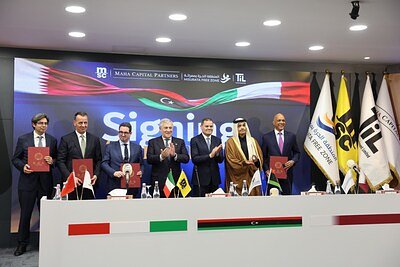
Libya's $2.7B Port Deal: A Bid for Mediterranean Hub Status
MISURATA, Libya – January 19, 2026 – In a move signaling a potential turning point for its post-conflict economy, Libya has secured a landmark $2.7 billion public-private partnership (PPP) to transform the Misurata Free Zone (MFZ) Port into a leading Mediterranean gateway and transhipment hub. The agreement, the first major non-energy infrastructure PPP in the nation's recent history, brings together powerful international players to modernize and expand Libya's most commercially active maritime hub.
The deal partners the Misurata Free Zone authority with Terminal Investment Limited (TIL), the port operating arm of the world's largest container shipping line, MSC Group, and Maha Capital Partners (MCP), a Doha-based infrastructure investor. Together, they aim to dramatically increase the port's capacity, deploy state-of-the-art technology, and integrate the facility into global supply chains, positioning Misurata as a pivotal link between Africa, Europe, and the Middle East.
A New Chapter for a Fractured Economy
This ambitious project unfolds against a complex backdrop of a politically divided nation striving for stability. For years, Libya's economy has been almost entirely dependent on its vast oil reserves, which account for over 95% of economic output and government revenue. This reliance has made the country acutely vulnerable to production disruptions and global energy market volatility. The $2.7 billion foreign direct investment into port infrastructure represents a significant step toward the long-sought goal of economic diversification.
Speaking at a high-profile signing ceremony attended by Italian and Qatari dignitaries, Libyan Prime Minister Abdul Hamid Dbeibah hailed the agreement as a critical indicator of returning international confidence. "This partnership represents an important milestone in Libya's economic recovery and infrastructure modernisation," he stated. "It demonstrates our commitment to rebuilding strategic assets through structured public–private cooperation and to creating the conditions for sustainable growth, investment, and international confidence."
Despite positive economic growth projections contingent on political stability, investors remain cautious due to the country's persistent governance challenges, security concerns, and bureaucratic hurdles. However, the structure of this PPP, fully financed by the foreign partners without burdening the Libyan state budget, is seen as a de-risking model that could pave the way for future large-scale projects.
The Power Players Behind the Port
The credibility of the Misurata expansion rests heavily on the expertise and financial might of its international partners. Terminal Investment Limited is a global heavyweight in the port operations sector. As the primary terminal operator for the Swiss-Italian shipping giant MSC, TIL manages a portfolio of 29 terminals across 26 countries and is one of the most geographically diversified operators in the world. Its involvement not only brings world-class operational expertise but also provides a strategic link to MSC's vast global shipping network, a crucial factor for attracting vessel traffic.
TIL's ownership structure further underscores the project's financial backing, with MSC holding a majority stake alongside Global Infrastructure Partners (part of BlackRock) and Singapore's sovereign wealth fund, GIC. This consortium of powerful investors signals a long-term commitment to the port's success.
Complementing TIL's operational prowess is Maha Capital Partners, a Qatari infrastructure investment firm specializing in emerging markets, with a particular focus on African ports. MCP's strategy involves mobilizing private capital for essential infrastructure projects that drive economic growth, making the Misurata deal a flagship application of its investment thesis. The firm's role will be to provide long-term capital and strategic guidance, ensuring the project aligns with regional development goals.
Forging a Mediterranean Competitor
The operational goals for Misurata are ambitious. The partnership aims to expand the port's container-handling capacity to four million containers per year, a massive increase that will require new loading areas, modernized quays, and upgraded storage infrastructure. Currently, the port handles around 60-65% of all container trade in Libya, and this expansion is designed to elevate it from a national gateway to a regional transhipment powerhouse.
However, Misurata enters a fiercely competitive arena. The Mediterranean is home to some of the world's most efficient and largest ports. Tanger Med in Morocco, the continent's busiest port, boasts a capacity of 9 million TEUs and serves as a primary hub connecting global trade routes. Other major players include Spain's Port of Valencia and Greece's Port of Piraeus, both of which are also undergoing significant expansion and handle millions of containers annually. MSC itself is a major investor in Valencia's new terminal, highlighting the intense competition for shipping line loyalty.
To compete, Misurata will leverage its strategic location on the North African coast and the promise of becoming a deep-sea port capable of accommodating the world's largest vessels. The deployment of advanced digital systems and modern terminal equipment is intended to boost efficiency and performance to world-class standards, potentially offering a compelling alternative for shipping lines seeking new routes and less congested hubs.
Local Impact and Long-Term Vision
Beyond its geopolitical and commercial significance, the project promises a profound impact on the local economy. Projections indicate the creation of approximately 8,400 direct jobs and as many as 60,000 indirect job opportunities, a vital injection of employment in a country with high youth unemployment. The modernized port is also expected to generate annual operating revenues of around $500 million, providing a substantial new stream of non-oil income.
MFZ Chairman Muhsin M. Sigutri emphasized the project's role in fostering local development. "This partnership reflects Misurata's determination to build modern, internationally competitive infrastructure that can unlock new industries, support local employment, and strengthen Libya's position within regional and global supply chains," he said. "MFZ was created to be a gateway for investment and growth, today we take a decisive step toward realising that vision."
The development plan includes integrating the port with the broader Misurata Free Zone, an economic area set to expand from 2,576 to 20,000 hectares, creating opportunities for small and medium-sized enterprises, manufacturing, and value-added logistics services. This initiative reinforces Misurata's historic role as one of Libya's most dynamic commercial centers and a symbol of resilience and entrepreneurial spirit since 2011.