
- Bilateral trade volume (2025): €3.9 billion
- Latvia's trade deficit with Poland (2025): €1.8 billion
- Latvia's military 5G testbed: Europe's first, located at Ādaži military base
Experts view this alliance as a strategic necessity for regional security and economic resilience, leveraging high-tech cooperation to address defense needs and trade imbalances.
Latvia and Poland Forge Strategic Alliance in Defense, Tech, and Energy
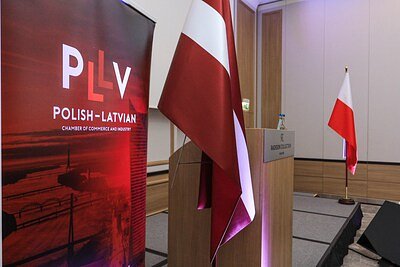
WARSAW, Poland – April 29, 2026 – A recent high-level business forum here was far more than a routine trade gathering. It marked a deliberate and strategic pivot by Latvia and Poland to deepen their alliance, binding their economies closer in the critical sectors of defense, technology, and energy. Against the backdrop of a transformed European security landscape, the Latvia-Poland Business Forum, held on April 23 and organized by the Investment and Development Agency of Latvia (LIAA), served as a clear declaration of intent: to move from dialogue to decisive action.
Opening the event, Latvia's Minister of Economics, Viktors Valainis, framed the relationship in starkly strategic terms. "Poland is a strategically important partner for Latvia – both economically and geopolitically," he stated. "Our cooperation is built on shared interests in strengthening regional security, advancing technological development and building resilient supply chains. Today's forum provides an opportunity to move from dialogue to concrete projects, particularly in areas where Latvian companies can offer high value-added solutions."
Forging a Shield on NATO's Eastern Flank
The emphasis on security is no coincidence. As frontline NATO states, both Poland and Latvia have dramatically increased defense spending and are actively working to fortify the alliance's eastern flank. The forum underscored how economic cooperation is now inextricably linked to this shared defense posture. The collaboration aims to build not just commercial partnerships, but a more resilient regional security architecture.
This alignment is already producing tangible results. In October 2025, Latvian technology company dots. signed a significant cooperation agreement with WB Group, Poland's largest private defense contractor. This partnership allows dots. to represent WB Group's advanced communications, unmanned systems, and cybersecurity solutions in Latvia, directly contributing to the nation's defense capacity. It is a prime example of the high-value, strategic partnerships the forum seeks to replicate.
Broader initiatives are also taking shape. Poland, Lithuania, Latvia, and Estonia recently formed a coalition to coordinate defense financing, seeking to leverage their combined political weight within the EU. This comes as Poland champions a comprehensive "Baltic Shield" strategy, a multi-domain plan covering military, infrastructural, and economic security across the Baltic Sea region. Further cementing this cooperation, the Baltic states are advancing plans for a "Baltic Drone Wall" to secure their borders, an area where Latvia's burgeoning drone industry and its leadership of a 15-country drone coalition for Ukraine give it a distinct advantage.
Tackling the Trade Imbalance with Innovation
Beyond the geopolitical imperatives, the forum addressed a pressing economic reality: a significant trade imbalance. In 2025, bilateral trade in goods and services reached approximately €3.9 billion, but the figures reveal a lopsided relationship. Latvian imports from Poland stood at €2.88 billion, while its exports to the much larger Polish market were only €1.06 billion, creating a deficit of roughly €1.8 billion for Latvia.
Polish officials acknowledged this gap as an opportunity. In a video address to the forum, Michał Baranowski, Deputy Minister at Poland's Ministry of Economic Development and Technology, noted that while economic ties are strong, "there remains significant potential for further growth, particularly by increasing imports from Latvia."
Latvia's strategy to close this gap hinges on promoting the "high value-added solutions" mentioned by Minister Valainis. Rather than competing on volume, Latvian firms are being positioned to offer specialized, high-tech products and services in sectors where they possess a competitive edge.
Information and Communication Technology (ICT) is a primary focus. Latvia is home to Europe's first military 5G testbed at the Ādaži military base, a joint project between telecommunications firm LMT, the armed forces, and the Ministry of Defense. This unique facility, open to NATO allies, is a hub for developing next-generation defense applications and showcases Latvia's deep-tech capabilities. In the energy sector, the drive for regional energy independence has spurred innovation. Companies like Ignitis Renewables and Elenger are making substantial investments in Latvian solar power, building expertise in renewable energy that can be exported. This push aligns with the successful desynchronization of the Baltic states' power grids from the Russian system in February 2025, a landmark achievement in European energy security.
Powering Partnerships from the Ground Up
Facilitating these ambitious goals is the Investment and Development Agency of Latvia (LIAA), the chief architect of the Warsaw forum. The agency is actively working to connect Latvian businesses, particularly small and medium-sized enterprises (SMEs), with international partners and supply chains. This work is significantly bolstered by EU co-funding through programs like the European Regional Development Fund (ERDF), which supports innovative entrepreneurship.
Vita Balode-Andrews, Acting Director of the Export and Innovation Department at LIAA, emphasized the agency's hands-on approach. "Poland is one of the most promising cooperation partners for Latvian companies, particularly in the fields of technology and energy," she explained. "LIAA's role is to support companies not only in initiating dialogue, but also in reaching concrete agreements and building long-term partnerships within international supply chains."
The trade mission to Poland, which included the forum, is a direct outcome of this strategy. By bringing business leaders and policymakers together for targeted panel discussions on defense, ICT, and energy, LIAA aims to accelerate the transition from potential to profit, creating a more balanced and robust economic relationship.
The Warsaw forum, therefore, represents a crystallization of a new reality in Eastern Europe. It is a clear signal that economic policy is now security policy. Through strategic partnerships in defense, targeted exports in high-tech sectors, and dedicated institutional support, Latvia is not just seeking to sell more goods to Poland; it is working with its key ally to build a more secure, resilient, and prosperous future for the entire region.